

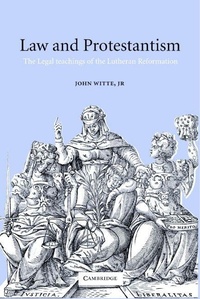
Law and Protestantism
The Legal Teachings of the Lutheran Reformation
Published on 16. May 2002
Book
Paperback/Softback
360 pages
978-0-521-01299-7 (ISBN)
Description
The Lutheran Reformation of the early sixteenth century brought about immense and far-reaching change in the structures of both church and state, and in both religious and secular ideas. This book investigates the relationship between the law and religious ideology in Luther's Germany, showing how they developed in response to the momentum of Lutheran teachings and influence. Profound changes in the areas of education, politics and marriage were to have long-lasting effects on the Protestant world, inscribed in the legal systems inherited from that period. John Witte, Jr. argues that it is not enough to understand the Reformation either in theological or in legal terms alone but that a perspective is required which takes proper account of both. His book should be essential reading for scholars and students of church history, legal history, Reformation history, and in adjacent areas such as theology, ethics, the law, and history of ideas.
Reviews / Votes
'This book breaks new ground ... succeeds in mastering the daunting task of tracing the link between law and theology in the Lutheran Reformation ... The task is accomplished with solid scholarship, presented in an engaging literary style.' Theology Today 'Reformation scholars of all kinds will find this a most stimulating and rewarding study, for which the author is to be thanked and congratulated.' The Journal of Ecclesiastical History '... carefully researched and illuminating volume ... for the general legal historian, and for those reflecting on how far religious conviction still finds an echo in modern law, Law and Protestantism renders impressive service.' Ecclesiastical Law Journal 'Undoubtedly the book by John Witte Junior is an extremely erudite and thorough analysis of the legal teachings of the Lutheran Reformation. I have learnt an enormous amount from reading it and highly recommend it to both lawyers and theologians who are interested in the Reformation and indeed thinking about the links between law and theology.' Evangelical QuarterlyMore details
Language
English
Place of publication
Cambridge
United Kingdom
Target group
Professional and scholarly
Product notice
Paperback (trade)
Illustrations
7 Halftones, unspecified
Dimensions
Height: 229 mm
Width: 152 mm
Thickness: 22 mm
Weight
584 gr
ISBN-13
978-0-521-01299-7 (9780521012997)
Copyright in bibliographic data and cover images is held by Nielsen Book Services Limited or by the publishers or by their respective licensors: all rights reserved.
Schweitzer Classification
Other editions
Additional editions
E-Book
01/2005
1st Edition
Cambridge University Press
€42.99
Available for download
Persons
John Witte, Jr. is the Jonas Robitscher Professor of Law and Ethics, Director of the Law and Religion Program, and Director of the Center for the Interdisciplinary Study of Religion at Emory University, Atlanta. A specialist in legal history and religious liberty, he has published 100 professional articles, and 12 books, including Religious Human Rights in Global Perspective, 2 vols. (1996); From Sacrament to Contract: Marriage, Religion, and Law in the Western Tradition (1997); Proselytism and Orthodoxy in Russia (1999) and Religion and the American Constitutional Experiment (2000). Professor Witte's writings have appeared in German, French, Italian, Hebrew, Spanish, Russian, Ukrainian, and Romanian translations. He has lectured throughout North America, Western Europe, Israel, and South Africa.
Content
Foreword Martin E. Marty; Introduction; 1. Canon law and civil law on the eve of the Reformation; 2. Loving thine enemy's law: the evangelical conversion of Catholic canon law; 3. A mighty fortress: Luther and the two-kingdoms framework; 4. Perhaps jurists are good Christians after all: Lutheran theories of law, politics, and society; 5. From gospel to law: the Lutheran reformation laws; 6. The mother of all earthly laws: the reformation of marriage law; 7. The civic seminary: the reformation of education law; Concluding reflections.