

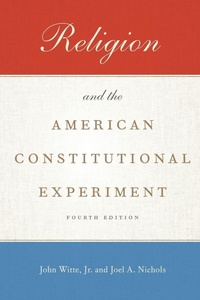
Religion and the American Constitutional Experiment
4th Edition
Published on 21. April 2016
Book
Paperback/Softback
424 pages
978-0-19-045942-0 (ISBN)
Description
This accessible introduction tells the American story of religious liberty from its colonial beginnings to the latest Supreme Court cases. The authors provide extensive analysis of the formation of the First Amendment religion clauses and the plausible original intent or understanding of the founders. They describe the enduring principles of American religious freedom-liberty of conscience, free exercise of religion, religious equality, religious pluralism,
separation of church and state, and no establishment of religion-as those principles were developed by the founders and applied by the Supreme Court. Successive chapters analyze the two hundred plus Supreme Court cases on religious freedom-on the free exercise of religion, the roles of government and
religion in education, the place of religion in public life, and the interaction of religious organizations and the state. A final chapter shows how favorably American religious freedom compares with international human rights norms and European Court of Human Rights case law.
Lucid, comprehensive, multidisciplinary, and balanced, this volume is an ideal classroom text and armchair paperback. Detailed appendices offer drafts of each of the religion clauses debated in 1788 and 1789, a table of all state constitutional laws on religious freedom, and a summary of every Supreme Court case on religious liberty from 1815 to 2015. Throughout the volume, the authors address frankly and fully the hot button issues of our day: religious freedom versus sexual liberty, freedom
of conscience and its limitations, religious group rights and the worries about abuse, faith-based legal systems and their place in liberal democracies, and the fresh rise of anti-Semitism, Islamophobia, and anti-Christianity in America and abroad.
For this new edition, the authors have updated each chapter in light of new scholarship and new Supreme Court case law (through the 2015 term) and have added an appendix mapping some of the cutting edge issues of religious liberty and church-state relations.
separation of church and state, and no establishment of religion-as those principles were developed by the founders and applied by the Supreme Court. Successive chapters analyze the two hundred plus Supreme Court cases on religious freedom-on the free exercise of religion, the roles of government and
religion in education, the place of religion in public life, and the interaction of religious organizations and the state. A final chapter shows how favorably American religious freedom compares with international human rights norms and European Court of Human Rights case law.
Lucid, comprehensive, multidisciplinary, and balanced, this volume is an ideal classroom text and armchair paperback. Detailed appendices offer drafts of each of the religion clauses debated in 1788 and 1789, a table of all state constitutional laws on religious freedom, and a summary of every Supreme Court case on religious liberty from 1815 to 2015. Throughout the volume, the authors address frankly and fully the hot button issues of our day: religious freedom versus sexual liberty, freedom
of conscience and its limitations, religious group rights and the worries about abuse, faith-based legal systems and their place in liberal democracies, and the fresh rise of anti-Semitism, Islamophobia, and anti-Christianity in America and abroad.
For this new edition, the authors have updated each chapter in light of new scholarship and new Supreme Court case law (through the 2015 term) and have added an appendix mapping some of the cutting edge issues of religious liberty and church-state relations.
Reviews / Votes
This book by John Witte and Joel Nichols is probably the best combination that exists of historical background, theoretical understanding, and legal doctrines of the religion clauses. It allows scholars, students, and other citizens to grasp the history behind the clauses without undertaking full-scale research on their own. The book is also a superb source to understand modern controversies and how courts are dealing with them. * Kent Greenawalt, University Professor, Columbia Law School * In evenhanded and clear prose, Witte and Nichols provide a clear and comprehensive history of religious liberty in the United States. Broad in scope, updated with the latest developments, and supplemented with impressive appendices that catalog state constitutional provisions and Supreme Court decisions, this text offers cogent analysis from leading scholars of law and religion. Already a trusted and valuable classroom resource, this book will also enlighten thoseseeking a deeper understanding of the contours of this important topic. * Amy E. Black, Professor of Political Science, Wheaton College *
More details
Edition
4th Revised edition
Language
English
Place of publication
New York
United States
Target group
College/higher education
Edition type
Revised edition
Dimensions
Height: 234 mm
Width: 156 mm
Thickness: 25 mm
Weight
712 gr
ISBN-13
978-0-19-045942-0 (9780190459420)
Copyright in bibliographic data and cover images is held by Nielsen Book Services Limited or by the publishers or by their respective licensors: all rights reserved.
Schweitzer Classification
Other editions
Additional editions
Jr. Witte | Joel A. Nichols
Religion and the American Constitutional Experiment
E-Book
03/2016
4th Edition
OUP eBook
€35.99
Available for download
John Witte | Joel A. Nichols
Religion and the American Constitutional Experiment
E-Book
03/2016
4th Edition
OUP eBook
€35.99
Available for download
Persons
John Witte, Jr. is Robert W. Woodruff Professor of Law, McDonald Distinguished Professor, and Director of the Center for the Study of Law and Religion at Emory University. A leading specialist in law and religion, legal history, and religious liberty, he has published 220 articles and 28 books, including Religion and Human Rights (Oxford, 2012) and No Establishment of Religion (Oxford, 2012).
Joel A. Nichols is Associate Dean for Academic Affairs and Professor of Law at the University of St. Thomas (MN), and Senior Fellow in the Center for the Study of Law and Religion. He has published two dozen articles on family law, constitutional law, and human rights, including Marriage and Divorce in a Multicultural Context (2012).
Joel A. Nichols is Associate Dean for Academic Affairs and Professor of Law at the University of St. Thomas (MN), and Senior Fellow in the Center for the Study of Law and Religion. He has published two dozen articles on family law, constitutional law, and human rights, including Marriage and Divorce in a Multicultural Context (2012).
Author
Robert W. Woodruff Professor of Law, Alonzo L. McDonald Distinguished Professor, and Director of the Center for the Study of Law and ReligionRobert W. Woodruff Professor of Law, Alonzo L. McDonald Distinguished Professor, and Director of the Center for the Study of Law and Religion, Emory University
Associate Dean for Academic Affairs and Professor of LawAssociate Dean for Academic Affairs and Professor of Law, University of St. Thomas (Minnesota)
Content
List of Tables and Figures
Preface
Introduction
1 The American Experiment in Historical Context
2 The Theology and Politics of the Religion Clauses
3 The Essential Rights and Liberties of Religion
4 Forging the First Amendment Religion Clauses
5 Religious Liberty in the States Before 1947 and the Creation of a New National Law on Religious Liberty
6 The Free Exercise of Religion: Mapping the Doctrinal Terrain
7 The Free Exercise of Religion, Free Religious Speech, and Religious Freedom Statutes
8 Modern Establishment Law: Mapping the Doctrinal Terrain
9 Religion and Public Education: No Establishment of Religion, But Equal Access for Religion
10 Government and Religious Education: Accommodation, Separation, and Equal Treatment
11 Religion and Public Life
12 Religious Organizations and the Law
13 The American Law of Religious Freedom in Comparative Perspective
Concluding Reflections
Appendices
Appendix 1: Drafts of Federal Religion Clauses (1787-1789)
Appendix 2: State Constitutional Provisions on Religion (as of 1947)
Appendix 3: United States Supreme Court Decisions Relating to Religious Liberty
Notes
Index
Preface
Introduction
1 The American Experiment in Historical Context
2 The Theology and Politics of the Religion Clauses
3 The Essential Rights and Liberties of Religion
4 Forging the First Amendment Religion Clauses
5 Religious Liberty in the States Before 1947 and the Creation of a New National Law on Religious Liberty
6 The Free Exercise of Religion: Mapping the Doctrinal Terrain
7 The Free Exercise of Religion, Free Religious Speech, and Religious Freedom Statutes
8 Modern Establishment Law: Mapping the Doctrinal Terrain
9 Religion and Public Education: No Establishment of Religion, But Equal Access for Religion
10 Government and Religious Education: Accommodation, Separation, and Equal Treatment
11 Religion and Public Life
12 Religious Organizations and the Law
13 The American Law of Religious Freedom in Comparative Perspective
Concluding Reflections
Appendices
Appendix 1: Drafts of Federal Religion Clauses (1787-1789)
Appendix 2: State Constitutional Provisions on Religion (as of 1947)
Appendix 3: United States Supreme Court Decisions Relating to Religious Liberty
Notes
Index