

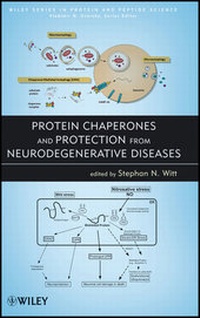
Protein Chaperones and Protection from Neurodegenerative Diseases
Published on 19. August 2011
Book
Hardback
444 pages
978-0-470-56907-8 (ISBN)
Description
The intersection of molecular chaperones and neurodegeneration is an intensely studied area because of the potential of manipulating the expression of molecular chaperones to thwart the progression of debilitating diseases. Encompassing contributions from leading experts, Molecular Chaperones and Protection from Neurodegenerative Proteopathies provides an in-depth examination of how protein chaperones are involved in protecting cells from toxic aggregated or misfolded protein states responsible for such diseases as Huntington's and Parkinson's diseases. Addressing the subject from both research and clinical perspectives, the book will appeal to scientists working in these areas of research.
More details
Product info
gebunden
Series
Edition
1. Auflage
Language
English
Place of publication
New York
United States
Target group
Professional and scholarly
Product notice
sewn/stitched
Cloth over boards
Dimensions
Height: 236 mm
Width: 157 mm
Thickness: 28 mm
Weight
794 gr
ISBN-13
978-0-470-56907-8 (9780470569078)
Schweitzer Classification
Other editions
Additional editions
E-Book
09/2011
Wiley
€142.99
Available for download
E-Book
07/2011
Wiley
€142.99
Available for download
Persons
Stephan N. Witt is a Professor in the Department of Biochemistry and Molecular Biology at the Louisiana State University Health Sciences Center in Shreveport, Louisiana. He obtained his PhD in biophysical chemistry from the California Institute of Technology.??Dr. Witt is a member of the editorial board of Cell Stress and Chaperones. He has served on numerous NIH study sections, has authored over forty scientific publications, and edited a book on using yeast as a model for human disease. His research focuses on identifying genes and small molecules that can be used against Parkinson's disease.
Content
Preface.
Introduction.
Contributors.
1 Intrinsically Disordered Chaperones and Neurodegeneration (Vladimir N. Uversky).
2 Redox Regulation of Protein Misfolding, Synaptic Damage, and Neuronal Loss in Neurodegenerative Diseases (Tomohiro Nakamura and Stuart A. Lipton).
3 Chaperone-Mediated Autophagy and Parkinson's Disease (Marta Martinez-Vicente and Ester Wong).
4 Chaperone and Anti-Chaperone Properties of Synuclein: Implications for Development, Aging, and Neurodegenerative Disease (Makoto Hashimoto, Kazuanri Sekiyama, Akio Sekigawa, and Masayo Fujita).
5 The Ubiquitin-Proteasome System in Neurodegenerative Diseases: More than the Usual Suspects (Anne Bertolotti).
6 Regulation of the Polyglutamine Androgen Receptor by the Hsp90/Hsp70-Based Chaperone Machinery (Andrew P. Lieberman and William B. Pratt).
7 Amyloid Remodeling by Hsp104 (James Shorter).
8 Chaperone-Dependent Amyloid Assembly and Prion Toxicity (Daniel W. Summers, Katie J. Wolfe, and Douglas M. Cyr).
9 Modulation of Amyloid Propagation in Yeast by Hsp70 and its Regulators and Chaperone Partners (Daniel C. Masison).
10 ALS and the Copper Chaperone CCS (Marjatta Son and Jeffrey L. Elliott).
11 Emerging Area: TorsinA, a Novel ATP-Dependent Factor Linked to Dystonia (Michal Zolkiewski and Hui-Chuan Wu).
12 Therapeutics: Harnessing the Power of Molecular and Pharmacological Chaperones (David S. Gross, Ronald L. Klein and Stephan N. Witt).
Index.