

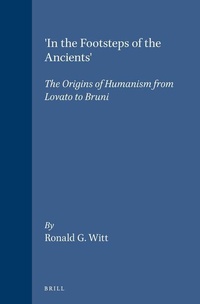
In the Footsteps of the Ancients
The Origins of Humanism from Lovato to Bruni
Published on 31. March 2000
Book
Leather / fine binding
XIV, 570 pages
978-90-04-11397-8 (ISBN)
Description
This monograph demonstrates why humanism began in Italy in the mid-thirteenth century. It considers Petrarch a third generation humanist, who christianized a secular movement. The analysis traces the beginning of humanism in poetry and its gradual penetration of other Latin literary genres, and, through stylistic analyses of texts, the extent to which imitation of the ancients produced changes in cognition and visual perception.
The volume traces the link between vernacular translations and the emergence of Florence as the leader of Latin humanism by 1400 and why, limited to an elite in the fourteenth century, humanism became a major educational movement in the first decades of the fifteenth. It revises our conception of the relationship of Italian humanism to French twelfth-century humanism and of the character of early Italian humanism itself.
In the Footsteps of the Ancients is the recipient of the Jacques Barzun Prize 2000 in Cultural History of the American Philosophical Society.
This publication has also been published in paperback, please click here for details.
The volume traces the link between vernacular translations and the emergence of Florence as the leader of Latin humanism by 1400 and why, limited to an elite in the fourteenth century, humanism became a major educational movement in the first decades of the fifteenth. It revises our conception of the relationship of Italian humanism to French twelfth-century humanism and of the character of early Italian humanism itself.
In the Footsteps of the Ancients is the recipient of the Jacques Barzun Prize 2000 in Cultural History of the American Philosophical Society.
This publication has also been published in paperback, please click here for details.
Reviews / Votes
'Ronals Witt's new book, recipient in 2000 of the Renaissance Society of America's Phyllis Goodhart Gordan Book Prize... In the Footsteps of the Ancients' is without doubt an authoritative and erudite book. It fastens upon a topic that had previously escaped sustained scholarly attention. It combines the appeal of a fresh interpretation with a thorough and methodical approach, grounded in a grammatical and rhetorical textual analysis conscious of the relevant social and political contexts. Witt's analysis of the emergence of humanism, generation by generation, successfully conveys the longue duree of humanism's origins...In the Footsteps of the Ancients' deserves the close attention of all serious Renaissance scholars.'Hilmar M Pabel, The Catholic Historical Review, 2001.
More details
Series
Language
English
Place of publication
Leiden
Netherlands
Target group
College/higher education
Professional and scholarly
Product notice
Cloth
With dust jacket
Dimensions
Height: 247 mm
Width: 170 mm
Thickness: 42 mm
Weight
1166 gr
ISBN-13
978-90-04-11397-8 (9789004113978)
Schweitzer Classification
Other editions
Additional editions

Software
03/2000
Brill
Unfortunately, price unknown
Available (delivery time upon request)
Person
Ronald G. Witt, Ph.D. (1965) in History, Harvard University, is Professor of History at Duke University and researches the discontinuities and continuities between medieval and early European thought, especially in France and Italy. His publications include The Earthly Republic of the Italian Humanists (1976), Hercules at the Crossroads: The Life, Works, and Thought of Coluccio Salutati (1983), and Cultural Roots and Continuities, 5th ed. (1997).
Content
Acknowledgements
Abbreviations
1. Introduction
2. The Birth of the New Aesthetic
3. Padua and the Origins of Humanism
4. Albertino Mussato and the Second Generation
5. Florence and Vernacular Learning
6. Petrarch, Father of Humanism?
7. Coluccio Salutati
8. The Revival of Oratory
9. Leonardo Bruni
10. The First Ciceronianism
11. Conclusion
Appendix
Bibliography
Indexes
Index of Persons
Index of Places
Index of Subjects
Abbreviations
1. Introduction
2. The Birth of the New Aesthetic
3. Padua and the Origins of Humanism
4. Albertino Mussato and the Second Generation
5. Florence and Vernacular Learning
6. Petrarch, Father of Humanism?
7. Coluccio Salutati
8. The Revival of Oratory
9. Leonardo Bruni
10. The First Ciceronianism
11. Conclusion
Appendix
Bibliography
Indexes
Index of Persons
Index of Places
Index of Subjects