

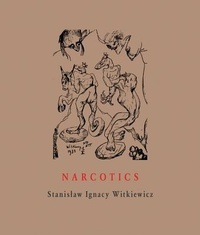
Narcotics
Nicotine, Alcohol, Cocaine, Peyote, Morphine, Ether + Appendices
Published on 12. February 2018
Book
Hardback
198 pages
978-80-86264-48-6 (ISBN)
Description
In the vein of the well-known drug writings of De Quincey and Baudelaire from a century earlier and those of his contemporaries Walter Benjamin and Jean Cocteau - and foreshadowing the later writings of Aldous Huxley and Carlos Castaneda on psychoactive drugs - Witkacy composed Narcotics in 1930 to discuss and document not only his own experimentation with different substances but the nature of addiction itself and the prevailing social attitude toward drugs, particularly those that were considered "acceptable." As life became increasingly mechanized, Witkacy felt that a sense of the metaphysical could only be achieved by artificial means, and like Henri Michaux, he produced an extensive oeuvre of singular visual art while under the influence of a variety of substances.
Meandering, acerbic, and burlesque, rife with neologisms and expressions from German, French, English, and Russian, Witkacy dissects Polish society and the art world as well as himself via the hypocrisy surrounding drug use. Since it was first published in the 1930s, Narcotics has achieved a cult status in Poland where it is considered both a modernist classic and a paragon of Witkiewiczian madness. This edition, the first complete translation in English, includes a second appendix written later, passages from the novel Farewell to Autumn, and 34 color reproductions of a cross section of portraits to show how various substances impacted Witkacy's art.
Meandering, acerbic, and burlesque, rife with neologisms and expressions from German, French, English, and Russian, Witkacy dissects Polish society and the art world as well as himself via the hypocrisy surrounding drug use. Since it was first published in the 1930s, Narcotics has achieved a cult status in Poland where it is considered both a modernist classic and a paragon of Witkiewiczian madness. This edition, the first complete translation in English, includes a second appendix written later, passages from the novel Farewell to Autumn, and 34 color reproductions of a cross section of portraits to show how various substances impacted Witkacy's art.
More details
Series
Language
English
Place of publication
Prague
Czech Republic
Product notice
With ribbon marker(s)
sewn/stitched
Paper over boards
Illustrations
34 full-color
Dimensions
Height: 204 mm
Width: 177 mm
Thickness: 22 mm
Weight
523 gr
ISBN-13
978-80-86264-48-6 (9788086264486)
Copyright in bibliographic data and cover images is held by Nielsen Book Services Limited or by the publishers or by their respective licensors: all rights reserved.
Schweitzer Classification
Persons
Painter, photographer, novelist, and playwright, Stanislaw Ignacy Witkiewicz (known as Witkacy) was born on February 24, 1885, in Warsaw, but grew up and lived most of his life in Zakopane. After witnessing firsthand the Russian Revolution, he returned to Poland in 1918 and joined the Formists, a group of artists pursuing a program of Pure Form. Over the next two decades Witkacy penned a number of plays and his two great dystopian novels. Sandwiched between Nazi Germany and the Soviet Union invading Poland in early September 1939, he committed suicide on September 18 in the village of Jeziory.