

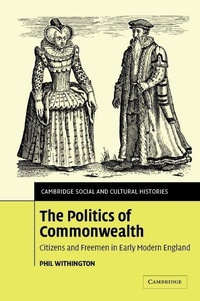
The Politics of Commonwealth
Citizens and Freemen in Early Modern England
Published on 17. February 2005
Book
Hardback
314 pages
978-0-521-82687-7 (ISBN)
Description
The Politics of Commonwealth offers a major reinterpretation of urban political culture in England during the sixteenth and seventeenth centuries. Examining what it meant to be a freeman and citizen in early modern England, it also shows the increasingly pivotal place of cities and boroughs within the national polity. It considers the practices that constituted urban citizenship as well as its impact on the economic, patriarchal and religious life of towns and the larger commonwealth. The author has recovered the language and concepts used at the time, whether by eminent citizens like Andrew Marvell or more humble tradesmen and craftsmen. Unprecedented in terms of the range of its sources and freshness of its approach, the book reveals a dimension of early modern culture that has major implications for how we understand the English state, economy and 'public sphere'; the political upheavals of the mid-seventeenth-century and popular political participation more generally.
More details
Series
Language
English
Place of publication
Cambridge
United Kingdom
Target group
Professional and scholarly
Illustrations
22 Tables, unspecified
Dimensions
Height: 235 mm
Width: 157 mm
Thickness: 21 mm
Weight
608 gr
ISBN-13
978-0-521-82687-7 (9780521826877)
Copyright in bibliographic data and cover images is held by Nielsen Book Services Limited or by the publishers or by their respective licensors: all rights reserved.
Schweitzer Classification
Person
Dr Phil Withington is Lecturer in Cultural History at the University of Aberdeen. He is the coeditor of Communities in Early Modern England (2000).
Content
Part I. Introductions; Part II. Cultural Resources : ideology, place, company; Part III. Honest distinctions: economy, patriarchy, religion; Bibliography; Index.