

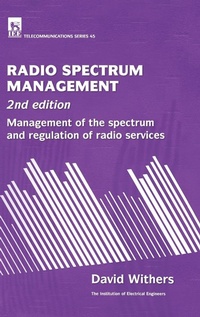
Radio Spectrum Management
Management of the spectrum and regulation of radio services
2nd Edition
Published on 30. June 1999
Book
Hardback
364 pages
978-0-85296-770-6 (ISBN)
Description
Vast numbers of radio systems are now in use, and with new users and new uses constantly emerging, these systems have the potential to interfere with each other.
National agencies are empowered to control the use of radio to ensure that systems within their jurisdiction do not disrupt each other's services. Interference may also arise between radio systems operating in different countries. An elaborate code of regulations has been agreed, under the aegis of the International Telecommunication Union, to facilitate cooperation between the national agencies to control interference across frontiers. The Union also provides the global forum for the standardisation of radio systems where this has been found to be desirable.
For some kinds of radio system, especially broadcasting and land mobile radio, governments may also find it necessary to determine which of the organisations competing to provide radio facilities for public use should be licensed and which should not. This process is known as regulation.
Intended as a handbook for administrators and engineers, this book reviews the processes of interference management, regulation of competing service providers and system standardisation for the control and use of the radio spectrum. At a time when telecommunication services and broadcasting are being liberalised in many countries, this book will also provide new operators of radio facilities, private and public, with valuable insights into the regulatory process.
National agencies are empowered to control the use of radio to ensure that systems within their jurisdiction do not disrupt each other's services. Interference may also arise between radio systems operating in different countries. An elaborate code of regulations has been agreed, under the aegis of the International Telecommunication Union, to facilitate cooperation between the national agencies to control interference across frontiers. The Union also provides the global forum for the standardisation of radio systems where this has been found to be desirable.
For some kinds of radio system, especially broadcasting and land mobile radio, governments may also find it necessary to determine which of the organisations competing to provide radio facilities for public use should be licensed and which should not. This process is known as regulation.
Intended as a handbook for administrators and engineers, this book reviews the processes of interference management, regulation of competing service providers and system standardisation for the control and use of the radio spectrum. At a time when telecommunication services and broadcasting are being liberalised in many countries, this book will also provide new operators of radio facilities, private and public, with valuable insights into the regulatory process.
Reviews / Votes
'this book represents everything you ever wanted to know about spectrum management but never dared ask. It is also everything we have come to expect of an IEE publication, written in clear and concise language by a specialist with years of working experience.' * Info *More details
Series
Edition
2nd edition
Language
English
Place of publication
Stevenage
United Kingdom
Target group
College/higher education
Professional and scholarly
Product notice
sewn/stitched
Cloth over boards
Dimensions
Height: 240 mm
Width: 161 mm
Thickness: 24 mm
Weight
718 gr
ISBN-13
978-0-85296-770-6 (9780852967706)
Copyright in bibliographic data and cover images is held by Nielsen Book Services Limited or by the publishers or by their respective licensors: all rights reserved.
Schweitzer Classification
Other editions
Previous edition
D.J. Withers
Radio Spectrum Management
Book
07/1991
Institution of Engineering and Technology
€105.42
Article exhausted; check for reprint
Person
David Withers, OBE FIEE retired from British Telecom in 1984 as Chief Engineer of its International Division. His career had been spent in the engineering management and direction of BT's international radio services. Since retirement he has served as an independent consultant, much of his work being with the UK Radiocommunications Agency.
Content
Chapter 1: Introduction
Chapter 2: The International Telecommunication Union
Chapter 3: Frequency allocation
Chapter 4: Frequency assignment
Chapter 5: Frequency band planning and mandatory frequency coordination
Chapter 6: The fixed service
Chapter 7: The broadcasting service
Chapter 8: The mobile services
Chapter 9: The fixed-satellite service
Chapter 10: The broadcasting-satellite service
Chapter 11: The mobile-satellite services
Chapter 12: The amateur services
Chapter 13: The science radio services
Chapter 14: The inter-satellite service
Chapter 15: Radionavigation and radiolocation
Appendix: Radio propagation and radio noise
Chapter 2: The International Telecommunication Union
Chapter 3: Frequency allocation
Chapter 4: Frequency assignment
Chapter 5: Frequency band planning and mandatory frequency coordination
Chapter 6: The fixed service
Chapter 7: The broadcasting service
Chapter 8: The mobile services
Chapter 9: The fixed-satellite service
Chapter 10: The broadcasting-satellite service
Chapter 11: The mobile-satellite services
Chapter 12: The amateur services
Chapter 13: The science radio services
Chapter 14: The inter-satellite service
Chapter 15: Radionavigation and radiolocation
Appendix: Radio propagation and radio noise