

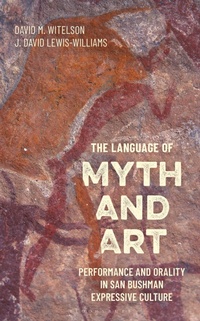
The Language of Myth and Art
Performance and Orality in San Bushman Expressive Culture
Will be published approx. on 15. October 2026
Book
Hardback
344 pages
979-8-216-39618-5 (ISBN)
Description
In 'primary oral societies', notions of repetition, addition, malleability of characters and agonistic contexts in narrative myths differ markedly from Western notions of time, orthodoxy and tediousness. What Western audiences and image-viewers expect as a consequence of their cultural background does not match the expectations of those who belong to oral societies. In The Language of Myth and Art, Witelson and Lewis-Williams strive to distance the language of Western myth and art from that of San myths and rock art.
The book argues that Western categories such as 'myth' and 'art' obscure the inner logic of Indigenous San (Bushman) expressive culture. Drawing on performance theory and the principles of orality, they show that nineteenth-century |Xam and related San languages illuminate the chains of allusion and metaphor that pervade everyday speech and performances of myth, ritual, and image-making. By placing language at the center of interpretation, The Language of Myth and Art offers a new approach to the expressive culture of oral societies, with implications far beyond southern Africa.
The book argues that Western categories such as 'myth' and 'art' obscure the inner logic of Indigenous San (Bushman) expressive culture. Drawing on performance theory and the principles of orality, they show that nineteenth-century |Xam and related San languages illuminate the chains of allusion and metaphor that pervade everyday speech and performances of myth, ritual, and image-making. By placing language at the center of interpretation, The Language of Myth and Art offers a new approach to the expressive culture of oral societies, with implications far beyond southern Africa.
Reviews / Votes
Can a contemporary Westerner understand the symbolism of Indigenous cultures, from a true insider's perspective and at the most detailed level? In a remarkable intellectual tour de force, David Witelson and David Lewis-Williams do just that in The Language of Myth and Art. They chart an interpretive method that reveals and illustrates the underlying meanings of both the Southern African San (Bushmen) mythic corpus and cave paintings, based on a recognition of the key distinctions between oral and literate societies and the implications these have for the verbal and graphic arts. The result is a landmark study in mythic analysis, rock art interpretation and symbolic study that is destined to become a classic in the anthropological and archaeological literature. * David S. Whitley, author of Cave Painting and the Human Spirit: The Origin of Creativity and Belief * The Language of Myth and Art is an important book of rare beauty and intellectual adventure. Its strength proceeds from a lifetime of ceaseless research into the complex and elusive rock paintings and folklore of indigenous San hunter-gatherer populations of southern Africa. Cognitive archaeologists David Witelson and David Lewis-Williams together forge a fine synthesis of both fields as illuminated by oral principles and modern performance theory. * Megan Biesele, author of Once Upon a Time is Now: A Kalahari Memoir * This is a compelling analysis of San (Bushman) rock art and myth by two of the leading scholars in the field, one well-established, the other very much up-and-coming. It is, without doubt, the most innovative and significant work on San rock art (and San worldviews in general) to appear for many, many years and charts a new path for researchers, emphasising the enormous potential of investigating the subtle nuances and metaphorical allusions of San languages. After reading it, there can be no doubt that detailed knowledge and understanding of San ethnography - rather than Western expectations of what images might signify - is an essential precondition for saying anything useful about the meanings of southern Africa's hunter-gatherer rock art. In this, as well as in its eloquence and command of the subject, the book is a tour de force. * Peter Mitchell, University of Oxford, UK * The Language of Myth and Art is a productive and in-depth analysis of the complex visual expressions we call San hunter-gatherer 'rock art'. The authors' method draws on a wealth of imagery, ethnographic sources, anthropological and archaeological knowledge, contained within the framework of an overarching grammar. A similar approach could, potentially, be fruitfully applied to other bodies of rock art. The argument advanced here is clearly structured and the work is well-documented and richly illustrated. It will be a thought-provoking read for scholars and students of rock art, oral traditions, and southern African cultural history. * Jeremy Hollmann, University of the Witwatersrand, South Africa *More details
Language
English
Place of publication
New York
United States
Publishing group
Bloomsbury Publishing Plc
Target group
College/higher education
Professional and scholarly
Product notice
sewn/stitched
Cloth over boards
With dust jacket
Illustrations
18 color images, 38 bw images, 7 tables
Dimensions
Height: 229 mm
Width: 152 mm
Thickness: 25 mm
Weight
454 gr
ISBN-13
979-8-216-39618-5 (9798216396185)
Copyright in bibliographic data and cover images is held by Nielsen Book Services Limited or by the publishers or by their respective licensors: all rights reserved.
Schweitzer Classification
Persons
David M. Witelson is a Marie Sklodowska-Curie Post-doctoral Fellow in the School of Archaeology at the University of Oxford researching unity and diversity across southern African hunter-gatherers. He has authored two monographs on rock art and performance, A Painted Ridge (2019, Archaeopress) and Theatres of Imagery (2023, BAR Publishing).
J. David Lewis-Williams is Professor Emeritus in the Rock Art Research Institute in Johannesburg. He is the author of numerous books on hunter-gatherer religion, myth and rock art, including Believing and Seeing (1981, Academic Press), The Mind in the Cave (2002, Thames and Hudson) and Image-Makers (2019, Cambridge University Press).
J. David Lewis-Williams is Professor Emeritus in the Rock Art Research Institute in Johannesburg. He is the author of numerous books on hunter-gatherer religion, myth and rock art, including Believing and Seeing (1981, Academic Press), The Mind in the Cave (2002, Thames and Hudson) and Image-Makers (2019, Cambridge University Press).
Content
Preface (David M. Witelson)
Chapter 1. An Intercontinental Quest
Chapter 2. Questions of Evidence
Chapter 3. Myth, Art and a Shared Experience
Chapter 4. San Orality and Allusiveness: Exploring Below the Surface
Chapter 5. As Uncountable as Grains of Sand: Dynamic |Xam Myths
Chapter 6. Three Verbatim |Xam Texts and Their Narrators
Chapter 7. Contrasting Protagonists
Chapter 8. Allusive Actions, Powerful Substances and an Incantation
Chapter 9. A Contrasting Performance Setting
Chapter 10. Language and Setting in the Apprehension of Imagery
Chapter 11. Language Made Visible
Chapter 12. Human and Hybrid Anthropomorphs
Chapter 13. Allusive Objects
Chapter 14. A San Cynosure
Chapter 15. Creative Performances: Making Eland, Making Images
Chapter 16. Performance, Orality and Synoptic Questions
Epilogue: The Consonance of San Expressive Culture
References
Index
Chapter 1. An Intercontinental Quest
Chapter 2. Questions of Evidence
Chapter 3. Myth, Art and a Shared Experience
Chapter 4. San Orality and Allusiveness: Exploring Below the Surface
Chapter 5. As Uncountable as Grains of Sand: Dynamic |Xam Myths
Chapter 6. Three Verbatim |Xam Texts and Their Narrators
Chapter 7. Contrasting Protagonists
Chapter 8. Allusive Actions, Powerful Substances and an Incantation
Chapter 9. A Contrasting Performance Setting
Chapter 10. Language and Setting in the Apprehension of Imagery
Chapter 11. Language Made Visible
Chapter 12. Human and Hybrid Anthropomorphs
Chapter 13. Allusive Objects
Chapter 14. A San Cynosure
Chapter 15. Creative Performances: Making Eland, Making Images
Chapter 16. Performance, Orality and Synoptic Questions
Epilogue: The Consonance of San Expressive Culture
References
Index