

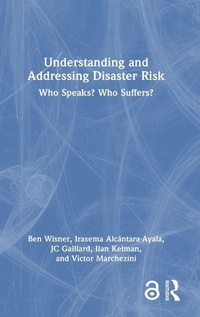
Understanding and Addressing Disaster Risk
Who Speaks? Who Suffers?
1st Edition
Published on 9. May 2025
Book
Hardback
270 pages
978-1-032-27444-7 (ISBN)
Description
In Understanding and Addressing Disaster Risk, the authors explain how people modify the environment and exert power over each other in ways that make nature potentially harmful and put people in harm's way. Opportunities and challenges faced by those engaging with disaster risk are explored.
Across 11 chapters, the authors show that disasters are not natural, are not events, and do not happen quickly. Instead, they are the result of chronic societal processes emerging from the creation and perpetuation of vulnerabilities and limitations on people's abilities to respond to hazards. The book also explores the environmental component of disaster risk through the lens of different natural elements and phenomena, including biological-ecological and water-weather-climate processes as well as geological and outer space dynamics. The authors explain the mutual influence of the different components of disasters in creating disaster risk across diverse regions of the world. They critique attempts to reduce disaster risk through top-down, siloed assumptions, attitudes, and values. The value of people's knowledge of hazards - often ignored or dismissed by authorities - is a central theme. This book is original because of how it re-interprets and advances understanding of the disaster process through the study of such societal processes of vulnerability, risk creation, and power imbalances. It is also unique in diving further into "root causes" of disaster in order to place them within local histories and colonial legacies as well as contemporary, typically misdirected, agendas while upending previous "solutions" which have been shown to do more harm than good.
Understanding and Addressing Disaster Risk is useful for and useable by decision-makers, policy makers, researchers, and students to shatter the vicious cycle of repeating known mistakes which compound detrimental outcomes.
The Open Access version of this book, available at www.taylorfrancis.com, has been made available under a Creative Commons Attribution-Non Commercial-No Derivatives (CC-BY-NC-ND) 4.0 International license.
Across 11 chapters, the authors show that disasters are not natural, are not events, and do not happen quickly. Instead, they are the result of chronic societal processes emerging from the creation and perpetuation of vulnerabilities and limitations on people's abilities to respond to hazards. The book also explores the environmental component of disaster risk through the lens of different natural elements and phenomena, including biological-ecological and water-weather-climate processes as well as geological and outer space dynamics. The authors explain the mutual influence of the different components of disasters in creating disaster risk across diverse regions of the world. They critique attempts to reduce disaster risk through top-down, siloed assumptions, attitudes, and values. The value of people's knowledge of hazards - often ignored or dismissed by authorities - is a central theme. This book is original because of how it re-interprets and advances understanding of the disaster process through the study of such societal processes of vulnerability, risk creation, and power imbalances. It is also unique in diving further into "root causes" of disaster in order to place them within local histories and colonial legacies as well as contemporary, typically misdirected, agendas while upending previous "solutions" which have been shown to do more harm than good.
Understanding and Addressing Disaster Risk is useful for and useable by decision-makers, policy makers, researchers, and students to shatter the vicious cycle of repeating known mistakes which compound detrimental outcomes.
The Open Access version of this book, available at www.taylorfrancis.com, has been made available under a Creative Commons Attribution-Non Commercial-No Derivatives (CC-BY-NC-ND) 4.0 International license.
Reviews / Votes
"A wonderful compendium and source for inspiration in the field of reducing and managing disaster risk. An immense contribution to an essential requirement for sustainable development in the world."Salvano Briceno, former Director of UNISDR (now UNDRR), 2001-2011.
"This book reinforces inevitable principles from studying disaster risks: disasters are socially constructed processes; we must look at the global from the local and the local from the global; always privilege the identification of root causes of disasters. It brings together theoretically, methodologically, and conceptually the disaster risk realities experienced daily around the world."
Virginia Garcia-Acosta, Emeritus Researcher, Professor in History and Anthropology, CIESAS (Center for Research and Advanced Studies in Social Anthropology), Mexico.
"This volume represents a good overall synthesis of existing literature, but also expands beyond traditional topics to include analyses of the COVID-19 pandemic and potential hazards beyond the Earth. This volume continues the extraordinary work of Ben Wisner and his colleagues, providing insights into existing and evolving hazards and suggesting pathways for action."
Michele Companion, Professor of Sociology, University of Colorado-Colorado Springs, and President of the Research Committee on Sociology of Disasters (RC-39) at the International Sociological Association (ISA).
More details
Language
English
Place of publication
London
United Kingdom
Publishing group
Taylor & Francis Ltd
Target group
College/higher education
Professional and scholarly
Postgraduate, Professional, and Undergraduate Advanced
Illustrations
30 s/w Abbildungen, 20 s/w Photographien bzw. Rasterbilder, 10 s/w Zeichnungen, 12 s/w Tabellen
12 Tables, black and white; 10 Line drawings, black and white; 20 Halftones, black and white; 30 Illustrations, black and white
Dimensions
Height: 240 mm
Width: 161 mm
Thickness: 21 mm
Weight
614 gr
ISBN-13
978-1-032-27444-7 (9781032274447)
Copyright in bibliographic data and cover images is held by Nielsen Book Services Limited or by the publishers or by their respective licensors: all rights reserved.
Schweitzer Classification
Other editions
Additional editions
Ben Wisner | Irasema Alcantara-Ayala | JC Gaillard
Understanding and Addressing Disaster Risk
Who Speaks? Who Suffers?
E-Book
05/2025
Routledge
€0.00
Available for download
Ben Wisner | Irasema Alcantara-Ayala | JC Gaillard
Understanding and Addressing Disaster Risk
Who Speaks? Who Suffers?
E-Book
05/2025
Routledge
€0.00
Available for download
Ben Wisner | Irasema Alcantara-Ayala | JC Gaillard
Understanding and Addressing Disaster Risk
Who Speaks? Who Suffers?
Book
05/2025
1st Edition
Routledge
€63.70
Shipment within 10-20 days
Persons
Ben Wisner is an activist scholar who finds himself tempted by nostalgia for the 70s, 80s, and 90s when he worked to understand and address disaster risk with civil society and local government in a number of countries in eastern and southern Africa, Asia, Latin America, and the Caribbean.
Irasema Alcantara-Ayala is a professor and former director at the Institute of Geography at the National Autonomous University of Mexico.
JC Gaillard is Ahorangi / Professor of Geography at Waipapa Taumata Rau / The University of Auckland.
Ilan Kelman is Professor of Disasters and Health at University College London, England, and a Professor II at the University of Agder, Kristiansand, Norway.
Victor Marchezini is a sociologist at the Brazilian Early Warning Center (Cemaden).
Irasema Alcantara-Ayala is a professor and former director at the Institute of Geography at the National Autonomous University of Mexico.
JC Gaillard is Ahorangi / Professor of Geography at Waipapa Taumata Rau / The University of Auckland.
Ilan Kelman is Professor of Disasters and Health at University College London, England, and a Professor II at the University of Agder, Kristiansand, Norway.
Victor Marchezini is a sociologist at the Brazilian Early Warning Center (Cemaden).
Content
1. The challenges of disaster
2. Framing disaster risk reduction
3. Abilities
4. The living world
5. Water, weather, and climate
6. Earthly hazards: earthquakes and volcanoes
7. Living with tsunamis and landslides
8. Beyond the earth
9. Disaster risk construction
10. Understanding risk and living life
11. Afterword: head and heart - Compassion and anger in disaster studies and action
2. Framing disaster risk reduction
3. Abilities
4. The living world
5. Water, weather, and climate
6. Earthly hazards: earthquakes and volcanoes
7. Living with tsunamis and landslides
8. Beyond the earth
9. Disaster risk construction
10. Understanding risk and living life
11. Afterword: head and heart - Compassion and anger in disaster studies and action