

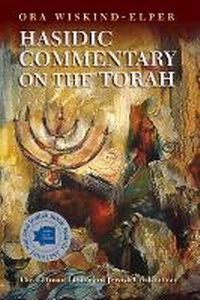
Hasidic Commentary on the Torah
Published on 7. June 2024
Book
Paperback/Softback
230 pages
978-1-83764-052-2 (ISBN)
Description
National Jewish Book
Awards Finalist
for the Nahum N. Sarna Memorial Award for Scholarship, 2018.
Hasidism, a movement of religious awakening and social reform,
originated in the mid-eighteenth century. After two and a half centuries of
crisis, upheaval, and renewal, it remains a vibrant way of life and a
compelling aspect of Jewish experience. This book explores the profound
intellectual and religious issues that the hasidic masters raised in their
Torah commentary, and brings to the fore the living qualities of their sermons
(derashot).
Ora Wiskind-Elper addresses a spectrum of topics: creation,
revelation, and redemption; hermeneutics, epistemology, psychology,
Romanticism, poetry and poetics, art history, Hebrew fiction, cultural history,
and tropes of Jewish suffering and hope. Fully engaged in the texts and their
spirituality, she brings them to bear on postmodernist challenges to
traditional spiritual and religious sensibilities.
This is a comprehensive study, unique in pedagogy, clarity, and
originality. It uses the full range of critical scholarship on hasidism as a
social and ideological movement. At the same time, it maintains a strong focus
on hasidic Torah commentary as a conveyor of theology and value. Each of its
chapters presents a fundamentally new approach. Wiskind-Elper's translations
are in themselves an innovative moment in the tradition and spiritual history
of the passages she offers.
Awards Finalist
for the Nahum N. Sarna Memorial Award for Scholarship, 2018.
Hasidism, a movement of religious awakening and social reform,
originated in the mid-eighteenth century. After two and a half centuries of
crisis, upheaval, and renewal, it remains a vibrant way of life and a
compelling aspect of Jewish experience. This book explores the profound
intellectual and religious issues that the hasidic masters raised in their
Torah commentary, and brings to the fore the living qualities of their sermons
(derashot).
Ora Wiskind-Elper addresses a spectrum of topics: creation,
revelation, and redemption; hermeneutics, epistemology, psychology,
Romanticism, poetry and poetics, art history, Hebrew fiction, cultural history,
and tropes of Jewish suffering and hope. Fully engaged in the texts and their
spirituality, she brings them to bear on postmodernist challenges to
traditional spiritual and religious sensibilities.
This is a comprehensive study, unique in pedagogy, clarity, and
originality. It uses the full range of critical scholarship on hasidism as a
social and ideological movement. At the same time, it maintains a strong focus
on hasidic Torah commentary as a conveyor of theology and value. Each of its
chapters presents a fundamentally new approach. Wiskind-Elper's translations
are in themselves an innovative moment in the tradition and spiritual history
of the passages she offers.
Reviews / Votes
Reviews 'Hasidism, for Ora Wiskind-Elper, is the crucible into which the whole world flows: creation, revelation, redemption; hermeneutics, epistemology, Freudian psychology, Romanticism, poetry and poetics, autobiography (which she calls "self-perception"), art history, Hebrew fiction, social history, the challenge of modernity, and the major catastrophes that befell the Jewish people in the twentieth century. In order to produce this definitive, synoptic work on Hasidic Torah commentary, she has mastered the entire corpus of critical scholarship; the different schools of Hasidic thought from master to disciple; the relevant methodologies of reading and interpretation; and last but not least, a social-historical guide to the early and later masters and their disciples, down to the present day. Hasidic Commentary on the Torah is magisterial; unique in its scope, pedagogy, clarity and original insight.'David G. Roskies Sol & Evelyn Henkind Professor of Yiddish Literature and Culture Jewish Theological Seminary, New York 'Ora Wiskind-Elper's ability to utilize the fullest range of academic scholarship on Hasidism as a cultural and religious movement, in all its diversity is exemplary, and always done with the stronger focus on the role and dynamics of the Hasidic derashah. . . . [her] choice of thematics - from the self-conception of the masters, to their hermeneutics and use of language and tradition, and including the role of historical or social factors to condition the thematics, is not only superb, but brings to the forefront the living qualities of these spiritual sermons, and demonstrates the powerful hermeneutics at play . . . we get an excellent survey of issues . . . one is brought to a new level of comprehension and also spiritual-hermeneutical insight.'
Michael Fishbane, Nathan Cummings Distinguished Service Professor of Jewish Studies, University of Chicago
More details
Series
Language
English
Place of publication
Liverpool
United Kingdom
Target group
College/higher education
Dimensions
Height: 234 mm
Width: 156 mm
Weight
368 gr
ISBN-13
978-1-83764-052-2 (9781837640522)
Copyright in bibliographic data and cover images is held by Nielsen Book Services Limited or by the publishers or by their respective licensors: all rights reserved.
Schweitzer Classification
Person
Ora Wiskind-Elper is the author of Wisdom of the Heart: The Teachings of Rabbi Ya'akov of Izbica-Radzyn (2010) and Tradition and Fantasy in the Tales of Reb Nahman of Bratslav (1998). She is associate professor in the Graduate Programme in Jewish Thought at Michlalah Jerusalem College and at Ono Academic College, Israel.
Content
Note on Transliteration
Introduction
1. Dimensions of Collective Self-Understanding
Beginnings
Receiving, Revealing
'When Your Wellsprings Will Flow Forth'
To Create New Worlds with Words
'They Made Their Souls Anew'
To See and to be Seen
'Well said, Moses!'
2. Modes of Reading
Metaphors We Live By
A Parable in Wait
Imagining the World
The Essence of Being Human
Bread-Eaters and Dreamers
Know Me in Translation
Conclusions So Far
How to Teach, How to Learn
To Know or Not to Know
Finding the Words
The Secret of Exile
The Secret of Redemption
Summing Up
3. Responses to a Shifting Landscape
Introduction
The Space in the Middle
'For the Times They are A-Changin' '
Reason for Hope
The Inward Turn
Modernity and Its Discontents
'God is in the Detail'
Prophets of the Past, Prophets of the Future
Deep Blue Sky and Yellow Stars
Song of Dust and Ashes
Postscript
Bibliography
Index
Introduction
1. Dimensions of Collective Self-Understanding
Beginnings
Receiving, Revealing
'When Your Wellsprings Will Flow Forth'
To Create New Worlds with Words
'They Made Their Souls Anew'
To See and to be Seen
'Well said, Moses!'
2. Modes of Reading
Metaphors We Live By
A Parable in Wait
Imagining the World
The Essence of Being Human
Bread-Eaters and Dreamers
Know Me in Translation
Conclusions So Far
How to Teach, How to Learn
To Know or Not to Know
Finding the Words
The Secret of Exile
The Secret of Redemption
Summing Up
3. Responses to a Shifting Landscape
Introduction
The Space in the Middle
'For the Times They are A-Changin' '
Reason for Hope
The Inward Turn
Modernity and Its Discontents
'God is in the Detail'
Prophets of the Past, Prophets of the Future
Deep Blue Sky and Yellow Stars
Song of Dust and Ashes
Postscript
Bibliography
Index