

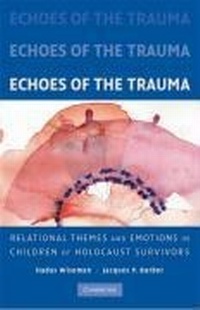
Echoes of the Trauma
Relational Themes and Emotions in Children of Holocaust Survivors
Will be published approx. on 18. August 2008
Book
Hardback
304 pages
978-0-521-87947-7 (ISBN)
Description
Echoes of trauma are traced in the relational narratives that the sons and daughters of Holocaust survivors tell about their experiences growing up in survivor families. An innovative combination of the Core Conflictual Relationship Theme (CCRT) method with narrative-qualitative analysis revealed common themes and emotional patterns that are played out in the survivors' children's meaningful relationships, especially in those with their parents. The relational world of the second generation is understood in the context of an intergenerational communication style called 'knowing-not knowing', in which there is a dialectical tension between knowing and not knowing the parental trauma. In the survivors' children's current parent-adolescent relationships with their own children, they aspire to correct the child-parent dynamics that they had experienced by trying to openly negotiate conflicts and to maintain close bonds. Clinicians treating descendents of other massive trauma would benefit from the insights offered into these complex intergenerational psychological processes.
Reviews / Votes
"In this remarkable book, Wiseman and Barber employ an ingenious approach for studying the "echoes of trauma" in children of Holocaust survivors. Combining the descriptive nuance of the case study approach with the rigor of formal narrative analysis procedures, they provide a powerful portrait of the relational and emotional themes that pervade the lives of survivors' children. Common themes such as the conflicting needs for closeness and autonomy, and the need to protect vulnerable parents are vividly illustrated in their subjects' lives. Of particular interest is the phenomenon of intergenerational transmission of trauma resulting in a type of knowing without knowing. This is a rich, compelling and beautifully written book that will be of interest to a wide audience of readers."-Jeremy D. Safran, Ph.D., Professor and Director of Clinical Psychology, New School for Social Research "As a wartime hidden child I lived in the shadow of the Holocaust. The miraculous survival of my parents ensured that I lived in their shadow also. There are consequences that reverberate for a life-time . . . and beyond. I see myself, my parents and my children in the accounts offered in this compelling work. It is not about pathology, it is about life lived within a profound and dramatic trauma and its inevitable consequences-some damaging, some inspirational. This book is an important contribution to the understanding and treatment of trans-generational issues, no matter the origins."
-Robert Krell, M.D., Professor Emeritus of Psychiatry, University of British Columbia "This book offers a sensitive and textured portrayal of three-generational familial processes of the conspiracy of silence that has been demonstrated to be a prevalent and perhaps the most powerful mechanism of transmission of trauma in numerous massively traumatized populations around the world. Through a fresh analysis of relational themes and emotions, Wiseman and Barber trace the echoes of parental trauma in survivors' offspring lives as they struggle with the conflicts between silence and breaking of the silence."
-Yael Danieli, Ph.D., Director, Group Project for Holocaust Survivors and their Children, New York, NY "Wiseman (counseling and human development, U. of Haifa, Israel) and Barber (psychology, U. of Pennsylvania) present this study of the psychological legacy of the Holocaust on children of survivors, basing their study on interviews conducted with about 60 Israelis that fit that description who were sampled randomly. Combining the Core Conflictual Relationship Theme method with narrative-qualitative analysis, the authors address relational themes and emotions among the narratives, illuminating issues for clinicians working with survivors of mass trauma and their families."
-Book News "The book is organized into emergent relational themes described within the context of CCRT, capturing the "echoes" of trauma of the Holocaust within second-generation survivors. The authors address the clinical implications of their findings and summarize the echoes of trauma as they occur within the context of parent-child relationships rather than specific transmission of traumatic sequelae, though they also pay attention to the sociocultural context of the survivor...Recommended..."
--A.N. Douglas, Mount Holyoke College, CHOICE "The book is well written and easy to digest, and may be applied immediately in therapeutic situations. The overview of the CCRT method seems sufficient for the reader to understand the information presented and may prompt additional exploration of the theory. The concepts are clearly articulated."
--Patricia M. Hernandez, PsycCRITIQUES
More details
Language
English
Place of publication
Cambridge
United Kingdom
Target group
Professional and scholarly
Product notice
sewn/stitched
Paper over boards
With dust jacket
Illustrations
2 Tables, unspecified
Dimensions
Height: 226 mm
Width: 152 mm
Thickness: 25 mm
Weight
544 gr
ISBN-13
978-0-521-87947-7 (9780521879477)
Copyright in bibliographic data and cover images is held by Nielsen Book Services Limited or by the publishers or by their respective licensors: all rights reserved.
Schweitzer Classification
Other editions
Additional editions
Hadas Wiseman | Jacques P. Barber
Echoes of the Trauma
Relational Themes and Emotions in Children of Holocaust Survivors
E-Book
11/2008
1st Edition
Cambridge University Press
€90.49
Available for download
Persons
Hadas Wiseman is Senior Lecturer in the Department of Counseling and Human Development, Faculty of Education, University of Haifa, Israel. She is a member of the Society for Psychotherapy Research (SPR) and of the International Association for Relationship Research (IARR). She works in Israel and spent a sabbatical year in Simon Fraser University, Vancouver, Canada. Wiseman is also a certified clinical psychologist in private practice in Tivon, Israel, and is co-author of Conversation as Method: Analyzing the Relational World of People Who Were Raised Communally. Jacques P. Barber is Professor of Psychology, Center for Psychotherapy Research, Department of Psychiatry, University of Pennsylvania, Philadelphia, PA, USA. He is President of the Society for Psychotherapy Research. He co-authored the Handbook of Brief Dynamic Therapies; Handbook of Dynamic Psychotherapy Research and Practice: A How-to-Do-Them Guide; and Dynamic Therapies for Psychiatric Disorders (Axis 1).
Content
1. Introduction: a narrative approach to bridging the gap between clinical case studies and empirical research; 2. Studying relationship narratives with the Core Conflictual Relationship Theme (CCRT) method; Part I. Relational Themes in Narratives: 3. Wishes for closeness and autonomy; 4. The need to protect vulnerable parents and to avoid conflicts; 5. 'Without words': themes of interpersonal communication; Part II. Emotions in the Narratives: 6. Anger; 7. Guilt, shame and embarrassment; 8. Anxiety and helplessness; 9. Loneliness; 10. Joy and pride; Part III. Healing Trauma in the Chain of the Generations: 11. The second generation's experience of parenting their adolescent children; 12. Growing up to the music of knowing-not knowing: reflections and clinical implications.