

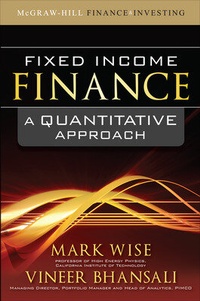
Fixed Income Finance: A Quantitative Approach
Will be published approx. on 16. February 2010
Book
Hardback
256 pages
978-0-07-162120-5 (ISBN)
Description
A complete guide forprofessionals with advancedmathematical skills but little orno financial knowledge . . .
You're smart. Logical. Mathematicallyadept. One of those people who canmake quick work of long, difficult equations.But when it comes to managing a financialportfolio and managing risk, you wonder ifyou're missing out.
Fixed Income Finance is the book for you.It's the perfect introduction to the concepts,formulas, applications, and methodology,all derived from first principles, that youneed to succeed in the world of quantitativefinance-with a special emphasis on fixedincomes. Written by two of the sharpest analyticalminds in their fields, this instructiveguide takes you through the basics of fixedincome finance, including many new andoriginal results, to help you understand:
Treasury Bonds and the Yield CurveThe Macroeconomics behind TermStructure ModelsStructural Models for CorporateBonds and Portfolio DiversificationOptionsFixed Income DerivativesNumerical Techniques
Filled with step-by-step equations, clearand concise concepts, and ready-to-useformulas, this essential workbook bridges thegap between basic beginners' primers andmore advanced surveys to provide hands-on tools you can begin to use immediately. It's allyou need to put your math skills to work-and make the money work for you.
Brilliantly researched, impeccably detailed,and thoroughly comprehensive, Fixed IncomeFinance is applied mathematics at its best andmost useful.
You're smart. Logical. Mathematicallyadept. One of those people who canmake quick work of long, difficult equations.But when it comes to managing a financialportfolio and managing risk, you wonder ifyou're missing out.
Fixed Income Finance is the book for you.It's the perfect introduction to the concepts,formulas, applications, and methodology,all derived from first principles, that youneed to succeed in the world of quantitativefinance-with a special emphasis on fixedincomes. Written by two of the sharpest analyticalminds in their fields, this instructiveguide takes you through the basics of fixedincome finance, including many new andoriginal results, to help you understand:
Treasury Bonds and the Yield CurveThe Macroeconomics behind TermStructure ModelsStructural Models for CorporateBonds and Portfolio DiversificationOptionsFixed Income DerivativesNumerical Techniques
Filled with step-by-step equations, clearand concise concepts, and ready-to-useformulas, this essential workbook bridges thegap between basic beginners' primers andmore advanced surveys to provide hands-on tools you can begin to use immediately. It's allyou need to put your math skills to work-and make the money work for you.
Brilliantly researched, impeccably detailed,and thoroughly comprehensive, Fixed IncomeFinance is applied mathematics at its best andmost useful.
More details
Language
English
Place of publication
United States
Publishing group
McGraw-Hill Education - Europe
Target group
Professional and scholarly
Illustrations
50 Illustrations
Dimensions
Height: 236 mm
Width: 160 mm
Thickness: 22 mm
Weight
509 gr
ISBN-13
978-0-07-162120-5 (9780071621205)
Copyright in bibliographic data and cover images is held by Nielsen Book Services Limited or by the publishers or by their respective licensors: all rights reserved.
Schweitzer Classification
Other editions
Additional editions
Mark Wise | Vineer Bhansali
Fixed Income Finance: A Quantitative Approach
E-Book
02/2010
1st Edition
McGraw-Hill Education
€158.29
Available for download
Persons
Mark Wise is the John A. McCone
Professor of High Energy Physics at the
California Institute of Technology. He is the
winner of the 2001 J.J. Sakurai Prize of the
American Physical Society and a member of
the American Academy of Arts and Sciences
and National Academy of Sciences. He is also
the coauthor of Heavy Quark Physics.
Vineer Bhansali is an executive vice
president, portfolio manager, firm-wide head
of analytics for portfolio management, and a
senior member of PIMCO's portfolio management
team. He is the author of Pricing
and Managing Exotic and Hybrid Options and
currently serves as an associate editor for
the International Journal of Theoretical and
Applied Finance.
Professor of High Energy Physics at the
California Institute of Technology. He is the
winner of the 2001 J.J. Sakurai Prize of the
American Physical Society and a member of
the American Academy of Arts and Sciences
and National Academy of Sciences. He is also
the coauthor of Heavy Quark Physics.
Vineer Bhansali is an executive vice
president, portfolio manager, firm-wide head
of analytics for portfolio management, and a
senior member of PIMCO's portfolio management
team. He is the author of Pricing
and Managing Exotic and Hybrid Options and
currently serves as an associate editor for
the International Journal of Theoretical and
Applied Finance.
Content
Section 1: Bond Basics: Treasury bonds and the Yield Curve/Corporate Bonds and Credit Risk/ Derivatives/ Mortgages/ Municipal Bonds/Real Return Bonds
Section 2: Probability Theory and Stochastic Processes:Normal Random Variables/The Central Limit Theory/ The Probability Distribution for Corporate Bonds Returns/ Correlated Random Variables/ Random Walks/Survival Probabilities/ Correlated Random Walks/Simulation
Section 3: Term Structure Models: One Factor Models and Two Factor Models/Bond Prices, Volatilities/Eurodollar Futures/Futures and Forward Contracts/ Macroeconomics and Two Factor Models
Section 4: Options: Call and Put Options on a Stock/The Merton Model/Options on Interest Rate Sensitive SecuritiesSection 5: Portfolio Allocation: Utility Functions/The Sharpe Ratio/Beyond Mean and Variance/ Value at Risk/ Examples
Section 2: Probability Theory and Stochastic Processes:Normal Random Variables/The Central Limit Theory/ The Probability Distribution for Corporate Bonds Returns/ Correlated Random Variables/ Random Walks/Survival Probabilities/ Correlated Random Walks/Simulation
Section 3: Term Structure Models: One Factor Models and Two Factor Models/Bond Prices, Volatilities/Eurodollar Futures/Futures and Forward Contracts/ Macroeconomics and Two Factor Models
Section 4: Options: Call and Put Options on a Stock/The Merton Model/Options on Interest Rate Sensitive SecuritiesSection 5: Portfolio Allocation: Utility Functions/The Sharpe Ratio/Beyond Mean and Variance/ Value at Risk/ Examples