

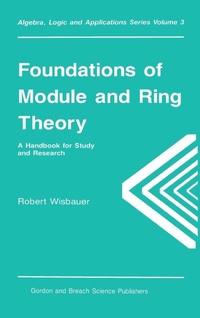
Foundations of Module and Ring Theory
A Handbook for Study and Research
1st Edition
Published on 5. September 1991
Book
Hardback
618 pages
978-2-88124-805-4 (ISBN)
Description
This volume provides a comprehensive introduction to module theory and the related part of ring theory, including original results as well as the most recent work. It is a useful and stimulating study for those new to the subject as well as for researchers and serves as a reference volume. Starting form a basic understanding of linear algebra, the theory is presented and accompanied by complete proofs. For a module M, the smallest Grothendieck category containing it is denoted by o[M] and module theory is developed in this category. Developing the techniques in o[M] is no more complicated than in full module categories and the higher generality yields significant advantages: for example, module theory may be developed for rings without units and also for non-associative rings. Numerous exercises are included in this volume to give further insight into the topics covered and to draw attention to related results in the literature.
More details
Series
Language
English
Place of publication
Oxford
Netherlands
Target group
College/higher education
Professional and scholarly
Dimensions
Height: 235 mm
Width: 157 mm
Thickness: 38 mm
Weight
1036 gr
ISBN-13
978-2-88124-805-4 (9782881248054)
Copyright in bibliographic data and cover images is held by Nielsen Book Services Limited or by the publishers or by their respective licensors: all rights reserved.
Schweitzer Classification
Other editions
Additional editions
Robert Wisbauer
Foundations of Module and Ring Theory
E-Book
05/2018
1st Edition
CRC Press
€693.99
Available for download
Robert Wisbauer
Foundations of Module and Ring Theory
E-Book
05/2018
1st Edition
CRC Press
€693.99
Available for download
Person
Wisbauer, Robert
Content
1. Elementary properties of rings 2. Module categories 3. Modules characterized by the Hom-functor 4. Notions derived from simple modules 5. Finiteness conditions in modules 6. Dual finiteness conditions 7. pure sequences and derived notions 8. Modules described by means of projectivity 9. Relations between functors 10. Functor Rings