

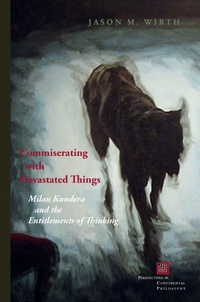
Commiserating with Devastated Things
Milan Kundera and the Entitlements of Thinking
Published on 20. October 2015
Book
Hardback
256 pages
978-0-8232-6820-7 (ISBN)
Description
Commiserating with Devastated Things seeks to understand the place Milan Kundera calls "the universe of the novel." Working through Kundera's oeuvre as well as the continental philosophical tradition, Wirth argues that Kundera transforms-not applies-philosophical reflection within literature.
Reading between Kundera's work and his self-avowed tradition, from Kafka to Hermann Broch, Wirth asks what it might mean to insist that philosophy does not have a monopoly on wisdom, that the novel has its own modes of wisdom that challenge philosophy's.
Reading between Kundera's work and his self-avowed tradition, from Kafka to Hermann Broch, Wirth asks what it might mean to insist that philosophy does not have a monopoly on wisdom, that the novel has its own modes of wisdom that challenge philosophy's.
Reviews / Votes
"Like Kafka but for different reasons, Kundera has been not been fully at home in Prague, and so it is not surprising that this major reflection on existential, political, musical, and novelistic dimensions of Kundera's literature and literary theory migrates beyond Bohemian coasts. Writing with a Zen sense of Czech irony and from a comparative East-West perspective, Wirth situates Kundera's opus at the borders of philosophy and literature. Commiserating with Devastated Things draws Kundera's characters and ideas into dialogue with the intellectual history from Plato to Nietzsche to Musil and Kafka to Deleuze and Dogen." -- -Martin Matustik Arizona State University "Wirth's book is an enormous gift. It flirts successfully with Philosophy's self-proclaimed grandeur without giving up on its deepest, often laughable desires. It is in its encounter with the novel that Philosophy is best tested, teased, and held accountable. And in the absence of a conversation with Philosophy, perhaps the novel's own explorations-of contingency, ambiguity, and irony-lack the kind of pursuit its implications demand. Wirth's commiserations with Kundera's concerns and with Philosophy's display the best of both worlds, with rich and stunning force. Perhaps no novelist satirizes Philosophy more compellingly than Kundera while seducing any thinker to dare rescuing it from its own well-worn fantasies. I can think of no one who's done a greater service than Wirth at crossing the borders, at putting Kundera's labors and those of Philosophy into such compelling dialogue. Both testaments risk betrayal; neither is betrayed. We can be grateful for Wirth's exceptional guidance in how to inhabit both worlds so fully." -- -Timothy Engstrom Rochester Institute of Technology "A unique, groundbreaking work that crosses the disciplinary lines between philosophy and literature to advance a highly creative thesis regarding the nature of thinking itself." -- -Leah Kalmanson Drake UniversityMore details
Series
Language
English
Place of publication
New York
United States
Target group
Professional and scholarly
Product notice
Cloth over boards
Dimensions
Height: 231 mm
Width: 155 mm
Thickness: 23 mm
Weight
540 gr
ISBN-13
978-0-8232-6820-7 (9780823268207)
Copyright in bibliographic data and cover images is held by Nielsen Book Services Limited or by the publishers or by their respective licensors: all rights reserved.
Schweitzer Classification
Other editions
Additional editions
E-Book
10/2015
1st Edition
Fordham University Press
€63.99
Available for download
E-Book
10/2015
1st Edition
Fordham University Press
€46.99
Available for download
Person
Jason Wirth is Professor of Philosophy and the current Piggott-McCone chair of the Arts and Sciences at Seattle University.
Content
Preface Acknowledgments List of Abbreviations 1 Tamina at the Border 2 Caught Looking: The Universe of the Novel 3 Laughter 4 Dogs and History 5 Kitsch 6 Idiocy on the Verge of the Novel 7 Novel Idiocy Abbreviations Notes Bibliography Index