

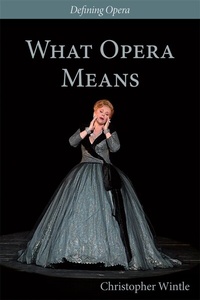
What Opera Means
Categories and Case-studies
Published on 15. March 2018
Book
Hardback
288 pages
978-0-9931983-4-2 (ISBN)
Description
A fresh, elegant and vital enquiry into the elusive character of opera, unfolded through categories and case-studies, with an emphasis on historical background, psychology and performance.
This book mounts a searching enquiry into the elusive character of opera. The author argues that any work of art can be grasped primarily through its constellation of Platonic ideas, or 'categories', several of which he explores in light of a new definition of the art-form. He elaborates each category with case-studies rooted in the time, place and circumstance of an opera's origin: most of these are adaptations of previously-published essays, though somedraw on talks for universities, opera houses and the BBC.
Although he looks back to the infancy of opera, he concentrates on later, more familiar repertory - principally Wagner, Verdi, Strauss and Britten. Case-studies included under 'Psychology' reveal his long-standing involvement with psychoanalysis, and those under 'Performance' reinforce his view of opera as a branch of rhetoric. As the first of a two-volume project, What Opera Means deals with categories accessible to all: of fifty entries, only two require basic musical knowledge (the second volume will be for specialists). The book is thus suitable for the general reader, as well as for college courses.
CHRISTOPHER WINTLE is Emeritus Senior Lecturer in Music at King's College London and General Editor of the series Defining Opera (Plumbago Books). He has published extensively on nineteenth- and twentieth-century music, and for twenty years was an opera critic for the Times Literary Supplement.
KATE HOPKINS (Editor) is Content Producer for Opera at the Royal Opera House and Senior Assistant Editor of Plumbago Books. She has written on opera and literature for ENO, WNO and The Royal Opera.
This book mounts a searching enquiry into the elusive character of opera. The author argues that any work of art can be grasped primarily through its constellation of Platonic ideas, or 'categories', several of which he explores in light of a new definition of the art-form. He elaborates each category with case-studies rooted in the time, place and circumstance of an opera's origin: most of these are adaptations of previously-published essays, though somedraw on talks for universities, opera houses and the BBC.
Although he looks back to the infancy of opera, he concentrates on later, more familiar repertory - principally Wagner, Verdi, Strauss and Britten. Case-studies included under 'Psychology' reveal his long-standing involvement with psychoanalysis, and those under 'Performance' reinforce his view of opera as a branch of rhetoric. As the first of a two-volume project, What Opera Means deals with categories accessible to all: of fifty entries, only two require basic musical knowledge (the second volume will be for specialists). The book is thus suitable for the general reader, as well as for college courses.
CHRISTOPHER WINTLE is Emeritus Senior Lecturer in Music at King's College London and General Editor of the series Defining Opera (Plumbago Books). He has published extensively on nineteenth- and twentieth-century music, and for twenty years was an opera critic for the Times Literary Supplement.
KATE HOPKINS (Editor) is Content Producer for Opera at the Royal Opera House and Senior Assistant Editor of Plumbago Books. She has written on opera and literature for ENO, WNO and The Royal Opera.
Reviews / Votes
An academic as well as respected commentator on opera, Christopher Wintle has here assembled a collection of his writings on the genre, including essays for the Royal Opera...plus a selection of reviews for the Times Literary Supplement...a wide-ranging analysis of the meaning of opera...Wintle demonstrates considerable knowledge on Verdi, Wagner, Strauss, Weill, Britten and George Benjamin, [while] Wintle's own expertise in other fields - particularly psychology - adds depth and complexity. Four Stars. * BBC MUSIC MAGAZINE * In this superb selection of essays, Christopher Wintle ranges over 400 years of operatic history, from Peri to Prokofiev, Bizet to Benjamin. Whether discussing the mechanics of music or the psychoanalytic import of words and actions, Wintle's prose is always elegant, his arguments accessible and engaging. Readers will discover surprising, fresh insights into the well-known repertoire, and astute reflections - often just as surprising - on the less familiar. -- Musikhochschule Basel * CHRIS WALTON *More details
Series
Language
English
Place of publication
London
United Kingdom
Target group
Professional and scholarly
Product notice
Cloth over boards
Illustrations
3 s/w Abbildungen
3 b/w illus.
Dimensions
Height: 242 mm
Width: 160 mm
Weight
1 gr
ISBN-13
978-0-9931983-4-2 (9780993198342)
Copyright in bibliographic data and cover images is held by Nielsen Book Services Limited or by the publishers or by their respective licensors: all rights reserved.
Schweitzer Classification
Other editions
Additional editions
Book
03/2018
Plumbago Books and Arts
€39.80
Article exhausted; check different version