

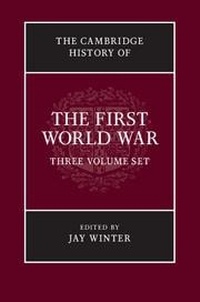
The Cambridge History of the First World War 3 Volume Paperback Set
Published on 4. February 2016
Book
Paperback/Softback
2340 pages
978-1-316-60066-5 (ISBN)
Description
The Cambridge History of the First World War is a comprehensive, three-volume work which provides an authoritative account of the military, political, social, economic and cultural history of the Great War. Reflecting the very latest research in the field, the volumes provide a comprehensive guide to the course of the war and of how the dynamics of conflict unfolded throughout the world. Volume 1 surveys the military history showing the brutal realities of a global war among industrialized powers, whilst Volumes 2 and 3 explore the social, economic, cultural and political challenges that the war presented to politicians, industrialists, soldiers and civilians. Written by a team of leading international historians, the volumes together reveal the ways in which the war transcended the boundaries of Europe to subsequently transform the Middle East, Africa, Asia and the Americas just as much as Europe itself.
Reviews / Votes
'The Cambridge History of the First World War not only deserves to find a place in every university and school, but also on the shelves of anyone with an interest in the war that was supposed to end all wars. Utterly absorbing, endlessly fascinating, absolutely essential.' History of War '... formidably comprehensive ...' The Bookseller '... an astonishing achievement. It is a comprehensive, insightful and challenging collection, beautifully produced.' Richard Grayson, Reviews in History (history.ac.uk/reviews) 'The single most important piece of collective scholarship to emerge from the centenary.' BBC History Magazine 'The global perspective on the war, represented in these volumes, adds further layers of complexity to our understanding of this foundational moment in modern history. The conjunction of early twentieth-century patterns of globalization and industrialized great power war was singular, distinguishing it from earlier European conflicts fought across the globe and the Second World War, which followed the collapse of globalization in the 1930s.' William Mulligan, European History QuarterlyMore details
Series
Language
English
Place of publication
Cambridge
United Kingdom
Target group
College/higher education
Illustrations
6 Plates, black and white; 34 Maps; 183 Halftones, color
Dimensions
Height: 228 mm
Width: 151 mm
Thickness: 111 mm
Weight
3967 gr
ISBN-13
978-1-316-60066-5 (9781316600665)
Copyright in bibliographic data and cover images is held by Nielsen Book Services Limited or by the publishers or by their respective licensors: all rights reserved.
Schweitzer Classification
Other editions
Additional editions
Book
01/2014
Cambridge University Press
€450.50
Article not available at the moment
Person
Jay Winter is Charles J. Stille Professor of History at Yale University. He came to Yale from Cambridge where he took his doctorate and where he taught history from 1979 to 2001 and was a Fellow of Pembroke College. He is the author of Sites of Memory, Sites of Mourning: The Great War in European Cultural History (1995); Remembering War (2006) and Dreams of Peace and Freedom (2006). In 1997, he received an Emmy award for the best documentary series of the year as co-producer and co-writer of 'The Great War and the Shaping of the Twentieth Century', an eight-hour series broadcast on PBS and the BBC, and shown subsequently in 28 countries. He is one of the founders of the Historial de la grande guerre, the international museum of the Great War, in Peronne, Somme, France. His biography of Rene Cassin, written with Antoine Prost, published by Fayard in French in 2011, will appear in an English edition in 2013, published by Cambridge University Press.
Content
Volume 1: Introduction to Volume 1; Part I. A Narrative History: Introduction to Part I; 1. Origins; 2. 1914: outbreak; 3. 1915: stalemate; 4. Total war; 5. 1917: global war; 6. 1918: endgame; 7. 1919: aftermath; Part II. Theatres of War: Introduction to Part II; 8. The Western Front; 9. The Eastern Front; 10. The Italian Front; 11. The Ottoman Front; 12. The war at sea; 13. The air war; 14. Command and strategy; Part III. World War: Introduction to Part III; 15. The imperial framework; 16. Africa; 17. The Ottoman Empire; 18. Asia; 19. North America; 20. Latin America; Part IV. Rules of Engagement, Laws of War and War Crimes: Introduction to Part IV; 21. Atrocities and war crimes; 22. Genocide; 23. The laws of war; 24. Visual essay: global war. Volume 2: Introduction to Volume 2; Part I. Political Power: Introduction to Part I; 1. Heads of State and government; 2. Parliaments; 3. Diplomats; 4. Civil-military relations; 5. Revolution; Part II. Armed Forces: Introduction to Part II; 6. Combat and tactics; 7. Morale; 8. Mutiny; 9. Logistics; 10. Technology and armaments; 11. Prisoners of war; Part III. The Sinews of War: Introduction to Part III; 12. War economies; 13. Workers; 14. Cities; 15. Agrarian society; 16. Finance; 17. Scientists; 18. Blockade and economic warfare; Part IV. The Search for Peace: Introduction to Part IV; 19. Diplomacy; 20. Neutrality; 21. Pacifism; 22. Drafting the peace; 23. The wars after the war; 24. Visual essay: the State. Volume 3: Introduction to Volume 3; Part I. Private Life: Introduction to Part I; 1. The couple; 2. Children; 3. Families; Part II. Gender at Home: Introduction to Part II; 4. War work; 5. Gender at home; 6. At the Front; 7. Gender roles in killing zones; Part III. Populations at Risk: Introduction to Part III; 8. Refugees and exiles; 9. Minorities; 10. Populations under occupation; 11. Captive civilians; Part IV. Bodies in Pain: Introduction to Part IV; 12. Military medicine; 13. Shell shock; 14. The Spanish flu; 15. Mourning practices; Part V. The Social History of Cultural Life: Introduction to Part V; 16. Mobilising minds; 17. Beliefs and religion; 18. Soldier-writers and poets; 19. Cinema; 20. Arts; 21. War memorials; Part VI. A Reckoning: Costs and Outcomes: Introduction to Part VI; 22. The dead; 23. The living; 24. The Great War at its centenary; 25. Visual essay: civil society.