

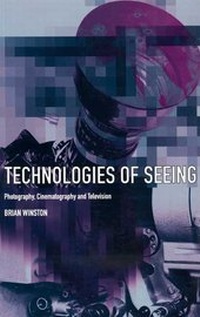
Technologies of Seeing
Photography, Cinema and Television
Published on 1. October 1996
Book
Paperback/Softback
152 pages
978-0-85170-602-3 (ISBN)
Description
This text examines the complex forces pushing and constraining technological developments in cinema. It contests the view that technological advance is simply the result of scientific progress. Rather, the author argues that social forces control the media technology agenda at every stage.
Reviews / Votes
wonderfully readable ... impressive in its conceptual energy and scholarly detail'. ScreenMore details
Edition
1996
Language
English
Place of publication
London
United Kingdom
Publishing group
Bloomsbury Publishing PLC
Target group
College/higher education
Professional and scholarly
Product notice
Paperback (trade)
Illustrations
152 p.
Dimensions
Height: 234 mm
Width: 153 mm
Thickness: 0 mm
ISBN-13
978-0-85170-602-3 (9780851706023)
Copyright in bibliographic data and cover images is held by Nielsen Book Services Limited or by the publishers or by their respective licensors: all rights reserved.
Schweitzer Classification
Other editions
Additional editions
E-Book
07/2019
1st Edition
BFI Publishing
€122.99
Available for download
E-Book
07/2019
1st Edition
BFI Publishing
€122.99
Available for download
Person
BRIAN WINSTON is the Lincoln Professor of Communications at the University of Lincoln, and has been involved with documentary since 1963. He has an Emmy for documentary scriptwriting; has taught documentary in both the US and the UK; and has long been involved with many international documentary film festivals and the Visible Evidence conference series. Winston first wrote about documentary in 1978. He is the author of a number of books, including Media, Technology and Society: A History, from the Telegraph to the Internet (1998), a volume on "Fires Were Started-" (1999) in the BFI Film Classics series, Lies, Damn Lies and Documentaries (2000) and Messages: Free Expression, Media and the West, from Gutenberg to Google (2005).
Content
Contents .- Preface viii .- NTRODUCTION: NECESSITIES AND CONSTRAINTS 1.- A Pattern of Technological Change .- On Technological Determinism .- Modelling Technological Change .- CHAPTER 1: THE CASE OF THE CINEMA 10 The 'Invention' of the Cinema: Accelerators and Brakes: Great Men Invent the Cinema Errors and Omissions The Edison Patent Battles The Context for Cinema: Realism and Illusionism The Context for Cinema: Narrative The Context for Cinema: The Mass Audience Towards a Structural Account of the Making of Cinema .- CHAPTER 2: THE CASE OF COLOUR FILM 39 White Skin and Colour Film: The Ideology of the Apparatus .- On Ideological Innocence 'Natural' Colour 'Inventing' Colour Film Reproducing Colour Colour in Motion The Meaning of Colour 'Pleasing Flesh Tones' .- CHAPTER 3: THE CASE OF 16MM FILM 58From Home Movies to Cinema Verite: Looking for a Need: The Standard of the Art: Edison's Strategy The Emergence of 16mm: Kodak's Strategy Avoiding the Amateur (1): The Newsreels Avoiding the Amateur (2): The Documentary Movement Avoiding the Amateur (3): The Radicals and The Ethnographers Suppressing 16mm's Potential Supervening Necessity: Stage 1 - World War II Supervening Necessity: Stage 2 - TV News Supervening Necessity: Stage 3 - 'A Breath of Fresh Air for Documentary The Rise and Fall of 16mm .- CHAPTER 4: THE CASE OF HDTV 88Lights, Camera, Inaction: Hollywood and Technology One from the Heart: Coppola's Strategy Social Demands of Post-Industrial Societies: NHK's Strategy Broadcasters Must Maintain Faith: The Engineer's Strategy We're Behind Japan - Again: The Media's Strategy 35mm Quality at 16mm Production Prices: Sony's Strategy Give Me One Good Reason to Change: Hollywood's Strategies They Could Not See the Sound: Hollywood's Strategies (1) Technicolour: Hollywood's Strategies (2) Too Grainy for Projection: Hollywood's Strategies (3) A Man and His Dream: Coppola's Strategy Revisited The Five-Year Syndrome: The Technophiles' Strategy .- CHAPTER 5: THE CASE OF THE THIRD DIMENSION 109Where is Holography?: Necessities and Constraints From the Stereoptician to Bwana Devil From the Interference Hypothesis to the Interferometer Holography as a 'Time-Based Medium'.- Notes 119.