

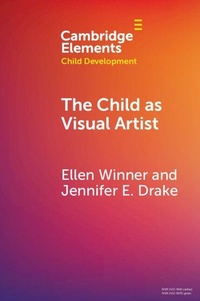
The Child as Visual Artist
Published on 12. May 2022
Book
Paperback/Softback
96 pages
978-1-108-94772-5 (ISBN)
Description
This Element focuses on the development of drawing (and painting) in childhood. The author begins by examining children's representational drawing, a topic that has received quite wide attention from the nineteenth century on. The author then turns to issues that have received far less attention and discusses the aesthetic property of expression, weighing the claim that young children's highly expressive drawings bear an affinity to twentieth century modernist art. The author then examines the function of drawing for children's emotional development. Next, looking at art prodigies, the author turns to the how of drawing, considering the relation of drawing talent to IQ and to visual-spatial skills. Finally, the author considers the relation between development and education in art and how educators can best nurture children's artistic development.
More details
Series
Language
English
Place of publication
Cambridge
United Kingdom
Target group
College/higher education
Product notice
Paperback (trade)
Illustrations
Worked examples or Exercises
Dimensions
Height: 229 mm
Width: 152 mm
Thickness: 6 mm
Weight
153 gr
ISBN-13
978-1-108-94772-5 (9781108947725)
Copyright in bibliographic data and cover images is held by Nielsen Book Services Limited or by the publishers or by their respective licensors: all rights reserved.
Schweitzer Classification
Other editions
Additional editions
Ellen Winner
Child as Visual Artist
E-Book
05/2022
Cambridge University Press
€15.49
Available for download
Ellen Winner | Jennifer E. Drake
The Child as Visual Artist
E-Book
05/2022
Cambridge University Press
€15.49
Available for download
Content
1. Introduction; 2. Emergence and development of representational drawing; 3. External influences on representational drawings; 4. Aesthetic properties of children's drawings; 5. Drawing as a form of emotion regulation; 6. The case of child art prodigies; 7. The relationship between development and education in visual art; 8. Concluding Remarks; References.