

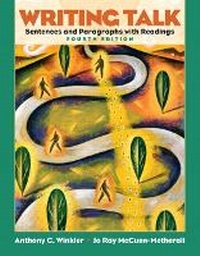
Writing Talk
Sentences & Paragraphs with Readings
4th Edition
Published on 4. February 2005
Book
Paperback/Softback
552 pages
978-0-13-152361-6 (ISBN)
Description
Writing Talk addresses students' diverse learning styles by providing the most varied practice exercises.
Each student learns differently. Winkler and McCuen-Matherall created a writing series to help instructors reach more students. Writing Talk reaches more students by providing the most varied practice exercises of any writing text. Every unit contains Practice Exercises, Unit Tests, Unit Talk-Write Exercises, Unit Collaborative Assignments, Unit Writing Assignments, and Photo Writing Assignments. These diverse exercises will help students of all types, including visual, audio, and collaborative learners learn and retain the material.
Each student learns differently. Winkler and McCuen-Matherall created a writing series to help instructors reach more students. Writing Talk reaches more students by providing the most varied practice exercises of any writing text. Every unit contains Practice Exercises, Unit Tests, Unit Talk-Write Exercises, Unit Collaborative Assignments, Unit Writing Assignments, and Photo Writing Assignments. These diverse exercises will help students of all types, including visual, audio, and collaborative learners learn and retain the material.
More details
Edition
4th edition
Language
English
Place of publication
United States
Publishing group
Pearson Education (US)
Target group
Professional and scholarly
ISBN-13
978-0-13-152361-6 (9780131523616)
Copyright in bibliographic data and cover images is held by Nielsen Book Services Limited or by the publishers or by their respective licensors: all rights reserved.
Schweitzer Classification
Other editions
New editions
Anthony C. Winkler | Jo Ray McCuen-Matherell
Writing Talk
Writing Sentences and Paragraphs with Readings with NEW MyWritingLab
Book
08/2013
5th Edition
Longman Inc
€127.47
Shipment within 10-20 days
Anthony C. Winkler | Jo Ray McCuen-Matherell
Writing Talk
Writing Sentences and Paragraphs with Readings
Book
02/2009
5th Edition
Pearson
€114.07
Article exhausted; check for reprint
Previous edition
Book
06/2004
3rd Edition
Pearson
€49.59
Article exhausted; check for reprint
Content
(NOTE: Each chapter contains: Unit Test, Unit Talk-Write Assignment, Unit Collaborative Assignment, Unit Writing Assignment and Photo Writing Assignment).
UNIT 1. The ESL Student and the Native Speaker.
Differences Between a Native and an ESL Student.
Pronunciation.
Homonyms.
Context.
Grammar.
Idioms.
UNIT 2. Myths About Writing.
Myths About Writing.
Standard English.
UNIT 3. How to Start Writing.
Freewriting.
Keeping a Journal.
Brainstorming.
Clustering.
The Topic Sentence.
UNIT 4. Moving from Sentences to Paragraphs.
Supporting Details.
UNIT 5. Writing a Solid Paragraph.
Begin with a Discussible Point.
Stick to the Point.
Prove the Point; Don't Merely Repeat It.
Link the Sentences.
UNIT 6. Revising Paragraphs.
What Is Revision?
The Revising Checklist.
Using Talk Skills to Revise Your Work.
Getting Rid of Wordiness.
UNIT 7. The Basic Sentence.
Subject and Verb.
Kernel Sentences.
Sentences Worded as Questions.
Prepositional Phrases.
Action Verbs and Linking Verbs.
Helping Verbs.
Verbals.
Compound Subjects and Verbs.
UNIT 8. Building Sentences.
Dependent and Independent Clauses.
Three Basic Sentence Types.
Sentence Variety.
UNIT 9. Avoiding Non-Sentences.
Sentence Fragments.
Avoiding Sentence Fragments.
Run-on Sentences.
UNIT 10. Verbs-An Overview.
Twelve Tenses.
Present Tense Endings.
Past Tense Endings.
Problems with -ing verbs.
Difficult Verbs: Be, Have, Do.
UNIT 11. Regular and Irregular Verbs.
Regular Verbs.
Irregular Verbs.
Problem Verbs: Lie/Lay, Sit/Set, Rise/Raise.
Lie/Lay, Sit/Set, Rise/Raise: Does It Really Matter?
UNIT 12. Subject-Verb Agreement.
Do, Does, Doesn't, Don't, Was, Were, Wasn't, Weren't.
Indefinite Pronouns.
Phrases Between a Subject and Its Verb.
Sentences Beginning with There/Here.
Questions.
Compound Subjects Joined by And, Or, Either/Or, or Neither/Nor
Who, Which, and That.
UNIT 13. Problems with Verbs.
Shifts in Tense.
Would Have, Could Have, Should Have, and Must Have.
Double Negatives.
Active and Passive Voice.
UNIT 14. Using Pronouns Correctly.
Antecedent Problems.
Agreement Problems.
Sexist Use of Pronouns.
Shifting Point of View.
UNIT 15. Pronoun Problems.
Case Problems.
Pesky Pronouns.
UNIT 16. Distinguishing Between Adjectives and Adverbs.
Adjectives and Adverbs.
Comparisons.
Using Superlatives.
Using Good/Well and Bad/Badly.
This/That and These/Those.
UNIT 17. Dangling and Misplaced Modifiers.
Dangling Modifiers.
Misplaced Modifiers.
UNIT 18. Using Prepositions.
Multiword Prepositions.
Prepositional Phrases.
Prepositions in Commonly Used Expressions.
Frequently Misused Prepositions.
Frequently Misused Prepositional Expressions.
UNIT 19. Punctuation You Can Hear.
End Punctuation.
Comma (,).
The Apostrophe (').
UNIT 20. Punctuation You Can't Hear.
Semicolon (;).
Colon (:).
The Dash (--).
Quotation Marks ("").
Parentheses [( )].
UNIT 21. Capitalization.
Rules of Capitalization.
UNIT 22. How to Use the Dictionary.
Spelling.
Word Division.
Pronunciation.
Grammatical Uses.
Meanings.
Usage Labels.
Origin.
Synonyms.
UNIT 23. Spelling Rules.
Tips for Improving Your Spelling.
Using a Spell Checker.
Rules for Spelling.
UNIT 24. Commonly Misspelled Words.
Homophones and Frequently Confused Words.
Commonly Misspelled Words.
Words Spelled with One or Two Words.
Readings.
Help for Your Reading.
An Object.
Tortillas, Jose Antonio Burciaga.
Beautiful Music, Dana Wall.
The Cello, Lorena Bruff.
A Place.
The Hole at Alcatraz, Jim Quillen.
Letter from Tokyo, Michael A. Lev.
An Animal.
Snakes, Michael Ondaatje.
The Revolt of the Elephants, Ingrid E. Newkirk.
Sport, Jimmy Carter.
A Person.
A Brotherly Bond That Beats the Odds, Bill Paschke.
Two Roads Converged in a Wood, Jenijoy La Belle.
Barbie Doll, Marge Piercy.
An Event.
Last Flight, Isao Matsuo.
Shame, Dick Gregory.
A Problem.
Senor Payroll, William E. Barrett.
Talkin' White, Wayne Lionel Aponte.
An Argument.
With Things That People Can Control, Such as Dress, Stereotypes Make Sense, Leonard Pitts Jr.
Cheating, Iyah Romm.
Credits.
Index.
Instructor's Section.
UNIT 1. The ESL Student and the Native Speaker.
Differences Between a Native and an ESL Student.
Pronunciation.
Homonyms.
Context.
Grammar.
Idioms.
UNIT 2. Myths About Writing.
Myths About Writing.
Standard English.
UNIT 3. How to Start Writing.
Freewriting.
Keeping a Journal.
Brainstorming.
Clustering.
The Topic Sentence.
UNIT 4. Moving from Sentences to Paragraphs.
Supporting Details.
UNIT 5. Writing a Solid Paragraph.
Begin with a Discussible Point.
Stick to the Point.
Prove the Point; Don't Merely Repeat It.
Link the Sentences.
UNIT 6. Revising Paragraphs.
What Is Revision?
The Revising Checklist.
Using Talk Skills to Revise Your Work.
Getting Rid of Wordiness.
UNIT 7. The Basic Sentence.
Subject and Verb.
Kernel Sentences.
Sentences Worded as Questions.
Prepositional Phrases.
Action Verbs and Linking Verbs.
Helping Verbs.
Verbals.
Compound Subjects and Verbs.
UNIT 8. Building Sentences.
Dependent and Independent Clauses.
Three Basic Sentence Types.
Sentence Variety.
UNIT 9. Avoiding Non-Sentences.
Sentence Fragments.
Avoiding Sentence Fragments.
Run-on Sentences.
UNIT 10. Verbs-An Overview.
Twelve Tenses.
Present Tense Endings.
Past Tense Endings.
Problems with -ing verbs.
Difficult Verbs: Be, Have, Do.
UNIT 11. Regular and Irregular Verbs.
Regular Verbs.
Irregular Verbs.
Problem Verbs: Lie/Lay, Sit/Set, Rise/Raise.
Lie/Lay, Sit/Set, Rise/Raise: Does It Really Matter?
UNIT 12. Subject-Verb Agreement.
Do, Does, Doesn't, Don't, Was, Were, Wasn't, Weren't.
Indefinite Pronouns.
Phrases Between a Subject and Its Verb.
Sentences Beginning with There/Here.
Questions.
Compound Subjects Joined by And, Or, Either/Or, or Neither/Nor
Who, Which, and That.
UNIT 13. Problems with Verbs.
Shifts in Tense.
Would Have, Could Have, Should Have, and Must Have.
Double Negatives.
Active and Passive Voice.
UNIT 14. Using Pronouns Correctly.
Antecedent Problems.
Agreement Problems.
Sexist Use of Pronouns.
Shifting Point of View.
UNIT 15. Pronoun Problems.
Case Problems.
Pesky Pronouns.
UNIT 16. Distinguishing Between Adjectives and Adverbs.
Adjectives and Adverbs.
Comparisons.
Using Superlatives.
Using Good/Well and Bad/Badly.
This/That and These/Those.
UNIT 17. Dangling and Misplaced Modifiers.
Dangling Modifiers.
Misplaced Modifiers.
UNIT 18. Using Prepositions.
Multiword Prepositions.
Prepositional Phrases.
Prepositions in Commonly Used Expressions.
Frequently Misused Prepositions.
Frequently Misused Prepositional Expressions.
UNIT 19. Punctuation You Can Hear.
End Punctuation.
Comma (,).
The Apostrophe (').
UNIT 20. Punctuation You Can't Hear.
Semicolon (;).
Colon (:).
The Dash (--).
Quotation Marks ("").
Parentheses [( )].
UNIT 21. Capitalization.
Rules of Capitalization.
UNIT 22. How to Use the Dictionary.
Spelling.
Word Division.
Pronunciation.
Grammatical Uses.
Meanings.
Usage Labels.
Origin.
Synonyms.
UNIT 23. Spelling Rules.
Tips for Improving Your Spelling.
Using a Spell Checker.
Rules for Spelling.
UNIT 24. Commonly Misspelled Words.
Homophones and Frequently Confused Words.
Commonly Misspelled Words.
Words Spelled with One or Two Words.
Readings.
Help for Your Reading.
An Object.
Tortillas, Jose Antonio Burciaga.
Beautiful Music, Dana Wall.
The Cello, Lorena Bruff.
A Place.
The Hole at Alcatraz, Jim Quillen.
Letter from Tokyo, Michael A. Lev.
An Animal.
Snakes, Michael Ondaatje.
The Revolt of the Elephants, Ingrid E. Newkirk.
Sport, Jimmy Carter.
A Person.
A Brotherly Bond That Beats the Odds, Bill Paschke.
Two Roads Converged in a Wood, Jenijoy La Belle.
Barbie Doll, Marge Piercy.
An Event.
Last Flight, Isao Matsuo.
Shame, Dick Gregory.
A Problem.
Senor Payroll, William E. Barrett.
Talkin' White, Wayne Lionel Aponte.
An Argument.
With Things That People Can Control, Such as Dress, Stereotypes Make Sense, Leonard Pitts Jr.
Cheating, Iyah Romm.
Credits.
Index.
Instructor's Section.