

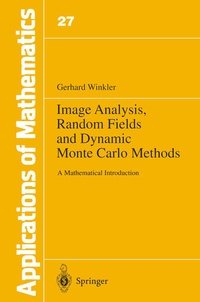
Image Analysis, Random Fields and Dynamic Monte Carlo Methods
A Mathematical Introduction
Published on 19. January 2012
Book
Paperback/Softback
XIV, 324 pages
978-3-642-97524-0 (ISBN)
Description
This text is concerned with a probabilistic approach to image analysis as initiated by U. GRENANDER, D. and S. GEMAN, B.R. HUNT and many others, and developed and popularized by D. and S. GEMAN in a paper from 1984. It formally adopts the Bayesian paradigm and therefore is referred to as 'Bayesian Image Analysis'. There has been considerable and still growing interest in prior models and, in particular, in discrete Markov random field methods. Whereas image analysis is replete with ad hoc techniques, Bayesian image analysis provides a general framework encompassing various problems from imaging. Among those are such 'classical' applications like restoration, edge detection, texture discrimination, motion analysis and tomographic reconstruction. The subject is rapidly developing and in the near future is likely to deal with high-level applications like object recognition. Fascinating experiments by Y. CHOW, U. GRENANDER and D.M. KEENAN (1987), (1990) strongly support this belief.
More details
Series
Edition
Softcover reprint of the original 1st ed. 1995
Language
English
Place of publication
Berlin
Germany
Publishing group
Springer Berlin
Target group
Professional and scholarly
Research
Illustrations
XIV, 324 p.
Dimensions
Height: 235 mm
Width: 155 mm
Thickness: 19 mm
Weight
517 gr
ISBN-13
978-3-642-97524-0 (9783642975240)
DOI
10.1007/978-3-642-97522-6
Schweitzer Classification
Other editions
Additional editions
Gerhard Winkler
Image Analysis, Random Fields and Dynamic Monte Carlo Methods
A Mathematical Introduction
Book
08/2000
Springer
€96.29
Article exhausted; check for reprint
Content
I. Bayesian Image Analysis: Introduction.- 1. The Bayesian Paradigm.- 2. Cleaning Dirty Pictures.- 3. Random Fields.- II. The Gibbs Sampler and Simulated Annealing.- 4. Markov Chains: Limit Theorems.- 5. Sampling and Annealing.- 6. Cooling Schedules.- 7. Sampling and Annealing Revisited.- III. More on Sampling and Annealing.- 8. Metropolis Algorithms.- 9. Alternative Approaches.- 10. Parallel Algorithms.- IV. Texture Analysis.- 11. Partitioning.- 12. Texture Models and Classification.- V. Parameter Estimation.- 13. Maximum Likelihood Estimators.- 14. Spacial ML Estimation.- VI. Supplement.- 15. A Glance at Neural Networks.- 16. Mixed Applications.- VII. Appendix.- A. Simulation of Random Variables.- B. The Perron-Frobenius Theorem.- C. Concave Functions.- D. A Global Convergence Theorem for Descent Algorithms.- References.