

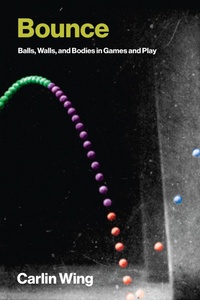
Bounce
Balls, Walls, and Bodies in Games and Play
Will be published approx. on 20. January 2026
Book
Paperback/Softback
316 pages
978-0-262-55321-6 (ISBN)
Description
A lively and insightful account that follows the bouncing ball through the history of nonelectronic and electronic games.
Bounce follows an array of bouncing balls through the histories of nonelectronic and electronic games, across the spectrum of play, game, and sport, and into the domains of physics, material science, animation, and computing. The book’s focus on bounce sidesteps the focus on play found in much of the game studies literature and broadens the scope of game history by spotlighting an interaction that is central to thousands of physical and digital games and sports.
The book is divided into three sections that introduce different kinds of bounce to address the matter of the ball, the virtuality of bounce, and bounded spectacle: Ricochet in ancient tennis is set against modern tennis’s true bounce; squash and stretch in animation serves as a mirror of the pings and pongs of computer bounce; and the bounce feel in Electronic Art’s FIFA video game series and pok ta pok of the Mesoamerican game ulama elaborate the contrasting positions of these two mythological games.
Bounce follows an array of bouncing balls through the histories of nonelectronic and electronic games, across the spectrum of play, game, and sport, and into the domains of physics, material science, animation, and computing. The book’s focus on bounce sidesteps the focus on play found in much of the game studies literature and broadens the scope of game history by spotlighting an interaction that is central to thousands of physical and digital games and sports.
The book is divided into three sections that introduce different kinds of bounce to address the matter of the ball, the virtuality of bounce, and bounded spectacle: Ricochet in ancient tennis is set against modern tennis’s true bounce; squash and stretch in animation serves as a mirror of the pings and pongs of computer bounce; and the bounce feel in Electronic Art’s FIFA video game series and pok ta pok of the Mesoamerican game ulama elaborate the contrasting positions of these two mythological games.
More details
Language
English
Place of publication
Cambridge (Massachusetts)
United States
Publishing group
MIT Press Ltd
Illustrations
87 BLACK AND WHITE ILLUS.
Dimensions
Height: 229 mm
Width: 154 mm
Thickness: 28 mm
Weight
444 gr
ISBN-13
978-0-262-55321-6 (9780262553216)
Copyright in bibliographic data and cover images is held by Nielsen Book Services Limited or by the publishers or by their respective licensors: all rights reserved.
Schweitzer Classification
Other editions
Additional editions
E-Book
01/2026
MIT Press
€63.49
Available for download
Person
Carlin Wing is Associate Professor of Media Studies at Scripps College. She is coeditor of The Techno-Galactic Guide to Software Observation and EA Sports FIFA: Feeling the Game.
Content
Introduction: Long Past Play
Part I: To
1 Regarding Ricochet: Modeling the World in a Closed Court
2 True Bounce: Tennis and Television in the Era of Vulcanized Play
Part II: &
3 Squash and Stretch: Animating Elastic Bounce
4 From Ping to PONG: Signal, Simulation, and Programmed Bounce
Part III: Fro
5 Bounce Feel: Playing FIFA Like a Girl
6 Pok ta Pok: The Return of Rubber Bounce
Conclusion: Bounce Break
Part I: To
1 Regarding Ricochet: Modeling the World in a Closed Court
2 True Bounce: Tennis and Television in the Era of Vulcanized Play
Part II: &
3 Squash and Stretch: Animating Elastic Bounce
4 From Ping to PONG: Signal, Simulation, and Programmed Bounce
Part III: Fro
5 Bounce Feel: Playing FIFA Like a Girl
6 Pok ta Pok: The Return of Rubber Bounce
Conclusion: Bounce Break