

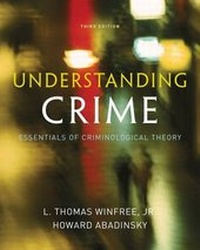
Understanding Crime
Essentials of Criminological Theory
3rd Edition
Published on 1. June 2009
Book
Paperback/Softback
480 pages
978-0-495-60083-1 (ISBN)
Description
This thought-provoking examination of crime and criminological theory takes a direct approach to a question that often confuses and frustrates students why do people commit crimes? Understanding Crime begins with an overview of the key elements of the study of crime and criminology, including law, public policy, research literature, and the philosophical origins of crime theories. These theories, based in biology, psychology, and sociology, are then broken down to their basic elements and causal processes in order to be explored. The authors examine the practical implications and applications each theory has on the administration of justice. In conclusion, the text looks at the future of crime theory by speculating whether or not new research designs, theories, and paradigms are needed. With a new modular format, this text can be customized for any teaching or learning style.
This thought-provoking examination of crime and criminological theory takes a direct approach to a question that often confuses and frustrates students why do people commit crimes? Understanding Crime begins with an overview of the key elements of the study of crime and criminology, including law, public policy, research literature, and the philosophical origins of crime theories. These theories, based in biology, psychology, and sociology, are then broken down to their basic elements and causal processes in order to be explored. The authors examine the practical implications and applications each theory has on the administration of justice. In conclusion, the text looks at the future of crime theory by speculating whether or not new research designs, theories, and paradigms are needed. With a new modular format, this text can be customized for any teaching or learning style.
This thought-provoking examination of crime and criminological theory takes a direct approach to a question that often confuses and frustrates students why do people commit crimes? Understanding Crime begins with an overview of the key elements of the study of crime and criminology, including law, public policy, research literature, and the philosophical origins of crime theories. These theories, based in biology, psychology, and sociology, are then broken down to their basic elements and causal processes in order to be explored. The authors examine the practical implications and applications each theory has on the administration of justice. In conclusion, the text looks at the future of crime theory by speculating whether or not new research designs, theories, and paradigms are needed. With a new modular format, this text can be customized for any teaching or learning style.
More details
Edition
3rd Revised edition
Language
English
Place of publication
Belmont, CA
United States
Publishing group
Cengage Learning, Inc
Target group
College/higher education
Edition type
Revised edition
Dimensions
Height: 246 mm
Width: 189 mm
Thickness: 20 mm
ISBN-13
978-0-495-60083-1 (9780495600831)
Copyright in bibliographic data and cover images is held by Nielsen Book Services Limited or by the publishers or by their respective licensors: all rights reserved.
Schweitzer Classification
Persons
L. Thomas Winfree, Jr., received his Ph.D. degree (sociology) from the University of Montana in 1976. Besides his current position as Professor of Criminal Justice at New Mexico State University, he has held academic appointments at the University of New Mexico, East Texas State University (now Texas A and M University, Commerce), and Louisiana State University. Winfree has authored or co-authored over 70 refereed journal articles, 20-plus book chapters, and numerous reports. He is co-author, with Howard Abadinsky, of UNDERSTANDING CRIME, Second Edition (Wadsworth, 2003). Included among Winfree's research interests are youth gangs, police socialization, and contemporary justice system responses to drug and alcohol problems. Howard Abadinsky is professor of criminal justice at St John's University. He served eight years as an inspector for the Cook County, Illinois, sheriff and 15 years as a New York state parole officer and senior parole officer. The founder of the International Association for the Study of Organized Crime, he also served as a consultant to the President's Commission on Organized Crime. He holds a B.A. from Queens College of the City University of New York, an M.S.W. from Fordham University, and a Ph.D. in sociology from New York University.
L. Thomas Winfree, Jr., received his Ph.D. degree (sociology) from the University of Montana in 1976. Besides his current position as Professor of Criminal Justice at New Mexico State University, he has held academic appointments at the University of New Mexico, East Texas State University (now Texas A and M University, Commerce), and Louisiana State University. Winfree has authored or co-authored over 70 refereed journal articles, 20-plus book chapters, and numerous reports. He is co-author, with Howard Abadinsky, of UNDERSTANDING CRIME, Second Edition (Wadsworth, 2003). Included among Winfree's research interests are youth gangs, police socialization, and contemporary justice system responses to drug and alcohol problems. Howard Abadinsky is professor of criminal justice at St John's University. He served eight years as an inspector for the Cook County, Illinois, sheriff and 15 years as a New York state parole officer and senior parole officer. The founder of the International Association for the Study of Organized Crime, he also served as a consultant to the President's Commission on Organized Crime. He holds a B.A. from Queens College of the City University of New York, an M.S.W. from Fordham University, and a Ph.D. in sociology from New York University.
L. Thomas Winfree, Jr., received his Ph.D. degree (sociology) from the University of Montana in 1976. Besides his current position as Professor of Criminal Justice at New Mexico State University, he has held academic appointments at the University of New Mexico, East Texas State University (now Texas A and M University, Commerce), and Louisiana State University. Winfree has authored or co-authored over 70 refereed journal articles, 20-plus book chapters, and numerous reports. He is co-author, with Howard Abadinsky, of UNDERSTANDING CRIME, Second Edition (Wadsworth, 2003). Included among Winfree's research interests are youth gangs, police socialization, and contemporary justice system responses to drug and alcohol problems. Howard Abadinsky is professor of criminal justice at St John's University. He served eight years as an inspector for the Cook County, Illinois, sheriff and 15 years as a New York state parole officer and senior parole officer. The founder of the International Association for the Study of Organized Crime, he also served as a consultant to the President's Commission on Organized Crime. He holds a B.A. from Queens College of the City University of New York, an M.S.W. from Fordham University, and a Ph.D. in sociology from New York University.
Content
1. Theory and the Study of Crime. 2. Deterrence and Opportunity Theories. 3. Biological and Biochemical Theories. 4. The Psychology of Crime I. 5. The Psychology of Crime II. 6. Social Organizational Theories. 7. Social Process Theories. 8. Labeling and Shaming Theories. 9. Conflict Theories. 10. Marxist and Critical Theories. 11. Gender, Race, and Crime Theories. 12. Extending the Boundaries of Crime Theory. References. Author Index. Subject Index.