

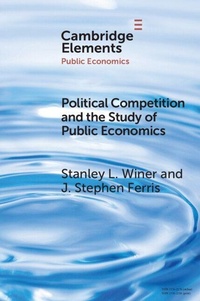
Political Competition and the Study of Public Economics
Published on 6. October 2022
Book
Paperback/Softback
94 pages
978-1-009-00169-4 (ISBN)
Description
Why is an understanding of political competition essential for the study of public economics and public policy generally? How can political competition be described and understood, and how does it differ from its strictly economic counterpart? What are the implications of the fact that policy proposals in a democracy must always pass a political test? What are the strengths and weaknesses of electoral competition as a mechanism for the allocation of economic resources? Why are tax structures in democratic polities so complicated, and what implications follow from this for normative views about good policy choice? How can the intensity of political competition be measured, why and how does it vary in mature democracies, and what are the consequences? This Element considers how answers to these questions can be approached, while also illustrating some of the interesting theoretical and empirical work that has been done on them.
More details
Series
Language
English
Place of publication
Cambridge
United Kingdom
Product notice
Paperback (trade)
Illustrations
Worked examples or Exercises
Dimensions
Height: 229 mm
Width: 152 mm
Thickness: 5 mm
Weight
136 gr
ISBN-13
978-1-009-00169-4 (9781009001694)
Copyright in bibliographic data and cover images is held by Nielsen Book Services Limited or by the publishers or by their respective licensors: all rights reserved.
Schweitzer Classification
Other editions
Additional editions
Stanley L. Winer | J. Stephen Ferris
Political Competition and the Study of Public Economics
E-Book
10/2022
Cambridge University Press
€20.99
Available for download
Stanley L. Winer | J. Stephen Ferris
Political Competition and the Study of Public Economics
E-Book
09/2022
Cambridge University Press
€20.99
Available for download
Persons
Content
1. Political economy in the study of public policy; 2. Thinking generally about economic and political competition; 3. Thinking generally about economic and political competition; 4. Electoral competition and economic welfare; 5. What can go wrong?; 6. Fiscal structure; 7. Political competitiveness; 8. In conclusion; References.