

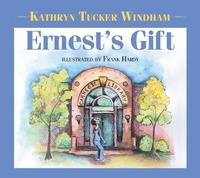
Ernest's Gift
Will be published approx. on 1. February 2004
Book
Hardback
20 pages
978-1-58838-149-1 (ISBN)
Description
A man's lifelong love of books and reading overcomes the hurt of a childhood humiliation in this touching true tale related by Alabama storyteller Kathryn Tucker Windham on the occasion of the Selma Public Library's 100th anniversary. As a child in the 1930s, Ernest Dawson loved books but was denied use of the library in segregated Selma. He grew up and became a teacher, and after segregation had ended, he left money in his will toward a children's wing of the Selma library so that children of all races could read and learn.
More details
Language
English
Place of publication
Athens
United States
Publishing group
University of Georgia Press
Target group
Children/juvenile
Interest Age: From 4 to 9 years
Dimensions
Height: 229 mm
Width: 203 mm
ISBN-13
978-1-58838-149-1 (9781588381491)
Copyright in bibliographic data and cover images is held by Nielsen Book Services Limited or by the publishers or by their respective licensors: all rights reserved.
Schweitzer Classification
Persons
Kathryn Tucker Windham (1918-2011) grew up in Thomasville, Alabama. She graduated from Huntingdon College in 1939, married Amasa Benjamin Windham in 1946, and had three children before being widowed in 1956. A newspaper reporter by profession, her career spanned four decades, beginning in the shadow of the Great Depression and continuing through the Civil Rights Movement, which she observed at ground level in her adopted home town of Selma. In the 1970s, she left journalism and worked as a coordinator for a federally funded agency for programs for the elderly. She continued to write, take photographs, and tell stories. The storytelling was an outgrowth of her 1969 book, 13 Alabama Ghosts and Jeffrey. More volumes of ghost stories, folklore, recipes, and essays followed; she has now published more than twenty books. Her reputation as a storyteller led to thirty-three appearances over an eighteen-month period on National Public Radio's All Things Considered, which introduced her to an even larger audience. She has written, produced, and acted in a one-woman play, My Name Is Julia, about pioneering social reformer Julia Tutwiler, has narrated several television documentaries, and is a regular interviewee for national and international journalists visiting Alabama in search of the Old or the New South. It is a testament to the good humor, keen intelligence, and life-long curiosity of one of the region's best known public citizens that she can guide visitors unerringly to either mythical place.