

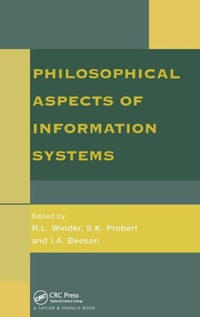
Philosophical Issues In Information Systems
1st Edition
Will be published approx. on 17. October 1997
Book
Hardback
272 pages
978-0-7484-0758-3 (ISBN)
Description
This ground-breaking book represents the work of a variety of researchers in information systems that share a common concern to use philosophical approaches to help solve problems in information systems. It brings together many of the leading researchers in the field and provides a broad-based range of chapters addressing key contemporary issues in the field. It looks at philosophical and social implications of the development of IS, relates these issues to the role IS plays in contemporary business and cultural theory, and discussed IS in a social and philosophical context, rather than simply as technology.
More details
Language
English
Place of publication
London
United Kingdom
Publishing group
Taylor & Francis Ltd
Target group
College/higher education
Professional and scholarly
Academic, Postgraduate, and Professional
Dimensions
Height: 240 mm
Width: 161 mm
Thickness: 19 mm
Weight
578 gr
ISBN-13
978-0-7484-0758-3 (9780748407583)
Copyright in bibliographic data and cover images is held by Nielsen Book Services Limited or by the publishers or by their respective licensors: all rights reserved.
Schweitzer Classification
Other editions
Additional editions
R. L. Winder | S. K. Probert | I. A. Beeson
Philosophical Issues In Information Systems
E-Book
11/2024
1st Edition
CRC Press
€73.99
Available for download
R. L. Winder | S. K. Probert | I. A. Beeson
Philosophical Issues In Information Systems
E-Book
11/2024
1st Edition
CRC Press
€73.99
Available for download
Persons
Content
Part 1 Ethical and political aspects: some philosophical and logical aspects of infomation systems, Fenton F. Robb; implications of regarding information as meaningful rather than factual, Norma Romm; the tool perspective on information system design - what Heidegger's philosophy can't do, Martin Spaul; thoughts towards a framework for critical practice, Anne Moggridge. Part 2 Language and meaning: patterns on glass - the language games of information, Jim Gilligan; the nature of information and its relationship to meaning, John Mingers; mapping information systems on to the real world, Frank Gregory; organic information for the organic organization? - an application of the work of Talcott Parsons to information systems, Richard Kamm. Part 3 Methodology: backing into philosophy via information systems, Brian Petheram; software engineering as a Kuhnian discipline, Paul Wernick and Russel Winder; the metaphysical assumptions of the main Soft Systems Methodology advocates, Stephen Probert; towards a paradigm of information systems, Marcus Lyncy. Part 4 Organizational aspects: sustainable information in community organizations, Nick Plant; a new philosophy, a new agenda - introducing information systems into complex organizations, Stuart Maguire; anthropological reflections on systems engineering - seeing is believing, George Bakehouse et al. Part 5 Physical aspects: evolution, emergence and synaesthesia, John Gammack and Carolyn Begg; the body in the information system, Ian Beeson.