

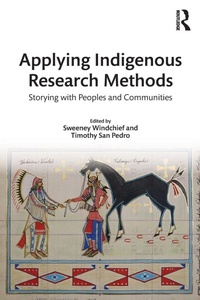
Applying Indigenous Research Methods
Storying with Peoples and Communities
1st Edition
Published on 16. January 2019
Book
Paperback/Softback
166 pages
978-1-138-04906-2 (ISBN)
Description
Applying Indigenous Research Methods focuses on the question of "How" Indigenous Research Methodologies (IRMs) can be used and taught across Indigenous studies and education.
In this collection, Indigenous scholars address the importance of IRMs in their own scholarship, while focusing conversations on the application with others. Each chapter is co-authored to model methods rooted in the sharing of stories to strengthen relationships, such as yarning, storywork, and others. The chapters offer a wealth of specific examples, as told by researchers about their research methods in conversation with other scholars, teachers, and community members.
Applying Indigenous Research Methods is an interdisciplinary showcase of the ways IRMs can enhance scholarship in fields including education, Indigenous studies, settler colonial studies, social work, qualitative methodologies, and beyond.
In this collection, Indigenous scholars address the importance of IRMs in their own scholarship, while focusing conversations on the application with others. Each chapter is co-authored to model methods rooted in the sharing of stories to strengthen relationships, such as yarning, storywork, and others. The chapters offer a wealth of specific examples, as told by researchers about their research methods in conversation with other scholars, teachers, and community members.
Applying Indigenous Research Methods is an interdisciplinary showcase of the ways IRMs can enhance scholarship in fields including education, Indigenous studies, settler colonial studies, social work, qualitative methodologies, and beyond.
More details
Series
Language
English
Place of publication
London
United Kingdom
Publishing group
Taylor & Francis Ltd
Target group
College/higher education
Professional and scholarly
Academic, Postgraduate, and Undergraduate Advanced
Illustrations
3 s/w Abbildungen
3 Illustrations, black and white
Dimensions
Height: 229 mm
Width: 152 mm
Thickness: 11 mm
Weight
293 gr
ISBN-13
978-1-138-04906-2 (9781138049062)
Copyright in bibliographic data and cover images is held by Nielsen Book Services Limited or by the publishers or by their respective licensors: all rights reserved.
Schweitzer Classification
Other editions
Additional editions
Sweeney Windchief | Timothy San Pedro
Applying Indigenous Research Methods
Storying with Peoples and Communities
Book
01/2019
1st Edition
Routledge
€207.30
Shipment within 10-20 days
Sweeney Windchief | Timothy San Pedro
Applying Indigenous Research Methods
Storying with Peoples and Communities
E-Book
01/2019
1st Edition
Routledge
€59.49
Available for download
Sweeney Windchief | Timothy San Pedro
Applying Indigenous Research Methods
Storying with Peoples and Communities
E-Book
01/2019
1st Edition
Routledge
€59.49
Available for download
Persons
Sweeney Windchief is a member of the Fort Peck Tribes (Assiniboine) in Montana and is an Assistant Professor of Adult and Higher Education at Montana State University, USA.
Timothy San Pedro is Filipino-American and grew up on the Flathead Indian Reservation in Western Montana. He is an Assistant Professor of Multicultural and Equity Studies in Education at The Ohio State University, USA.
Timothy San Pedro is Filipino-American and grew up on the Flathead Indian Reservation in Western Montana. He is an Assistant Professor of Multicultural and Equity Studies in Education at The Ohio State University, USA.
Content
PART I Palm Upwards: "Reaching Back to Receive Lessons" 1 Hands Back, Hands Forward for Indigenous Storywork as Methodology Jo-ann Archibald Q'um Q'um Xiiem [Sto:lo- and St'at'imc] and Amy Parent Nox Ayaaw? ilt [Nisga'a] 2 Community Relationships within Indigenous Methodologies Elizabeth Fast [Metis/Mennonite] and Margaret Kovach [Plains Cree/Saulteaux/member of Treaty Four in southern Saskatchewan] 3 K'e and Tdayp-tday-gaw: Embodying Indigenous Relationality in Research Methods Leola Roberta Rainbow Tsinnajinnie [Dine/Filipina and accepted into Santa Ana Pueblo], Robin Starr Zape-tah-hol-ah Minthorn [Kiowa/Apache/Umatilla/Nez Perce/Assiniboine], and Tiffany S. Lee [Dibe Lizhini Dine/Oglala Lakota] PART II Palm Downwards: "The Challenge and Opportunity to Live These Teachings" 4 Enacting Indigenous Research Methods: Centering Dine Epistemology to Guide the Process Valerie J. Shirley [Dine] and Deidra Angulo [Dine] 5 Research Before and After the Academy: Learning Participatory Indigenous Methods Sandi Wemigwase [Waganakising Odawa] and Eve Tuck [Unangax] 6 Indigenous Methodologies in Graduate School: Accountability, Relationships, and Tensions Daniel Piper [White], Jacob Jacobe [White], Rose Yazzie [Dine], and Dolores Calderon [Tigua/Mexican] PART III Palms Joined: "Responsibility to Pass Those Teachings to Others" 7 Indigenous Teachers: At the Cross-Roads of Applying Indigenous Research Methodologies Jeremy Garcia [Hopi/Tewa], Samuel Tenakhongva [Hopi], and Bryant Honyouti [Hopi] 8 Re-centering Tribally-Specific Research Methodologies within Dominant Academic Systems Michael M. Munson [Selis, Ql?ispe, and non-Native ancestries] and Timothy San Pedro 9 Mo?olelo: Continuity, Stories, and Research in Hawai?i Sunnie Kaikala Ma-kua ['O - iwi Hawai'i], Manulani Aluli Meyer ['O - iwi Hawai'i], and Lynette Lokelani Wakinekona ['O - iwi Hawai'i] Afterword: To Be an Indigenous Scholar Cornel Pewewardy [Comanche-Kiowa] List of Contributors