

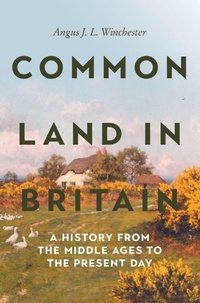
Common Land in Britain
A History from the Middle Ages to the Present Day
Published on 27. September 2022
Book
Hardback
330 pages
978-1-78327-743-8 (ISBN)
Description
The first authoritative survey of the history of common land in Great Britain from the medieval period to present day.
More than a million hectares of Britain has the status of common land, most of it consisting of semi-natural environments of mountain, moorland, wetland or heath. Formerly much more extensive, common land was, and in many places remains, an integral part of the pastoral economy. Even where it is no longer used by farmers, it plays an increasingly important role in modern life, as recreational space and for its value for nature conservation.
This book provides for the first time an authoritative survey of the history of common land across all three nations of Great Britain from medieval times to the present day. It charts how commons have been viewed and valued across the centuries, how they have been used, and how their vegetation has changed, highlighting parallels and differences between the histories of common land in England, Scotland and Wales.
It traces the distinctive legal status of common land and the management regimes which regulated the exercise of common rights; considers the role of commons as spaces for communal gatherings and as a resource for the poor; charts the loss of common land (but also its persistence) during the era of enclosure in the century 1760-1860; and explores the changing conceptions of the value and right use of commons since the nineteenth century, and the impact this has had on their ecological character. Eight case studies of individual commons illustrate the richness of common landscapes and their history at local level. They include crofters' common grazings in Sutherland, mountain commons in the Lake District and Snowdonia, lowland commons in Co. Durham, Herefordshire and the New Forest, turbary allotments in Lincolnshire, and the urban commons of Wimbledon and Putney Heath.
More than a million hectares of Britain has the status of common land, most of it consisting of semi-natural environments of mountain, moorland, wetland or heath. Formerly much more extensive, common land was, and in many places remains, an integral part of the pastoral economy. Even where it is no longer used by farmers, it plays an increasingly important role in modern life, as recreational space and for its value for nature conservation.
This book provides for the first time an authoritative survey of the history of common land across all three nations of Great Britain from medieval times to the present day. It charts how commons have been viewed and valued across the centuries, how they have been used, and how their vegetation has changed, highlighting parallels and differences between the histories of common land in England, Scotland and Wales.
It traces the distinctive legal status of common land and the management regimes which regulated the exercise of common rights; considers the role of commons as spaces for communal gatherings and as a resource for the poor; charts the loss of common land (but also its persistence) during the era of enclosure in the century 1760-1860; and explores the changing conceptions of the value and right use of commons since the nineteenth century, and the impact this has had on their ecological character. Eight case studies of individual commons illustrate the richness of common landscapes and their history at local level. They include crofters' common grazings in Sutherland, mountain commons in the Lake District and Snowdonia, lowland commons in Co. Durham, Herefordshire and the New Forest, turbary allotments in Lincolnshire, and the urban commons of Wimbledon and Putney Heath.
Reviews / Votes
Good maps and figures accompany each [case study], and Winchester's background as an historical geographer is evident throughout the book in the well-thought-out illustrative material. Also to be commended are the excellent footnotes, which together with the Select Bibliography flag myriad place-specific studies. A marvellous study. -- Paul Stamper, University of Leicester * Landscapes * Winchester captures what we know of the origins of this much misunderstood but cherished category of land and then proceeds to chart people's interaction with it over several centuries. Winchester draws on his own expertise and the work of others to document a rich history. The book is beautifully illustrated with maps, photographs, and archival sources. Winchester reminds us that common land has always and will continue to mean different things to different people. -- Frances Kerner * Open Space * The author deserves much credit, however, for his skilful navigation of a subject which aroused passions and provoked controversy in the past and still does. This is an important book. * THE LOCAL HISTORIAN * It stands alone as a singularly ambitious and impressive study, more detailed and comprehensive and wider ranging than anything that has come before. By combining an unrivalled range of material from the middle ages to the present and by offering a close, generous reading of existing work on British commons [...].Winchester's book will be the go-to reference for all those interested in every facet of common land. * AGRICULTURAL HISTORY REVIEW * An incomparable guide to what commons have been for people in the island of Britain, to why they should be of interest to all kinds of historians, and why they have always lain (and still lie) close the heart of British life. * HISTORIA AGRARIA * It adopts a comprehensive view, recognising that the concept of common land extends beyond shared usage. The chosen case studies highlight that a diverse range of landscapes held historical significance, going beyond the stereotypical British landscape. * LANDSCAPE HISTORY *More details
Series
Language
English
Place of publication
Woodbridge
United Kingdom
Publishing group
Boydell & Brewer Ltd
Target group
Professional and scholarly
Product notice
Cloth over boards
Illustrations
19 Karten
19 Maps
Dimensions
Height: 250 mm
Width: 175 mm
Thickness: 22 mm
Weight
750 gr
ISBN-13
978-1-78327-743-8 (9781783277438)
Copyright in bibliographic data and cover images is held by Nielsen Book Services Limited or by the publishers or by their respective licensors: all rights reserved.
Schweitzer Classification
Other editions
Additional editions
Book
04/2024
Boydell Press
€37.80
Shipment within 3-4 weeks
E-Book
09/2022
1st Edition
Boydell & Brewer Ltd
€48.99
Available for download
E-Book
09/2022
1st Edition
De Gruyter
€48.99
Available for download
Person
ANGUS WINCHESTER is Emeritus Professor of Local and Landscape History at Lancaster University. His interests in common land have developed over many years, arising originally out of research into the history of upland landscapes in northern England. He was also, the first Director of VCH Cumbria until his retirement from Lancaster University in 2016.
Content
List of Illustrations
Acknowledgements
List of Abbreviations
Introduction
Part I. Common Threads
1. Commons in the British Landscape
2. Custom and Law: The Genesis of Common Land
3. Managing Communal Resources
4. Commons as Communal Spaces
5. Living on the Edge: Commons and the Poor
6. The Age of 'Improvement': Privatisation and the Reconfiguration of Common Land
7. The Commons Reinvented
8. The Changing Face of Common Land since 1860
Part II. A Kaleidoscope of Common Landscapes: Eight Case Studies9. North Assynt Common Grazings, Sutherland
10. Nether Wasdale Common, Cumberland
11. Cockfield Fell, Co. Durham
12. Isle of Axholme Turbary Allotments, Lincolnshire
13. Llanllechid Mountain and Aber Mountain, Caernarvonshire
14. Bringsty Common and Bromyard Downs, Herefordshire
15. Ibsley Common and Rockford Common, New Forest, Hampshire
16. Wimbledon Common and Putney Heath, Surrey
Conclusion: Common Ground
Select Bibliography
Index
Acknowledgements
List of Abbreviations
Introduction
Part I. Common Threads
1. Commons in the British Landscape
2. Custom and Law: The Genesis of Common Land
3. Managing Communal Resources
4. Commons as Communal Spaces
5. Living on the Edge: Commons and the Poor
6. The Age of 'Improvement': Privatisation and the Reconfiguration of Common Land
7. The Commons Reinvented
8. The Changing Face of Common Land since 1860
Part II. A Kaleidoscope of Common Landscapes: Eight Case Studies9. North Assynt Common Grazings, Sutherland
10. Nether Wasdale Common, Cumberland
11. Cockfield Fell, Co. Durham
12. Isle of Axholme Turbary Allotments, Lincolnshire
13. Llanllechid Mountain and Aber Mountain, Caernarvonshire
14. Bringsty Common and Bromyard Downs, Herefordshire
15. Ibsley Common and Rockford Common, New Forest, Hampshire
16. Wimbledon Common and Putney Heath, Surrey
Conclusion: Common Ground
Select Bibliography
Index