

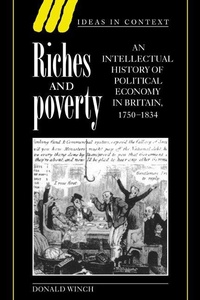
Riches and Poverty
An Intellectual History of Political Economy in Britain, 1750-1834
Published on 26. January 1996
Book
Paperback/Softback
444 pages
978-0-521-55920-1 (ISBN)
Description
In Riches and Poverty, Donald Winch explores the implications of a fundamental and influential idea in political economy. Adam Smith's science of the legislator provided a key to studying the rich and poor in commercial societies, transformed an ancient debate on luxury and inequality, and furnished a basis for assessing the American and French revolutions. Against this background, Britain embarked on its career as the first manufacturing nation, and Malthus made his first contributions to a debate which concluded with the Poor Law Amendment Act of 1834. Malthus provoked fierce opposition from the Lake poets, opening an intellectual rift that persisted throughout the nineteenth century and continues to influence our perceptions of cultural history. Donald Winch has written a compelling and consistently-argued narrative of these developments, which emphasises throughout the moral and political bearings of economic ideas.
Reviews / Votes
'Riches and Poverty is a powerful, innovative and magesterial survey. Large swathes of it are virtually definitive.' Boyd Hilton, The Times Higher Education SupplementMore details
Series
Language
English
Place of publication
Cambridge
United Kingdom
Target group
Professional and scholarly
Product notice
Paperback (trade)
Illustrations
1 Plates, color; 3 Halftones, unspecified
Dimensions
Height: 229 mm
Width: 152 mm
Thickness: 27 mm
Weight
716 gr
ISBN-13
978-0-521-55920-1 (9780521559201)
Copyright in bibliographic data and cover images is held by Nielsen Book Services Limited or by the publishers or by their respective licensors: all rights reserved.
Schweitzer Classification
Other editions
Additional editions
Book
01/1996
Cambridge University Press
€65.11
Article exhausted; check for reprint
Previous edition
Book
01/1996
Cambridge University Press
€65.11
Article exhausted; check for reprint
Person
Content
1. After Adam Smith: prologue; Part I. Adam Smith's Science of the Legislator: 2. An excessive solicitude for posthumous reputation; 3. The secret concatenation; 4. The wisdom of Solomon; Part II. Adam Smith, Edmund Burke, and Factious Citizens: 5. Contested affinities; 6. The loss of regal government; 7. Burke's creed: politics, chivalry, and superstition; 8. The labouring poor; Part III. Robert Malthus as Political Moralist: 9. Imminence and immediacy: initial bearings; 10. New and extraordinary lights; 11. Rather a matter of feeling than argument; 12. A manufacturing animal: things not persons?; 13. The bountiful gift of providence; 14. Last things and other legacies; Part IV: 15. Epilogue.