

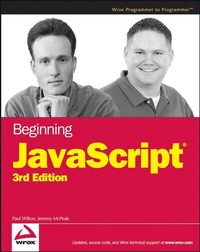
Beginning JavaScript
3rd Edition
Published on 18. May 2007
Book
Paperback/Softback
792 pages
978-0-470-05151-1 (ISBN)
Description
Do you want to create more exciting web applications that will increase visits to your site? With this up-to-date guide, you'll find everything you'll need to know to develop interactive, robust, and personalized pages using JavaScript. It takes you step by step through this powerful scripting language so you can begin enhancing your site right away.
You'll begin with the basic syntax and learn how to take advantage of native JavaScript objects. Next, you'll see how to manipulate objects that are available to you in the latest browsers. You'll then progress through more advanced topics, such as using cookies and jazzing up your web pages with Dynamic HTML.
Inside, you'll also discover how to use Ajax, a communication technique that uses JavaScript to communicate with a remote web server. All of this will help you build truly professional-looking applications that allow you to interact with the user.
What you will learn from this book
* How to use objects such as dates and strings to manage complex data and simplify your programs
*
Tips for using forms, windows, and other controls
*
Ways to spot common syntax and logical errors as well as how to use the Microsoft(r) Script Debugger
*
How to make JavaScript interact with XML and HTML
*
Techniques for integrating ActiveX(r) and plug-ins with JavaScript
*
Steps for communicating with a server using remote scripting
Who this book is for
This book is for anyone who wants to learn JavaScript scripting. You should have some understanding of HTML and how to create static web pages, but no prior programming experience is necessary.
Wrox Beginning guides are crafted to make learning programming languages and technologies easier than you think, providing a structured tutorial format that will guide you through all the techniques involved.
You'll begin with the basic syntax and learn how to take advantage of native JavaScript objects. Next, you'll see how to manipulate objects that are available to you in the latest browsers. You'll then progress through more advanced topics, such as using cookies and jazzing up your web pages with Dynamic HTML.
Inside, you'll also discover how to use Ajax, a communication technique that uses JavaScript to communicate with a remote web server. All of this will help you build truly professional-looking applications that allow you to interact with the user.
What you will learn from this book
* How to use objects such as dates and strings to manage complex data and simplify your programs
*
Tips for using forms, windows, and other controls
*
Ways to spot common syntax and logical errors as well as how to use the Microsoft(r) Script Debugger
*
How to make JavaScript interact with XML and HTML
*
Techniques for integrating ActiveX(r) and plug-ins with JavaScript
*
Steps for communicating with a server using remote scripting
Who this book is for
This book is for anyone who wants to learn JavaScript scripting. You should have some understanding of HTML and how to create static web pages, but no prior programming experience is necessary.
Wrox Beginning guides are crafted to make learning programming languages and technologies easier than you think, providing a structured tutorial format that will guide you through all the techniques involved.
More details
Edition
3., Auflage
Language
English
Place of publication
Chichester
United Kingdom
Publishing group
John Wiley and Sons Ltd
Target group
Professional and scholarly
Edition type
Revised edition
Illustrations
ill
Dimensions
Height: 23.3 cm
Width: 18.7 cm
Thickness: 41 mm
Weight
1088 gr
ISBN-13
978-0-470-05151-1 (9780470051511)
Schweitzer Classification
Other editions
New editions
Paul Wilton | Jeremy McPeak
Beginning JavaScript
Book
10/2009
4th Edition
Wrox Press
€38.90
Article exhausted; check for reprint
Previous edition

Paul Wilton
Beginning JavaScript
Book
05/2004
2nd Edition
Hungry Minds Inc,U.S.
€42.90
Article exhausted; check for reprint
Persons
Paul Wilton started as a Visual Bacic applications programmer at the Ministry of Defense in the UK, then found himself pulled into the Net. Having joined an Intermet development company, he spent three years helping create Internet solutions. He's now running his own successful and rapidly growing company developing online holiday property reservation systems.
Jeremy McPeak began tinkering with web development as a hobby in 1998. Currently working in IT department of a school district, Jeremy has experience developing web solutions with JavaScript, PHP, and C#. He has written several online articles covering topics such as XSLT, WebForms, and C#. He is also co-author of Professional Ajax.
Jeremy McPeak began tinkering with web development as a hobby in 1998. Currently working in IT department of a school district, Jeremy has experience developing web solutions with JavaScript, PHP, and C#. He has written several online articles covering topics such as XSLT, WebForms, and C#. He is also co-author of Professional Ajax.
Content
Acknowledgments.
Introduction.
Chapter 1: Introduction to JavaScript and the Web.
Chapter 2: Data Types and Variables.
Chapter 3: Decisions, Loops, and Functions.
Chapter 4: JavaScript--An Object-Based Language.
Chapter 5: Programming the Browser.
Chapter 6: HTML Forms--Interacting with the User.
Chapter 7: Windows and Frames.
Chapter 8: String Manipulation.
Chapter 9: Date, Time, and Timers.
Chapter 10: Common Mistakes, Debugging, and Error Handling.
Chapter 11: Storing Information: Cookies.
Chapter 12: Introduction to Dynamic HTML.
Chapter 13: Dynamic HTML in Modern Browsers.
Chapter 14: JavaScript and XML.
Chapter 15: Using ActiveX and Plug-Ins with JavaScript.
Chapter 16: Ajax and Remote Scripting.
Appendix A. Exercise Solutions.
Index.
Introduction.
Chapter 1: Introduction to JavaScript and the Web.
Chapter 2: Data Types and Variables.
Chapter 3: Decisions, Loops, and Functions.
Chapter 4: JavaScript--An Object-Based Language.
Chapter 5: Programming the Browser.
Chapter 6: HTML Forms--Interacting with the User.
Chapter 7: Windows and Frames.
Chapter 8: String Manipulation.
Chapter 9: Date, Time, and Timers.
Chapter 10: Common Mistakes, Debugging, and Error Handling.
Chapter 11: Storing Information: Cookies.
Chapter 12: Introduction to Dynamic HTML.
Chapter 13: Dynamic HTML in Modern Browsers.
Chapter 14: JavaScript and XML.
Chapter 15: Using ActiveX and Plug-Ins with JavaScript.
Chapter 16: Ajax and Remote Scripting.
Appendix A. Exercise Solutions.
Index.