

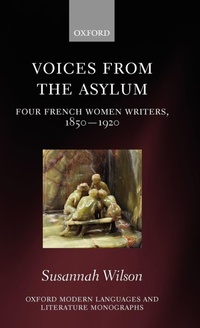
Voices from the Asylum
Four French Women Writers, 1850-1920
Published on 21. October 2010
Book
Hardback
272 pages
978-0-19-957935-8 (ISBN)
Description
Voices from the Asylum is a fascinating investigation of the lives of four women incarcerated in French psychiatric hospitals in the second half of the nineteenth century. The renowned sculptor (and mistress of Rodin) Camille Claudel, the musician Hersilie Rouy, the feminist activist Marie Esquiron, and the self-proclaimed mystic and eccentric Pauline Lair Lamotte, all left first-hand accounts of their experiences. These rare and unsettling documents provide the foundation for a unique insight into the experience of psychiatric breakdown and treatment from the patient's viewpoint.
By linking the question of gender to the process of medical diagnosis made by contemporary clinicians such as Sigmund Freud, this book argues that psychiatric medicine functioned as an integral part of an essentially misogynistic and oppressive society. Wilson suggests that "delusional" utterances can be read as meaningful when read as metaphorical expressions of real suffering, and as strategies to ensure the survival of a self under threat. These narratives therefore constituted an act of resistance on the part of the women who wrote them, and they prefigure the feminist revisionist histories of psychiatry that appeared later in the twentieth century.
Straddling the disciplines of literature and social history, and based on extensive archival research, this book makes an important contribution to the feminist project of writing women back into literary history. It brings to light a remarkable but hitherto unrecognised literary tradition in the prehistory of psychoanalysis: the psychiatric memoir.
By linking the question of gender to the process of medical diagnosis made by contemporary clinicians such as Sigmund Freud, this book argues that psychiatric medicine functioned as an integral part of an essentially misogynistic and oppressive society. Wilson suggests that "delusional" utterances can be read as meaningful when read as metaphorical expressions of real suffering, and as strategies to ensure the survival of a self under threat. These narratives therefore constituted an act of resistance on the part of the women who wrote them, and they prefigure the feminist revisionist histories of psychiatry that appeared later in the twentieth century.
Straddling the disciplines of literature and social history, and based on extensive archival research, this book makes an important contribution to the feminist project of writing women back into literary history. It brings to light a remarkable but hitherto unrecognised literary tradition in the prehistory of psychoanalysis: the psychiatric memoir.
Reviews / Votes
her vast knowledge of the contemporary judicial system helps to contextualize them for the uninitiated reader. * Kathy Comfort, French Review *More details
Series
Language
English
Place of publication
Oxford
United Kingdom
Target group
College/higher education
Professional and scholarly
Dimensions
Height: 222 mm
Width: 145 mm
Thickness: 19 mm
Weight
502 gr
ISBN-13
978-0-19-957935-8 (9780199579358)
Copyright in bibliographic data and cover images is held by Nielsen Book Services Limited or by the publishers or by their respective licensors: all rights reserved.
Schweitzer Classification
Person
Susannah Wilson is a scholar of nineteenth- and early twentieth-century French culture and literature, with a specialist interest in women's writing; psychoanalytical theory; the history of psychiatry in France; social history; and 'self-writing' (autobiography, memoir, correspondence). She studied for a BA (Hons) in French Studies and a Masters degree at the University of Manchester, and completed her D.Phil. in French at Jesus College, Oxford, in 2005.
Content
LIST OF ABBREVIATIONS ; NOTE ON PRESENTATION ; INTRODUCTION ; 1. Women's writing and women's incarceration: historical and theoretical approaches ; 2. Memoires d'une alienee by Hersilie Rouy: 'Ou est la folie la-dedans?' ; 3. Marie Esquiron: 'Ma triste et injuste sequestration' ; 4. Pauline Lair Lamotte: 'Je sens que la verite est la' ; 5. Camille Claudel: 'Du reve que fut ma vie, ceci est le cauchemar' ; CONCLUSION ; BIBLIOGRAPHY ; INDEX