

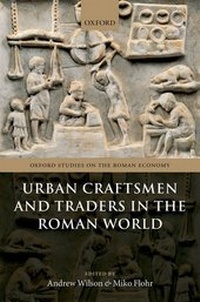
Urban Craftsmen and Traders in the Roman World
Published on 11. February 2016
Book
Hardback
426 pages
978-0-19-874848-9 (ISBN)
Description
This volume, featuring sixteen contributions from leading Roman historians and archaeologists, sheds new light on approaches to the economic history of urban craftsmen and traders in the Roman world, with a particular emphasis on the imperial period. Combining a wide range of research traditions from all over Europe and utilizing evidence from Italy, the western provinces, and the Greek-speaking east, this edited collection is divided into four sections. It first considers the scholarly history of Roman crafts and trade in the nineteenth and twentieth centuries, focusing on Germany and the Anglo-Saxon world, and on Italy and France. Chapters discuss how scholarly thinking about Roman craftsmen and traders was influenced by historical and intellectual developments in the modern world, and how different (national) research traditions followed different trajectories throughout the nineteenth and twentieth centuries. The second section highlights the economic strategies of craftsmen and traders, examining strategies of long-distance traders and the phenomenon of specialization, and presenting case studies of leather-working and bread-baking. In the third section, the human factor in urban crafts and trade-including the role of apprenticeship, gender, freedmen, and professional associations-is analysed, and the volume ends by exploring the position of crafts in urban space, considering the evidence for artisanal clustering in the archaeological and papyrological record, and providing case studies of the development of commercial landscapes at Aquincum on the Danube and at Sagalassos in Pisidia.
Reviews / Votes
This volume is itself a rich emporium with many expert shopkeepers manning individual tabernae organized into easily navigated rows. ... The broad methodological and interdisciplinary approaches highlighted in this volume make it a welcome addition to the growing number of works on the Roman economy. * Sarah E. Bond, Bryn Mawr Classical Review * As one would expect, the text is largely clean and replete with illustrations and photographs. This is a well-organized and impressive volume, representing an important contribution to the study of craftsmen and traders in the Roman Empire and the ancient economy generally. * Matt Gibbs (University of Winnipeg), The Journal of Roman Studies Vol.107 * make[s] some very useful contributions to the field. * Dominic Rathbone, Classics for All * Altogether, the volume offers excellent contributions of social-economic history. * Patrick Reinard, Sehepunkte * Urban Craftsmen and Traders in the Roman World ... is an important contribution to the history of crafts and trade in the Roman world. * Sergiu Musteata, Ancient History and Archaeology * Urban craftsmen and traders in the Roman world must be counted a valuable contribution to Roman economic history. * Kasey Reed, Tijdschrift voor Geschiedenis *More details
Other editions
Additional editions

Andrew Wilson | Miko Flohr
Urban Craftsmen and Traders in the Roman World
Book
06/2020
Oxford University Press
€46.00
Shipment within 15-20 days
Andrew Wilson | Miko Flohr
Urban Craftsmen and Traders in the Roman World
E-Book
02/2016
1st Edition
OUP eBook
€21.99
Available for download
Persons
Andrew Wilson is Professor of the Archaeology of the Roman Empire at the University of Oxford.
Miko Flohr is a postdoctoral researcher in the Institute for History at Leiden University.
Miko Flohr is a postdoctoral researcher in the Institute for History at Leiden University.
Content
PART I: APPROACHES; PART II: STRATEGIES; PART III: PEOPLE; PART IV: SPACE