

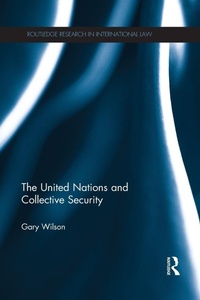
The United Nations and Collective Security
1st Edition
Published on 3. March 2016
Book
Paperback/Softback
280 pages
978-1-138-66552-1 (ISBN)
Description
The role of the United Nations in collective security has been evolving since its inception in 1945. This book explores collective security as practiced within the legal framework provided by the United Nations Charter, with a particular focus upon activity undertaken under the auspices of the UN Security Council, the body conferred by the Charter with the primary responsibility for the maintenance of international peace and security. Although the book is primarily grounded in international law, where appropriate it also draws upon relevant political insights in order to present a clear picture of the UN collective security system in operation and the factors which impact upon the way in which it functions.
Offering a comprehensive analysis it considers the full range of measures which can be utilised by the UN in the performance of its collective security remit including military enforcement action, peacekeeping, non-military sanctions and diplomacy. The book considers each of these measures in detail, assessing the legal framework applicable to the form of action, the main legal controversies which arise in respect of their appropriate utilisation, and the UN's use of this collective security 'tool' in practice. The book draws conclusions about the main strengths and shortcomings of the various means through which the UN can attempt to prevent, minimise or end conflict.
Offering a comprehensive analysis it considers the full range of measures which can be utilised by the UN in the performance of its collective security remit including military enforcement action, peacekeeping, non-military sanctions and diplomacy. The book considers each of these measures in detail, assessing the legal framework applicable to the form of action, the main legal controversies which arise in respect of their appropriate utilisation, and the UN's use of this collective security 'tool' in practice. The book draws conclusions about the main strengths and shortcomings of the various means through which the UN can attempt to prevent, minimise or end conflict.
More details
Series
Language
English
Place of publication
London
United Kingdom
Publishing group
Taylor & Francis Ltd
Target group
College/higher education
Dimensions
Height: 234 mm
Width: 156 mm
Thickness: 14 mm
Weight
406 gr
ISBN-13
978-1-138-66552-1 (9781138665521)
Copyright in bibliographic data and cover images is held by Nielsen Book Services Limited or by the publishers or by their respective licensors: all rights reserved.
Schweitzer Classification
Other editions
New editions
Gary Wilson
The United Nations and Collective Security
Book
06/2026
2nd Edition
Routledge
€50.00
Shipment within 10-20 days
Additional editions
Gary Wilson
The United Nations and Collective Security
E-Book
02/2014
1st Edition
Routledge
€69.99
Available for download
Gary Wilson
The United Nations and Collective Security
E-Book
02/2014
1st Edition
Routledge
€69.99
Available for download
Gary Wilson
The United Nations and Collective Security
Book
01/2014
1st Edition
Routledge
€231.80
Shipment within 15-20 days
Person
Gary Wilson is Senior Lecturer in Law at Liverpool John Moores University. His main research interests concern collective security, the use of force, and issues of statehood and self-determination.
Content
Introduction 1. The Concept of Collective Security 2. The UN Charter's System of Collective Security 3. A Brief Overview of Key Events of the UN Era 4. Diplomatic Responses to Security Threats 5. The Use of Non-Military Sanctions 6. Peacekeeping 7. Military Enforcement Action 8. The Role of Regional Arrangements Within The UN Collective Security System Conclusions