


The Triumph of Improvisation
Gorbachev's Adaptability, Reagan's Engagement, and the End of the Cold War
Published on 15. February 2014
Book
Hardback
280 pages
978-0-8014-5229-1 (ISBN)
Description
In The Triumph of Improvisation, James Graham Wilson takes a long view of the end of the Cold War, from the Soviet invasion of Afghanistan in December 1979 to Operation Desert Storm in January 1991. Drawing on deep archival research and recently declassified papers, Wilson argues that adaptation, improvisation, and engagement by individuals in positions of power ended the specter of a nuclear holocaust. Amid ambivalence and uncertainty, Mikhail Gorbachev, Ronald Reagan, George Shultz, and George H. W. Bush-and a host of other actors-engaged with adversaries and adapted to a rapidly changing international environment and information age in which global capitalism recovered as command economies failed.
Eschewing the notion of a coherent grand strategy to end the Cold War, Wilson paints a vivid portrait of how leaders made choices; some made poor choices while others reacted prudently, imaginatively, and courageously to events they did not foresee. A book about the burdens of responsibility, the obstacles of domestic politics, and the human qualities of leadership, The Triumph of Improvisation concludes with a chapter describing how George H. W. Bush oversaw the construction of a new configuration of power after the fall of the Berlin Wall, one that resolved the fundamental components of the Cold War on Washington's terms.
Eschewing the notion of a coherent grand strategy to end the Cold War, Wilson paints a vivid portrait of how leaders made choices; some made poor choices while others reacted prudently, imaginatively, and courageously to events they did not foresee. A book about the burdens of responsibility, the obstacles of domestic politics, and the human qualities of leadership, The Triumph of Improvisation concludes with a chapter describing how George H. W. Bush oversaw the construction of a new configuration of power after the fall of the Berlin Wall, one that resolved the fundamental components of the Cold War on Washington's terms.
Reviews / Votes
If John Kerry ever gets to spend a day back home, the US secretary of state might wish to meet James Graham Wilson, a young scholar in his department's Office of the Historian. Wilson's recent book, The Triumph of Improvisation, offers a fresh and valuable look at the end of the cold war.- Robert Zoellick (The Financial Times) Overall, The Triumph of Improvisation is a solid account of the culmination of the Cold War.... It is a well-researched and well-written piece that gives a solid account of the decisions and actions that led to the end of the decades-long conflict. Wilson's emphasis on the contributions of so many players and their willingness to try unconventional means make this book a worthwhile read, as many of these topics have not recieved the attention that they deserve.
- Chris Booth (H-War) Wilson focuses on a quartet of actors, including George Shultz and George H. W. Bush along with Reagan and Gorbachev. His compact narrative-just 204 pages of text-proceeds in disciplined chronological order, which restrains the sort of sweeping and dubious generalizations that often mar other treatments of the Cold War's last decade.
- Steven F. Hayward (National Review) Wilson's real contribution, and the part that scholars of this period will find most interesting, is his coverage of Reagan and Schultz. White House policy making during the Reagan years can be a difficult and puzzling process for historians to describe, but Wilson accomplishes it with grace and impressive analysis as he chronicles the shift from confrontation to cooperation with the Soviet Union. This is an excellent book with the broad goal of explaining the end of the Cold War based on the actions of individual leaders. Wilson's lively prose and clear analysis of superpower relations will appeal to the general reader, and the illuminating sections on Reagan and Schultz will be of special interest to Cold War scholars.
- Christopher Maynard (Journal of American History) What is surprising is his thesis, which is original in its approach, that these men brought an end to the great Soviet-American rivalry through unscripted actions. In this and in other ways, including its provocative argument, The Triumph of Improvisation is a useful and welcome addition to the literature on the subject.
- Joseph M. Siracusa (American Historical Review)
More details
Language
English
Place of publication
Ithaca
United States
Product notice
Paper over boards
Illustrations
10 halftones - 10 Halftones, black and white
Dimensions
Height: 235 mm
Width: 155 mm
Thickness: 25 mm
Weight
907 gr
ISBN-13
978-0-8014-5229-1 (9780801452291)
Copyright in bibliographic data and cover images is held by Nielsen Book Services Limited or by the publishers or by their respective licensors: all rights reserved.
Schweitzer Classification
Other editions
Additional editions
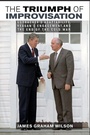
James Graham Wilson
The Triumph of Improvisation
Gorbachev's Adaptability, Reagan's Engagement, and the End of the Cold War
E-Book
02/2014
Cornell University Press
€9.49
Available for download
Person
James Graham Wilson is a Historian at the U.S. Department of State.
Content
Introduction: Individuals and Power
1. Reagan Reaches
2. Stagnation and Choices
3. Shultz Engages
4. Gorbachev Adapts
5. Recovery and Statecraft
6. Gorbachev's New World Order
7. Bush's New World Order
Conclusion: Individuals and Strategy
1. Reagan Reaches
2. Stagnation and Choices
3. Shultz Engages
4. Gorbachev Adapts
5. Recovery and Statecraft
6. Gorbachev's New World Order
7. Bush's New World Order
Conclusion: Individuals and Strategy