

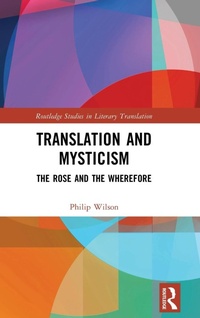
Translation and Mysticism
The Rose and the Wherefore
1st Edition
Published on 27. May 2024
Book
Hardback
192 pages
978-1-032-18241-4 (ISBN)
Description
This book examines how mysticism can tell us about translation and translation can tell us about mysticism, addressing the ancient but ongoing connections between the art of rendering one text in another language and the art of the ineffable.
The volume represents the first sustained act of attention to the interdisciplinary crossover of these two fields, taking a Wittgensteinian approach to language, and investigates how mystics and their translators manage to write about what cannot be written about. Three questions are addressed overall: how mysticism can be used to conceptualise translation; the issues that mysticism raises for translation theory and practice; and how mystical texts have been and might be translated. Walter Benjamin's 'The Translator's Task' is considered in detail as a controversial example of dialogue. Translation examples are given in a range of languages, and six major case studies are provided, including a close reading of Exodus and an analysis of a recent radical translation of Lucretius.
This book will be of interest to students and researchers in translation studies, mysticism studies, theology and literary translation, as well as practising translators.
The volume represents the first sustained act of attention to the interdisciplinary crossover of these two fields, taking a Wittgensteinian approach to language, and investigates how mystics and their translators manage to write about what cannot be written about. Three questions are addressed overall: how mysticism can be used to conceptualise translation; the issues that mysticism raises for translation theory and practice; and how mystical texts have been and might be translated. Walter Benjamin's 'The Translator's Task' is considered in detail as a controversial example of dialogue. Translation examples are given in a range of languages, and six major case studies are provided, including a close reading of Exodus and an analysis of a recent radical translation of Lucretius.
This book will be of interest to students and researchers in translation studies, mysticism studies, theology and literary translation, as well as practising translators.
More details
Series
Language
English
Place of publication
London
United Kingdom
Publishing group
Taylor & Francis Ltd
Target group
College/higher education
Professional and scholarly
Postgraduate
Dimensions
Height: 235 mm
Width: 157 mm
Thickness: 16 mm
Weight
457 gr
ISBN-13
978-1-032-18241-4 (9781032182414)
Copyright in bibliographic data and cover images is held by Nielsen Book Services Limited or by the publishers or by their respective licensors: all rights reserved.
Schweitzer Classification
Other editions
Additional editions
Book
10/2025
1st Edition
Routledge
€63.30
Shipment within 10-20 days
E-Book
05/2024
1st Edition
Routledge
€60.99
Available for download
E-Book
05/2024
1st Edition
Routledge
€60.99
Available for download
Person
Philip Wilson is Associate Professor of Philosophy and Translation at the University of East Anglia, UK, where he teaches Religion and World Philosophies, Philosophy Meets the Arts and Translation Studies.
Content
Prologue: Gold and Crystal
1. Becoming Present
1.1 Translation and Mysticism
1.2 The Ineffable
1.3 Case study: Reading Mystical Texts for Translation
2. Eternity
2.1 Problem or Mystery?
2.2 Grammar
2.3 Case study: Moses and the Burning Bush
3. The Sounding of the Song
3.1 Translation and Gnosis
3.2 The Translator and the Task
3.3 Case study: Friedrich Hoelderlin and Sophocles
4. Light from Darkness
4.1 Discovery, Construction and Declaration
4.2 Translation as Attention
4.3 Case study: Willis Barnstone and John of the Cross
5. Becoming the Script
5.1 Untranslatability
5.2 Translation as Performance
5.3 Case study: Translating the Spell
6. The Rose and the Wherefore
6.1 Problem and Mystery
6.2 Moving On
6.3 Case study: Emma Gee and Lucretius
Epilogue: Staying in the Sun
1. Becoming Present
1.1 Translation and Mysticism
1.2 The Ineffable
1.3 Case study: Reading Mystical Texts for Translation
2. Eternity
2.1 Problem or Mystery?
2.2 Grammar
2.3 Case study: Moses and the Burning Bush
3. The Sounding of the Song
3.1 Translation and Gnosis
3.2 The Translator and the Task
3.3 Case study: Friedrich Hoelderlin and Sophocles
4. Light from Darkness
4.1 Discovery, Construction and Declaration
4.2 Translation as Attention
4.3 Case study: Willis Barnstone and John of the Cross
5. Becoming the Script
5.1 Untranslatability
5.2 Translation as Performance
5.3 Case study: Translating the Spell
6. The Rose and the Wherefore
6.1 Problem and Mystery
6.2 Moving On
6.3 Case study: Emma Gee and Lucretius
Epilogue: Staying in the Sun