

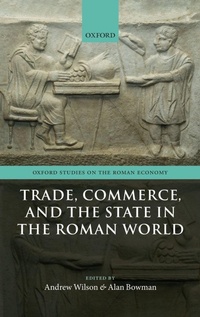
Trade, Commerce, and the State in the Roman World
Published on 9. November 2017
Book
Hardback
680 pages
978-0-19-879066-2 (ISBN)
Description
This volume presents eighteen papers by leading Roman historians and archaeologists discussing trade in the Roman Empire during the period c.100 BC to AD 350. It focuses especially on the role of the Roman state in shaping the institutional framework for trade within and outside the empire, in taxing that trade, and in intervening in the markets to ensure the supply of particular commodities, especially for the city of Rome and for the army.
As part of a novel interdisciplinary approach to the subject, the chapters address its myriad facets on the basis of broadly different sources of evidence: historical, papyrological, and archaeological. They are grouped into three sections, covering institutional factors (taxation, legal structures, market regulation, financial institutions); evidence for long-distance trade within the empire in wood, stone, glass, and pottery; and trade beyond the frontiers, with the east (as far as China), India, Arabia, the Red Sea, and the Sahara. Rome's external trade with realms to the east emerges as being of particular significance, but it is in the eastern part of the empire itself where the state appears to have adapted the mechanisms of taxation in collaboration with the elite holders of wealth to support its need for revenue. On the other hand, the price of that collaboration, which was in effect a fiscal partnership, ultimately led in the longer term in slightly different forms in the east and the west to a fundamental change in the political character of the empire.
As part of a novel interdisciplinary approach to the subject, the chapters address its myriad facets on the basis of broadly different sources of evidence: historical, papyrological, and archaeological. They are grouped into three sections, covering institutional factors (taxation, legal structures, market regulation, financial institutions); evidence for long-distance trade within the empire in wood, stone, glass, and pottery; and trade beyond the frontiers, with the east (as far as China), India, Arabia, the Red Sea, and the Sahara. Rome's external trade with realms to the east emerges as being of particular significance, but it is in the eastern part of the empire itself where the state appears to have adapted the mechanisms of taxation in collaboration with the elite holders of wealth to support its need for revenue. On the other hand, the price of that collaboration, which was in effect a fiscal partnership, ultimately led in the longer term in slightly different forms in the east and the west to a fundamental change in the political character of the empire.
Reviews / Votes
Like its predecessors from OxREP, this volume contains a wealth of valuable interventions in debates about the Roman economy. The synthesis of recently discovered or compiled archaeological material, often by scholars responsible for its initial production, makes this book invaluable to economic historians. The inclusion of materials that are usually marginalized and the insistence on the importance of extra-imperial trade are themselves important steps forward as well. Any collection of scholarship on the Roman economy should contain this book. * BMCR *More details
Series
Language
English
Place of publication
Oxford
United Kingdom
Target group
College/higher education
Professional and scholarly
Illustrations
94 black-and-white illustrations
Dimensions
Height: 240 mm
Width: 161 mm
Thickness: 41 mm
Weight
1174 gr
ISBN-13
978-0-19-879066-2 (9780198790662)
Copyright in bibliographic data and cover images is held by Nielsen Book Services Limited or by the publishers or by their respective licensors: all rights reserved.
Schweitzer Classification
Other editions
Additional editions
Andrew Wilson | Alan Bowman
Trade, Commerce, and the State in the Roman World
E-Book
11/2017
1st Edition
OUP eBook
€94.99
Available for download
Andrew Wilson | Alan Bowman
Trade, Commerce, and the State in the Roman World
E-Book
10/2017
1st Edition
OUP eBook
€102.99
Available for download
Persons
Andrew Wilson is Professor of the Archaeology of the Roman Empire at the University of Oxford and Fellow of All Souls College. He is also a Fellow of the Society of Antiquaries and former Chairman of the Society for Libyan Studies. His research interests include the economy of the Roman Empire, ancient technology, ancient water supply and usage, Roman North Africa, and archaeological field survey. He is the author of numerous articles on these subjects and has directed excavations in Italy, Tunisia, and Libya.
Alan Bowman is Vice-President and Fellow of the British Academy, Emeritus Camden Professor of Ancient History at the University of Oxford, and former Principal of Brasenose College, as well as a former President of the Society for the Promotion of Roman Studies. In addition to his work on the Roman economy, current research projects include further work on the Vindolanda Writing-Tablets and on the Oxyrhynchus Papyri, image-enhancement of damaged documents, and the development of Digital Humanities.
Alan Bowman is Vice-President and Fellow of the British Academy, Emeritus Camden Professor of Ancient History at the University of Oxford, and former Principal of Brasenose College, as well as a former President of the Society for the Promotion of Roman Studies. In addition to his work on the Roman economy, current research projects include further work on the Vindolanda Writing-Tablets and on the Oxyrhynchus Papyri, image-enhancement of damaged documents, and the development of Digital Humanities.
Content
FRONTMATTER; I. INSTITUTIONS AND THE STATE; II. TRADE WITHIN THE EMPIRE; III. TRADE BEYOND THE FRONTIERS; ENDMATTER