

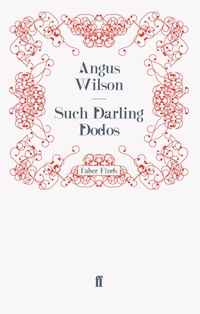
Such Darling Dodos
And Other Stories
Published on 19. February 2009
Book
Paperback/Softback
190 pages
978-0-571-24900-8 (ISBN)
Description
Towards the end of Angus Wilson's life his short stories were entombed in a collected volume. By way of signifying the corpus was sadly complete that made sense but it didn't do justice to the importance and quality of his work in this medium.
Three volumes of short stories were published - The Wrong Set, Such Darling Dodos and A Bit Off the Map. Faber Finds are reissuing these original selections.
Angus Wilson made his initial reputation by his short stories, The Wrong Set and Such Darling Dodos being his first two published books, appearing in 1949 and 1950 respectively.
When reviewing Such Darling Dodos C. P. Snow perceptively wrote, 'Part-bizarre, part-savage and part-maudlin, there is nothing much like it on the contemporary scene. It is rather as though a man of acute sensibility felt left out of the human party, and was surveying it, half-enviously, half-contemptuously, from the corner of the room, determined to strip-off the comfortable pretences and show that this party is pretty horrifying after all ... Sometimes the effect is too mad to be pleasant, sometimes most moving; no one could deny Mr Wilson's gift.'
As Margaret Drabble points out in her biography of Angus Wilson (to be reissued in Faber Finds) his stories were in their own way to be as iconoclastic and irreverent as John Osborne's plays were to be. They not so much deserve as demand to be re-read.
Three volumes of short stories were published - The Wrong Set, Such Darling Dodos and A Bit Off the Map. Faber Finds are reissuing these original selections.
Angus Wilson made his initial reputation by his short stories, The Wrong Set and Such Darling Dodos being his first two published books, appearing in 1949 and 1950 respectively.
When reviewing Such Darling Dodos C. P. Snow perceptively wrote, 'Part-bizarre, part-savage and part-maudlin, there is nothing much like it on the contemporary scene. It is rather as though a man of acute sensibility felt left out of the human party, and was surveying it, half-enviously, half-contemptuously, from the corner of the room, determined to strip-off the comfortable pretences and show that this party is pretty horrifying after all ... Sometimes the effect is too mad to be pleasant, sometimes most moving; no one could deny Mr Wilson's gift.'
As Margaret Drabble points out in her biography of Angus Wilson (to be reissued in Faber Finds) his stories were in their own way to be as iconoclastic and irreverent as John Osborne's plays were to be. They not so much deserve as demand to be re-read.
More details
Edition
Main
Language
English
Place of publication
London
United Kingdom
Product notice
Paperback (UK-trade)
Dimensions
Height: 198 mm
Width: 126 mm
Thickness: 14 mm
Weight
228 gr
ISBN-13
978-0-571-24900-8 (9780571249008)
Copyright in bibliographic data and cover images is held by Nielsen Book Services Limited or by the publishers or by their respective licensors: all rights reserved.
Schweitzer Classification
Other editions
Additional editions
E-Book
06/2009
Faber & Faber
€13.99
Available for download
Person
One of Britain's most distinguished novelists Sir Angus Wilson was born in 1913. Educated at Westminster and Merton College, Oxford he joined the British Museum as a cataloguer before being called for service in 1941. His literary career began with a collection of short-stories published in 1949. These were followed by other short-story collections, novels and plays.
Co-founder with Malcolm Bradbury of the MA programme in creative writing at the University of East Anglia, Wilson was appointed professor in 1967. Chair of many literary panels, including the Booker prize, and campaigner for homosexual equality he was knighted in 1980. He died in 1991.
Co-founder with Malcolm Bradbury of the MA programme in creative writing at the University of East Anglia, Wilson was appointed professor in 1967. Chair of many literary panels, including the Booker prize, and campaigner for homosexual equality he was knighted in 1980. He died in 1991.