

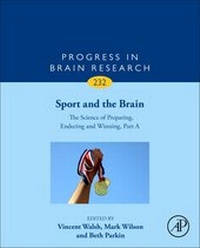
Sport and the Brain: The Science of Preparing, Enduring and Winning, Part A: Volume 232
Published on 26. June 2017
Book
Hardback
238 pages
978-0-12-811827-6 (ISBN)
Description
Sport and the Brain: The Science of Preparing, Enduring and Winning, Part A, Volume 231 reflects recent advancements in the understanding of how elite athletes prepare for-and perform at-peak levels during competition. The latest release in this series focuses on a variety of topics, including chapters on Great British medalists: Psychosocial biographies of Super-Elite and Elite athletes from Olympic sports, a chapter on elite and super-elite Great British athletes: Some theoretical implications from Hardy et al.'s (2016) findings, and The psychosocial development of world class athletes: Additional considerations for understanding the whole person and salience of adversity.
This series takes a multidisciplinary approach, focusing on aspects of psychology, neuroscience, skill learning, talent development and physiology.
This series takes a multidisciplinary approach, focusing on aspects of psychology, neuroscience, skill learning, talent development and physiology.
More details
Series
Language
English
Place of publication
San Diego
United States
Publishing group
Elsevier Science Publishing Co Inc
Target group
Professional and scholarly
Dimensions
Height: 235 mm
Width: 191 mm
Weight
650 gr
ISBN-13
978-0-12-811827-6 (9780128118276)
Copyright in bibliographic data and cover images is held by Nielsen Book Services Limited or by the publishers or by their respective licensors: all rights reserved.
Schweitzer Classification
Other editions
Additional editions
E-Book
06/2017
Academic Press
€206.00
Available for download
Persons
Professor Wilson is the Associate Professor in experimental psychology and human movement science. Broadly, his research is interested in the processes underpinning skilled performance; why skills might break down under pressure; and how we might optimize the skill acquisition process. As a chartered psychologist and registered practitioner with the Health and Care Professions Council, he also provides psychological support services in a range of performance domains (including Olympic and professional athletes). Dr. Walsh is Professor of Human Brain Research at the Institute of Cognitive Neuroscience at the University College, London. He is the author of over 300 manuscripts, most involving cognitive neuroscience and brain stimulation.
The research group he leads is called Applied Cognitive Neuroscience (ACN). The goal is to use neuroscience to improve high performance in sport, high pressure decision making and advancing human brain stimulation in cognition and health. Prof Walsh is particularly interested in sleep, plasticity and extending classical findings to older people. Traditional strengths of his group's work has been investigations of the functions of the parietal lobe, the frontal eye fields and their interactions with primary and secondary visual areas. The techniques his group uses include transcranial magnetic stimulation (TMS) and DC stimulation. He runs the ICN TMS facility and also organises the annual TMS Summer School with The Magstim Company. Professor Parkin is a professor at University College London
The research group he leads is called Applied Cognitive Neuroscience (ACN). The goal is to use neuroscience to improve high performance in sport, high pressure decision making and advancing human brain stimulation in cognition and health. Prof Walsh is particularly interested in sleep, plasticity and extending classical findings to older people. Traditional strengths of his group's work has been investigations of the functions of the parietal lobe, the frontal eye fields and their interactions with primary and secondary visual areas. The techniques his group uses include transcranial magnetic stimulation (TMS) and DC stimulation. He runs the ICN TMS facility and also organises the annual TMS Summer School with The Magstim Company. Professor Parkin is a professor at University College London
Content
1. Great British medalists: Psychosocial biographies of Super-Elite and Elite athletes from Olympic sports
2. On elite and super-elite Great British athletes: Some theoretical implications from Hardy et al.'s (2016) findings
3. The psychosocial development of world class athletes: Additional considerations for understanding the whole person and salience of adversity
4. The journey of a thousand miles... Notes on Hardy et al's Great British Medalists Project
5. Embedding the psychosocial biographies of Olympic medalists in a (meta-) theoretical model of dynamic networks
6. Assessing Risk Factors for Athletic Excellence
7. In Search of the Golden Skill
8. Much Ado About....? A response to Hardy et al.
9. The Stress Test: Does what doesn't kill me, make me a Super-Elite Athlete?
10. Adversity-Related Experiences are Essential for Olympic Success: Additional Evidence and Considerations
11. Getting gritty about practice and success: Motivational characteristics of great performers
12. Great British Medalists: A commentary based on a developmental systems theory perspective
13. Eventual sport performance level: what about the role of type of sport, perception of critical life events, and practice quality?
14. Is A Peaceful Mind A Winning Mind? Comment on Hardy et al (2016)
15. Super Elite Athletes: Some Complimentary Observations from Australia and Some Lessons for Sports Expertise Research - Comment on Hardy et al.
16. A culture of striving augments use of working memory? Implications for attention control
17. The Tales Athletes Tell: Narrative Structure and Identity in Great British Medalists
18. Great British medalists: Response to the commentaries
2. On elite and super-elite Great British athletes: Some theoretical implications from Hardy et al.'s (2016) findings
3. The psychosocial development of world class athletes: Additional considerations for understanding the whole person and salience of adversity
4. The journey of a thousand miles... Notes on Hardy et al's Great British Medalists Project
5. Embedding the psychosocial biographies of Olympic medalists in a (meta-) theoretical model of dynamic networks
6. Assessing Risk Factors for Athletic Excellence
7. In Search of the Golden Skill
8. Much Ado About....? A response to Hardy et al.
9. The Stress Test: Does what doesn't kill me, make me a Super-Elite Athlete?
10. Adversity-Related Experiences are Essential for Olympic Success: Additional Evidence and Considerations
11. Getting gritty about practice and success: Motivational characteristics of great performers
12. Great British Medalists: A commentary based on a developmental systems theory perspective
13. Eventual sport performance level: what about the role of type of sport, perception of critical life events, and practice quality?
14. Is A Peaceful Mind A Winning Mind? Comment on Hardy et al (2016)
15. Super Elite Athletes: Some Complimentary Observations from Australia and Some Lessons for Sports Expertise Research - Comment on Hardy et al.
16. A culture of striving augments use of working memory? Implications for attention control
17. The Tales Athletes Tell: Narrative Structure and Identity in Great British Medalists
18. Great British medalists: Response to the commentaries