

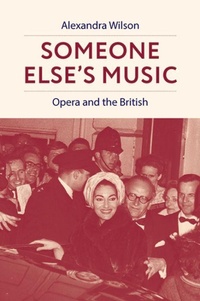
Someone Else's Music
Opera and the British
Will be published approx. on 30. September 2025
Book
Hardback
296 pages
978-0-19-780363-9 (ISBN)
Description
In Britain today, opera is routinely called elitist. But things were not always so. Examining shifting cultural attitudes over the century from 1920 to 2020, Someone Else's Music reveals a hidden history of popular opera-going in Britain, which defies the opera-elitism stereotype. At the same time, the book traces how, when, and why that stereotype arose. It uses opera as a lens through which to examine the broader history of changing cultural values in the UK, from 1920s Reithian ideals about art's civilising qualities to contemporary culture wars. The controversies opera has prompted over the last century reveal a great deal about national identity - who Britons think they are and who they want to be.
The book ranges widely across topics including education, public broadcasting, arts policy, and attitudes towards subsidy, and traces opera's surprisingly close relationship with popular culture. We meet a diverse cast of characters, including working-class East-End opera fans, opera-singing Welsh miners, soldiers discovering opera in wartime Italy, and holidaymakers watching it at Butlin's. The book is as much about the secretary camping out in the queue for gallery tickets as it is about the duchess in the stalls.
But at what point did people start calling opera elitist and why? Analysing lasting stereotypes around opera, Wilson reveals them to be politically motivated, founded in deep-seated British anxieties about class, education, and national identity. Someone Else's Music is essential reading for anybody who wants to understand the debates we are having today about arts funding, accessibility and who opera is 'for'. It reveals that opera used to be for everyone - and shows us how it could be again.
The book ranges widely across topics including education, public broadcasting, arts policy, and attitudes towards subsidy, and traces opera's surprisingly close relationship with popular culture. We meet a diverse cast of characters, including working-class East-End opera fans, opera-singing Welsh miners, soldiers discovering opera in wartime Italy, and holidaymakers watching it at Butlin's. The book is as much about the secretary camping out in the queue for gallery tickets as it is about the duchess in the stalls.
But at what point did people start calling opera elitist and why? Analysing lasting stereotypes around opera, Wilson reveals them to be politically motivated, founded in deep-seated British anxieties about class, education, and national identity. Someone Else's Music is essential reading for anybody who wants to understand the debates we are having today about arts funding, accessibility and who opera is 'for'. It reveals that opera used to be for everyone - and shows us how it could be again.
Reviews / Votes
Timely and provocative....Scrupulously researched, it patiently refutes lazily antagonistic prejudice. * Rupert Christiansen, Opera magazine * Wilson brings out the diversity of Britain's operatic cultures. * Nikhil Krishnan, New Statesman * Alexandra Wilson unpicks the myth that opera is alien to the working class. For much of the past century, Wilson shows, opera was a hugely important thread in working-class lives. * Kenan Malik, The Observer * Opera has become a stage on which questions of national identity and self-understanding are played out...It is to Wilson's credit that she recounts this troubled history with balance and insight. * Ioannes Chountis de Fabbri, Engelsberg Ideas * Prof Wilson has painstakingly researched the history of opera-going in Britain. * Country Life * All British opera buffs should read because it'll make their jaws drop. * Richard Bratby, The Spectator * For more on the forgotten history of opera as a popular art form, do read Alexandra Wilson's terrific Someone Else's Music. * Stephen Bush, The Financial Times * Wilson marshals this evidence with telling skill, and the depth and width of her research commands respect. * Christopher Cook, BBC Music Magazine *More details
Language
English
Place of publication
New York
United States
Target group
College/higher education
Illustrations
12 photographs
Dimensions
Height: 243 mm
Width: 167 mm
Thickness: 25 mm
Weight
638 gr
ISBN-13
978-0-19-780363-9 (9780197803639)
Copyright in bibliographic data and cover images is held by Nielsen Book Services Limited or by the publishers or by their respective licensors: all rights reserved.
Schweitzer Classification
Other editions
Additional editions
E-Book
07/2025
OUP eBook
€24.99
Available for download
E-Book
07/2025
OUP eBook
€24.99
Available for download
Person
Professor Alexandra Wilson is a musicologist and cultural historian. After holding two Oxford Junior Research Fellowships, she taught at Oxford Brookes University for nineteen years, latterly as Professor of Music and Cultural History. She is currently Researcher in Residence at the Guildhall School of Music and Drama in London and a Senior Research Fellow at Jesus College, Oxford. She has previously published The Puccini Problem (2007), Opera in the Jazz Age (2019), Puccini's La boheme (2021) and Puccini in Context (2023). She writes and broadcasts widely about cultural matters and works regularly with the UK's leading opera companies.
Content
1: The Elitism Myth
2: Opera for All
3: (Dis)-Enchanted Gardens
4: Opera Goes to War
5: Pageantry and Participation
6: Counterculture
7: A National Opera?
8: The E-Word
9: A Perfect Storm
10: Twenty-First-Century Blues
11: This Sceptic Isle
Conclusion
2: Opera for All
3: (Dis)-Enchanted Gardens
4: Opera Goes to War
5: Pageantry and Participation
6: Counterculture
7: A National Opera?
8: The E-Word
9: A Perfect Storm
10: Twenty-First-Century Blues
11: This Sceptic Isle
Conclusion