

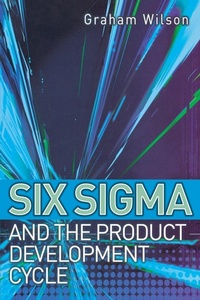
Six Sigma and the Product Development Cycle
1st Edition
Published on 15. June 2005
Book
Paperback/Softback
244 pages
978-0-7506-6218-5 (ISBN)
Description
Six sigma is an effective and important management approach particularly used by multinational companies with manufacturing bases in the Asian and Pacific rim.
One of the key issues facing businesses today is how to eliminate the high cost of developing new products. This is an area where the potential of six sigma has not been widely appreciated before.
Six Sigma and the Product Development Cycle brings the six sigma approach up-to-date and explains it in a way that appeals to today's management teams. It makes the concept of six sigma easy to understand and accessible with the statistics necessary for its implementation clearly explained.
Six Sigma and the Product Development Cycle covers the integration of quality function deployment with Taguchi's methods of experimental design and statistical process control. These tools gather detailed insights into customer needs, optimize the products or services to meet these needs at the lowest practical cost, and ensure that this performance is maintained. It is a book about both six sigma and product and service development. Through this approach an organization can gain greater flexibility, shorter timescales, and the ability to react more quickly to changes or new demands in the marketplace. The approach is illustrated with practical examples from the nuclear industry, motor manufacturing, inland mail, 'emergency response' organizations and financial services.
One of the key issues facing businesses today is how to eliminate the high cost of developing new products. This is an area where the potential of six sigma has not been widely appreciated before.
Six Sigma and the Product Development Cycle brings the six sigma approach up-to-date and explains it in a way that appeals to today's management teams. It makes the concept of six sigma easy to understand and accessible with the statistics necessary for its implementation clearly explained.
Six Sigma and the Product Development Cycle covers the integration of quality function deployment with Taguchi's methods of experimental design and statistical process control. These tools gather detailed insights into customer needs, optimize the products or services to meet these needs at the lowest practical cost, and ensure that this performance is maintained. It is a book about both six sigma and product and service development. Through this approach an organization can gain greater flexibility, shorter timescales, and the ability to react more quickly to changes or new demands in the marketplace. The approach is illustrated with practical examples from the nuclear industry, motor manufacturing, inland mail, 'emergency response' organizations and financial services.
More details
Language
English
Place of publication
Oxford
United Kingdom
Publishing group
Taylor & Francis Ltd
Target group
Professional and scholarly
Professional Practice & Development
Dimensions
Height: 234 mm
Width: 156 mm
Thickness: 13 mm
Weight
380 gr
ISBN-13
978-0-7506-6218-5 (9780750662185)
Copyright in bibliographic data and cover images is held by Nielsen Book Services Limited or by the publishers or by their respective licensors: all rights reserved.
Schweitzer Classification
Other editions
Additional editions
Graham Wilson | Maersk Molan
Six Sigma and the Product Development Cycle
Book
07/2017
1st Edition
Routledge
€282.26
Shipment within 10-20 days

Graham Wilson | Maersk Molan
Six Sigma and the Product Development Cycle
E-Book
05/2012
1st Edition
Routledge
€86.99
Available for download

Graham Wilson | Maersk Molan
Six Sigma and the Product Development Cycle
E-Book
05/2012
1st Edition
Routledge
€86.99
Available for download
Persons
Graham Wilson
Content
Chapter 1 Culture; Chapter 2 What is six sigma?; Chapter 3 The transformation that is six sigma; Chapter 4 The product development cycle; Chapter 5 Quality function deployment; Chapter 6 Taguchi's techniques; Chapter 7 Statistical process control;