

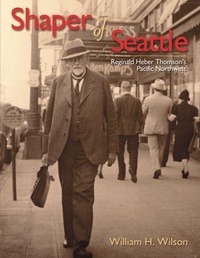
Shaper of Seattle
Reginald Heber Thomson's Pacific Northwest
Will be published approx. on 30. November 2009
Book
Paperback/Softback
200 pages
978-0-87422-301-9 (ISBN)
Description
His achievements are woven into Seattle and the surrounding region so durably that they are taken for granted even as Puget Sound, Lake Washington, and Mount Rainier." - Roy O. HadleyYoung, ambitious, and college-educated, Reginald Heber Thomson was eager to make a big impression. But when his steamer docked at Seattle's Yesler's Wharf in 1881, the view was dismal. Nondescript buildings and plank sidewalks sprawled along muddy streets. Utilities were crude to nonexistent. Pipes dumped untreated sewage straight into Elliott Bay. Rats scurried around the piers.
Surveying for his cousin's firm, Thomson quickly rose to partner and mingled with Seattle's elite. In 1884 he was appointed city surveyor, and in 1892, city engineer. The booming population was in dire need of a workable sewage system and a clean, reliable water supply. He delivered both and more. He installed drain pipes and sewers where others had failed, and his gravity-powered Cedar River project replaced water pumped from turbid Lake Washington. To improve transportation of goods, he leveled several steep hills and filled the worst hollows. His municipal power plant lit homes, businesses, and streets. The progressive, legendary engineer also straightened and dredged waterways, reclaimed tideflats, and installed countless miles of tunnels, bridges, and pavement.
Thomson became a civic leader and was involved with the Port of Seattle and the Chittenden locks. He is responsible for much of the Emerald City's existing infrastructure, succeeding despite a tenure filled with intense financial pressure, meticulous audits, and political and public controversy. A workaholic and a devoted family man driven by his religious and political convictions, he possessed extraordinary intelligence, energy, integrity, and perseverance. A comprehensive, critical examination, Shaper of Seattle explores the key events and forces that shaped his youth, career, personal life, and waning years.
Surveying for his cousin's firm, Thomson quickly rose to partner and mingled with Seattle's elite. In 1884 he was appointed city surveyor, and in 1892, city engineer. The booming population was in dire need of a workable sewage system and a clean, reliable water supply. He delivered both and more. He installed drain pipes and sewers where others had failed, and his gravity-powered Cedar River project replaced water pumped from turbid Lake Washington. To improve transportation of goods, he leveled several steep hills and filled the worst hollows. His municipal power plant lit homes, businesses, and streets. The progressive, legendary engineer also straightened and dredged waterways, reclaimed tideflats, and installed countless miles of tunnels, bridges, and pavement.
Thomson became a civic leader and was involved with the Port of Seattle and the Chittenden locks. He is responsible for much of the Emerald City's existing infrastructure, succeeding despite a tenure filled with intense financial pressure, meticulous audits, and political and public controversy. A workaholic and a devoted family man driven by his religious and political convictions, he possessed extraordinary intelligence, energy, integrity, and perseverance. A comprehensive, critical examination, Shaper of Seattle explores the key events and forces that shaped his youth, career, personal life, and waning years.
More details
Language
English
Place of publication
Pullman, WA
United States
Product notice
Paperback (trade)
Dimensions
Height: 267 mm
Width: 214 mm
Thickness: 16 mm
Weight
889 gr
ISBN-13
978-0-87422-301-9 (9780874223019)
Copyright in bibliographic data and cover images is held by Nielsen Book Services Limited or by the publishers or by their respective licensors: all rights reserved.
Schweitzer Classification
Person
William H. Wilson is a professor emeritus of history in the College of Arts and Sciences at the University of North Texas and an award-winning writer. He has served as president of the Society for American City and Regional Planning History, and also is a member of the Organization of American Historians, the Urban History Association, and the International Planning and History Society.
Content
AcknowledgmentsIntroduction
1. Boyhood and Adolescence in Indiana
2. Young Manhood in California
3. Early Years in Seattle
4. Thomson's Work in Context
5. The Sewers
6. Cedar River Water System
7. The Regrades
8. Railroads, Lighting, and the Ship Canal
9. Public and Private Life of an Engineer
10. Port Commission, Strathcona Park, the Times and Sun
11. Politics, Consulting, and Family
12. Return to City Engineering and the Fight with J.D. Ross
13. More Engineering and the Later Years
14. "R.H."--The Meaning of a Busy Life
A Note on Sources
Bibliography
Index
1. Boyhood and Adolescence in Indiana
2. Young Manhood in California
3. Early Years in Seattle
4. Thomson's Work in Context
5. The Sewers
6. Cedar River Water System
7. The Regrades
8. Railroads, Lighting, and the Ship Canal
9. Public and Private Life of an Engineer
10. Port Commission, Strathcona Park, the Times and Sun
11. Politics, Consulting, and Family
12. Return to City Engineering and the Fight with J.D. Ross
13. More Engineering and the Later Years
14. "R.H."--The Meaning of a Busy Life
A Note on Sources
Bibliography
Index