

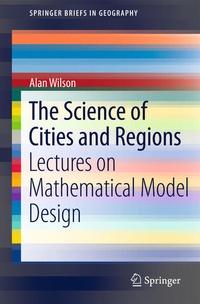
The Science of Cities and Regions
Lectures on Mathematical Model Design
Published on 5. January 2012
Book
Paperback/Softback
XII, 102 pages
978-94-007-2265-1 (ISBN)
Description
A 'science of cities and regions' is critical for meeting future challenges. The world is urbanising: huge cities are being created and are continuing to grow rapidly. There are many planning and development issues arising in different manifestations in countries across the globe. These developments can, in principle, be simulated through mathematical computer models which provide tools for forecasting and testing future scenarios and plans. These models can represent the functioning of cities and regions, predicting the spatial demography and the economy, the main flows such as journey to work or to services, and the mechanisms of future evolution. In this book, the main principles involved in the design of this range of models are articulated, providing an account of the current state of the art as well as future research challenges.Alan Wilson has over forty years working with urban and regional models and has contributed important discoveries. He has distilled this experience into what serves as both an introduction and a review of the research frontier. Topics covered include the Lowry model, the retail model, principles of account-based models and the methods rooted in Boltzmann-style statistical modelling and the Lotka-Volterra approach to system evolution. Applications range from urban and regional planning to wars and epidemics.
More details
Series
Edition
2012
Language
English
Place of publication
Dordrecht
Netherlands
Target group
Professional and scholarly
Research
Illustrations
31 s/w Abbildungen
XII, 102 p. 31 illus.
Dimensions
Height: 235 mm
Width: 155 mm
Thickness: 7 mm
Weight
189 gr
ISBN-13
978-94-007-2265-1 (9789400722651)
DOI
10.1007/978-94-007-2266-8
Schweitzer Classification
Other editions
Additional editions
E-Book
01/2012
1st Edition
Springer
€53.49
Available for download
Person
Francesca Romana Medda is a Professor of Applied Economics and Finance at the University College London (UCL). From 2010 she is the Director of the UCL QASER (Quantitative and Applied Spatial Economics Research) Laboratory. Since 2012 she serves as economic adviser to the UK Ministry of Environment and Agriculture (Defra) and in 2014 at the Ministry of Finance (HM Treasury). She is Vice-President of the Parliamentary and Scientific Committee. Her research focuses on project finance, innovative financial mechanisms and risk evaluation in different infrastructure sectors such as: transport industry, energy innovation and new technologies, urban investments (smart cities), supply chain provision and optimisation, and efficiency. Her work is published in leading academic and practitioner journals. She has worked and works actively with the private and public sector including The European Investment Bank, The World Bank, UNESCO, UN-Habitat, WILLIS Re, HALCROW, and UITP.
Francesco Caravelli is a theoretical physicist, interested in quantum and classical systems and the application of techniques of statistical physics and complexity to other disciplines such as economics and engineering. He is currently a Senior Researcher at Invenia Lab, a honorary member in the Computer Science Department at University College London and a visitor of the London Institute for Mathematical Sciences.Simone Caschili, enviromental engineer, received his Ph.D. in Ingegneria del Territorio (Land Engineering and Urban Planning) at University of Cagliari (IT) in February 2010. His research interests are the modelling of urban and regional systems as complex networks, the inclusion of time-space features in network modelling and policy evaluation for planning in both urban and environmental governance.
Content
1: Models and Systems: The Lowry Model as an Example.- 2: The Retail Model and its Applications.- 3: Wars, Epidemics, Ecology and the Evolution of Spatial Structure: Connecting Models through Generalisation.- 4: Theory.- 5: Methods: The Model-Building Tool Kit.- 6: Adding Dept-1: Spatial Interaction and the Location of Activities.- 7: Adding Depth-2: Structural Dynamics.- 8: Tools for Complexity Science.- 9 Research Challenges.