

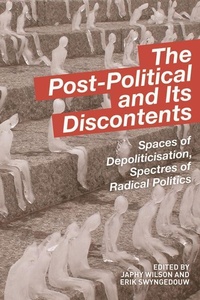
The Post-Political and Its Discontents
Spaces of Depoliticisation, Spectres of Radical Politics
Published on 23. June 2014
Book
Hardback
336 pages
978-0-7486-8297-3 (ISBN)
Description
Our age is celebrated as the triumph of liberal democracy. Yet it is also marked by a narrowing of party differences, a decline in voter participation, a rise in nationalist and religious fundamentalisms and an explosion of popular protests that challenge technocratic governance and the power of markets in the name of democracy itself. This book seeks to make sense of this situation by critically engaging with the influential theory of 'the post-political' developed by Chantal Mouffe, Jacques Ranciere, Slavoj Zizek and others. Through a multi-dimensional and fiercely contested assessment of contemporary depoliticization, 'The Post-Political and Its Discontents' urges us to confront the closure of our political horizons, and to re-imagine the possibility of emancipatory change.
Reviews / Votes
An excellent collection of theoretically innovative and empirically rich essays on practices of depoliticisation and repoliticisation, ranging from the everyday to the spectacular, The Post-Political and Its Discontents shows that liberal democracy and consensus building do not exhaust all political possibilities and futures. -- Mustafa Dikec, Institut Francais d'Urbanisme, Paris An excellent collection of theoretically innovative and empirically rich essays on practices of depoliticisation and repoliticisation, ranging from the everyday to the spectacular, The Post-Political and Its Discontents shows that liberal democracy and consensus building do not exhaust all political possibilities and futures. -- Mustafa Dikec, Institut Francais d'Urbanisme, ParisMore details
Language
English
Place of publication
Edinburgh
United Kingdom
Target group
College/higher education
Product notice
Unsewn / adhesive bound
Paper over boards
Illustrations
5 black and white tables
Dimensions
Height: 236 mm
Width: 157 mm
Thickness: 23 mm
Weight
680 gr
ISBN-13
978-0-7486-8297-3 (9780748682973)
Copyright in bibliographic data and cover images is held by Nielsen Book Services Limited or by the publishers or by their respective licensors: all rights reserved.
Schweitzer Classification
Other editions
Additional editions
Japhy Wilson | Erik Swyngedouw
Post-Political and Its Discontents
Spaces of Depoliticisation, Spectres of Radical Politics
E-Book
04/2015
Edinburgh University Press
€24.49
Available for download
Japhy Wilson | Erik Swyngedouw
Post-Political and Its Discontents
Spaces of Depoliticisation, Spectres of Radical Politics
E-Book
06/2014
1st Edition
Edinburgh University Press
€0.00
Available for download
Persons
Japhy Wilson is Research Coordinator at the National Strategic Centre for the Right to Territory (CENEDET) in Quito, Ecuador. His research explores the intertwining of space, power and ideology in the politics of international development. He has published in academic journals in the the fields of political economy, human geography, and development studies. He is the author of Jeffrey Sachs: The Strange Case of Dr. Shock and Mr. Aid (Verso 2014). Erik Swyngedouw is Professor of Geography at Manchester University. His research interests include critical theory, political-ecology, urban governance, democracy and political power, and the politics of globalisation. His was previously professor of geography at Oxford University (until 2006) and held the Vincent Wright Visiting Professorship in Political Science at Science Po, Paris, 2014. He is the author of Liquid Power: Contested Hydro-Modernities in Twentieth-Century Spain (MIT Press, 2015).
Content
List of Contributors; Seeds of Dystopia: Post-Politics and the Return of the Political, Japhy Wilson and Erik Swyngedouw; Part I Spaces of Depoliticisation; 1. The Post-Politics of Sustainability Planning: Privatisation and the Demise of Democratic Government, Mike Raco; 2. The Post-Political and the End of Nature: The Genetically Modified Organism, Larry Reynolds and Bronislaw Szerszynski; 3. The New Development Architecture and the Post- Political in the Global South, Sangeeta Kamat; 4. Opening Up the Post-Political Condition: Multiculturalism and the Matrix of Depoliticisation, Nicolas Van Puymbroeck and Stijn Oosterlynck; 5. The Jouissance of Philanthrocapitalism: Enjoyment as a Post-Political Factor, Japhy Wilson; 6. Religious Antinomies of Post-Politics, Buelent Diken; 7. Post-Ecologist Governmentality: Post-Democracy, Post-Politics and the Politics of Unsustainability, Ingolfur Bluehdorn; Part II Spectres of Radical Politics; 8. Insurgent Architects, Radical Cities and the Promise of the Political, Erik Swyngedouw; 9. The Limits of Post-Politics: Rethinking Radical Social Enterprise, Wendy Larner; 10. Neither Cosmopolitanism nor Multipolarity: The Political Beyond Global Governmentality, Hans-Martin Jaeger; 11. Against a Speculative Leftism, Alex Loftus; 12. Spatialising Politics: Antagonistic Imaginaries of Indignant Squares, Maria Kaika and Lazaros Karaliotas; 13. After Post-Politics: Occupation and the Return of Communism, Jodi Dean; 14. The Enigma of Revolt: Militant Politics in a 'Post- Political' Age, Andy Merrifield; There Is No Alternative, Erik Swyngedouw and Japhy Wilson; Index