

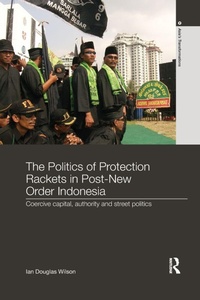
The Politics of Protection Rackets in Post-New Order Indonesia
Coercive Capital, Authority and Street Politics
1st Edition
Published on 16. June 2017
Book
Paperback/Softback
220 pages
978-1-138-30252-5 (ISBN)
Description
Gangs and militias have been a persistent feature of social and political life in Indonesia. During the authoritarian New Order regime they constituted part of a vast network of sub-contracted coercion and social control on behalf of the state. Indonesia's subsequent democratisation has seen gangs adapt to and take advantage of the changed political context. New types of populist street based organisations have emerged that combine predatory rent-seeking with claims of representing marginalised social and economic groups.
Based on extensive fieldwork in Jakarta this book provides a comprehensive analysis of the changing relationship between gangs, militias and political power and authority in post-New Order Indonesia. It argues that gangs and militias have manufactured various types of legitimacy in consolidating localised territorial monopolies and protection economies. As mediators between the informal politics of the street and the world of formal politics they have become often influential brokers in Indonesia's decentralised electoral democracy. More than mere criminal extortion, it is argued that the protection racket as a social relation of coercion and domination remains a salient feature of Indonesia's post-authoritarian political landscape.
This ground-breaking study will be of interest to students and scholars of Indonesian and Southeast Asian politics, political violence, gangs and urban politics.
Based on extensive fieldwork in Jakarta this book provides a comprehensive analysis of the changing relationship between gangs, militias and political power and authority in post-New Order Indonesia. It argues that gangs and militias have manufactured various types of legitimacy in consolidating localised territorial monopolies and protection economies. As mediators between the informal politics of the street and the world of formal politics they have become often influential brokers in Indonesia's decentralised electoral democracy. More than mere criminal extortion, it is argued that the protection racket as a social relation of coercion and domination remains a salient feature of Indonesia's post-authoritarian political landscape.
This ground-breaking study will be of interest to students and scholars of Indonesian and Southeast Asian politics, political violence, gangs and urban politics.
More details
Series
Language
English
Place of publication
London
United Kingdom
Publishing group
Taylor & Francis Ltd
Target group
College/higher education
Dimensions
Height: 234 mm
Width: 156 mm
Thickness: 12 mm
Weight
345 gr
ISBN-13
978-1-138-30252-5 (9781138302525)
Copyright in bibliographic data and cover images is held by Nielsen Book Services Limited or by the publishers or by their respective licensors: all rights reserved.
Schweitzer Classification
Other editions
Additional editions
Ian Douglas Wilson
The Politics of Protection Rackets in Post-New Order Indonesia
Coercive Capital, Authority and Street Politics
Book
04/2015
1st Edition
Routledge
€231.50
Shipment within 15-20 days
Ian Douglas Wilson
The Politics of Protection Rackets in Post-New Order Indonesia
Coercive Capital, Authority and Street Politics
E-Book
03/2015
Routledge
€69.99
Available for download
Ian Douglas Wilson
The Politics of Protection Rackets in Post-New Order Indonesia
Coercive Capital, Authority and Street Politics
E-Book
03/2015
Routledge
€69.99
Available for download
Person
Ian Douglas Wilson is a Lecturer in Politics and Security Studies at the School of Management and Governance, and a Research Fellow at the Asia Research Centre, Murdoch University, Australia.
Content
1. Protection, Violence and the State 2. Reconfigured Rackets: Continuity, Change and Consolidation 3. A New Order of Crime: Suharto's Racket Regime 4. The Changing of the Preman Guard 5. The Rise of the Betawi 6. Jakarta's Political Economy of Rackets 7. Coercive Capital, Political Entrepreneurship and Electoral Democracy 8. Conclusions