

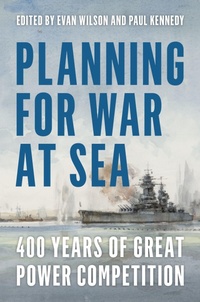
Planning for War at Sea
400 Years of Great Power Competition
Published on 20. March 2025
Book
Hardback
400 pages
978-1-61251-725-4 (ISBN)
Description
How have navies contemplated possible enemies? How did they learn, or fail to learn, once operations began? How does this analysis inform today's planning for future conflict? These questions guide the noted historians and naval strategists who contributed to Planning for War at Sea. A central theme is the regular failure of navies' best-laid plans.
Covering four centuries of naval warfare, the chapters illustrate the challenges all navies faced when considering possible enemies. Even during the Age of Sail, ships were among the most expensive and long-term national endeavors. Navies therefore planned well in advance for future wars, usually without knowing their adversaries or how they would fight them at sea. Building a capable navy requires sustained investment in naval infrastructure long before the fighting starts.
In the final chapters naval strategists expand on this historical analysis to address how effectively or ineffectively today's three leading navies-Russia, China, and the United States-have configured themselves during the post-Cold War era in preparing for future great power conflict. This collection is an important work for strategists, scholars, and policymakers.
Covering four centuries of naval warfare, the chapters illustrate the challenges all navies faced when considering possible enemies. Even during the Age of Sail, ships were among the most expensive and long-term national endeavors. Navies therefore planned well in advance for future wars, usually without knowing their adversaries or how they would fight them at sea. Building a capable navy requires sustained investment in naval infrastructure long before the fighting starts.
In the final chapters naval strategists expand on this historical analysis to address how effectively or ineffectively today's three leading navies-Russia, China, and the United States-have configured themselves during the post-Cold War era in preparing for future great power conflict. This collection is an important work for strategists, scholars, and policymakers.
Reviews / Votes
"A tour de force! Planning for War at Sea keenly examines lessons drawn from naval planning and execution across four centuries, analyzing the successes and failures. The contributors are world-class scholars, and we could ask for no better guides than Paul Kennedy and Evan Wilson. As the world begins a new maritime century, all serious leaders will read this book; the best will learn from it and prevail to set the global agenda for the next 100 years."-Adm John Richardson, USN (Ret.) 31st Chief of Naval Operations"Kennedy, Wilson and their world-class contributors provide a warning from the past, examining the causes of naval strategic failure in a succession of case studies that highlight the impact of flawed pre-war assumptions, outmoded plans, and ill-suited equipment. Today, with the biggest navies belonging to continental powers, and technology evolving by the day, the potential for catastrophic failure has never been greater. Essential reading."-Prof. Andrew Lambert, Laughton Professor of Naval History. Kings College, London
"In Planning for War at Sea, we see the enormous value of a deep knowledge of the past for helping us ask better questions about strategy and planning for our contemporary world. Kennedy and Wilson bring together insightful chapters from some of our leading naval scholars to share the wisdom naval history has to offer today's naval professionals."-Benjamin "BJ" Armstrong, editor of 21st Century Mahan, Revised and Expanded: Sound Military Conclusions for the Modern Era.
"This is an impressive and valuable collection of thought-provoking essays. It is timely, given the ways recent conflicts-like those in Ukraine and Afghanistan-have forced us to reassess how best to plan and prepare for war. Wilson, Kennedy, and their contributors review historical approaches to that challenge from a maritime perspective and illuminate how difficult and important it can be."-Trent Hone, author of Learning War and Mastering the Art of Command.
"This book, a collection of analyses by various historians, sets out to be thought-provoking and achieves that goal. The 15 essays are versions of papers presented at a 2022 conference organized by Yale University and the Naval War College and cover the war planning of various naval powers, beginning with the Anglo-Dutch War of the 1550s and concluding in the post-Cold War era. The essays cover discrete periods of great power competition of the navies of the United States, Russia, China, Great Britain, Germany, France, Japan and Holland. The essays focus on how navies prepared for war and discuss what went right or wrong, including the ability to adapt to initial failures and the failure to exploit successes."-Sea Power Magazine
More details
Edition
New edition
Language
English
Place of publication
Annopolis
United States
Target group
Professional and scholarly
Interest Age: From 0 to 99 years
Edition type
New edition
Product notice
Cloth over boards
Illustrations
Illustrations
Dimensions
Height: 235 mm
Width: 157 mm
Thickness: 28 mm
Weight
801 gr
ISBN-13
978-1-61251-725-4 (9781612517254)
Copyright in bibliographic data and cover images is held by Nielsen Book Services Limited or by the publishers or by their respective licensors: all rights reserved.
Schweitzer Classification
Other editions
Additional editions
E-Book
02/2025
1st Edition
Naval Institute Press
€41.49
Available for download
Persons
Evan Wilson is an associate professor at the U.S. Naval War College's Hattendorf Historical Center in Newport, Rhode Island. A recipient of the Sir Julian Corbett Prize in Modern Naval History, he is the author or editor of six books, most recently?The Horrible Peace: British Veterans and the End of the Napoleonic Wars.
Paul?Kennedy?is J. Richardson Dilworth Professor of History and Distinguished Fellow of the Brady-Johnson Program in Grand Strategy at Yale University.?He is author or editor of twenty books, the latest being Victory at Sea: Naval Power and the Transformation of the Global Order in World War II.
Paul?Kennedy?is J. Richardson Dilworth Professor of History and Distinguished Fellow of the Brady-Johnson Program in Grand Strategy at Yale University.?He is author or editor of twenty books, the latest being Victory at Sea: Naval Power and the Transformation of the Global Order in World War II.