

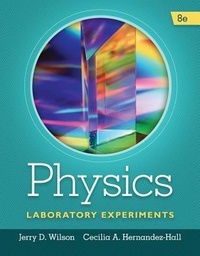
Physics Laboratory Experiments
8th Edition
Published on 25. February 2014
Book
Paperback/Softback
560 pages
978-1-285-73856-7 (ISBN)
Description
This market-leading manual for the first-year physics laboratory course offers a wide range of class-tested experiments designed specifically for use in small to mid-size lab programs. A series of integrated experiments emphasizes the use of computerized instrumentation and includes a set of "computer-assisted experiments" that allow you to gain experience with modern equipment. By analyzing data through two different methods, learners gain a greater understanding of the concepts behind the experiments. The Eighth Edition is updated with four new economical labs and thirty new Pre-Lab Demonstrations, designed to capture interest prior to the lab and requiring only widely available materials and items.
More details
Edition
8th edition
Language
English
Place of publication
CA
United States
Publishing group
Cengage Learning, Inc
Target group
College/higher education
Product notice
Paperback (trade)
Unsewn / adhesive bound
Dimensions
Height: 272 mm
Width: 213 mm
Thickness: 25 mm
Weight
1089 gr
ISBN-13
978-1-285-73856-7 (9781285738567)
Copyright in bibliographic data and cover images is held by Nielsen Book Services Limited or by the publishers or by their respective licensors: all rights reserved.
Schweitzer Classification
Persons
Jerry Wilson received his physics degrees from Ohio University (B.S., Ph.D.) and Union College in Schenectady, New York (M.S.). In addition to co-writing PHYSICS LABORATORY EXPERIMENTS, he is one of the original authors of the first edition of AN INTRODUCTION TO PHYSICAL SCIENCE (published in 1971) and has several other physics textbooks to his credit. Wilson is currently Emeritus Professor of Physics at Lander University in Greenwood, South Carolina, and continues to write the Curiosity Corner, a question and answer column run in five regional newspapers. Cecilia Hernandez-Hall received her M.S. in physics from the University of Puerto Rico, Mayagueez Campus, in 1993. After teaching for two years at the Mayagueez and Cayey campuses, she joined the Physics Education Research Group at the University of Nebraska, Lincoln, where research in physics education was conducted with an emphasis on computerized instruction. Professor Hernandez has used computerized instruction with hundreds of her students, and she contributes to the computerized-instruction material throughout PHYSICS LABORATORY EXPERIMENTS. In 1998, Professor Hernandez joined the faculty of American River College. She also works for PASCO Scientific in Roseville, California, where she helps develop computer-assisted lab activities for college physics and write manuals for new equipment.
Content
1. The Scientific Method and Thought.
2. Experimental Uncertainty (Error) and Data Analysis.
3. Measurement Instruments (Mass, Volume, and Density).
4. (GL) Simple Pendulum Parameters [Angle, Mass, Length, and Damping].
5. (GL) Uniformly Accelerated Motion: Measurement of g.
6. The Addition and Resolution of Vectors: The Force Table.
7. (GL) Newton's Second Law: The Atwood Machine.
8. Conservation of Linear Momentum.
9. (GL) Projectile Motion: The Ballistic Pendulum.
10. Centripetal Force.
11. Friction.
12. (GL) Work and Energy.
13. Potential Energy of a Spring.
14. Torques, Equilibrium, and Center of Gravity.
15. (GL) Simple Machines: Mechanical Advantage.
16. Simple Harmonic Motion.
17. Standing Waves in a String.
18. Temperature and Thermometer Calibration.
19. The Thermal Coefficient of Linear Expansion.
20. Specific Heats of Metals.
21. Archimedes' Principle: Buoyancy and Density.
22. Fields and Equipotentials.
23. Ohm's Law.
24. The Measurement of Resistance: Ammeter-Voltmeter Method and Wheatstone Bridge Method.
25. The Temperature Dependence of Resistance.
26. Resistances in Series and Parallel.
27. Joule Heat.
28. The RC Time Constant (Manual Timing).
29. The RC Time Constant (Electric Timing).
30. Reflection and Refraction.
31. Spherical Mirrors and Lenses.
32. Polarized Light.
33. The Prism Spectrometer: Dispersion and Index of Refraction.
34. Line Spectra and Rydberg Constant.
35. The Transmission Grating: Measuring the Wavelength of Light.
36. Detection of Nuclear Radiation: The Geiger Counter.
37. Radioactive Half-Life.
38. The Absorption of Nuclear Radiation.
[ONLY AVAILABLE THROUGH CUSTOM]
39. (TI/CI) Rotational Motion and Moment of Inertia.
40. Conservation of Angular Momentum and Energy: The Ballistic Pendulum.
41. Elasticity: Young's Modulus.
42. Air Column Resonance: The Speed of Sound in Air.
43. (TI) Latent Heats: Heats of Fusion and Vaporization of Water; CI) Latent Heat of Fusion for Water.
44. Newton's Law of Cooling: The Time Constant of a Thermometer.
45. The Potentiometer: emf and Terminal Voltage.
46. The Voltmeter and Ammeter.
47. Resistivity.
48. Multiloop Circuits: Kirchhoff's Rules.
49. The Earth's Magnetic Field.
50. Introduction to the Oscilloscope.
51. (TI/CI) Phase Measurements and Resonance in ac Circuits.
52. (TI/CI) Electromagnetic Induction.
53. The Mass of an Electron: e/m Measurement.
2. Experimental Uncertainty (Error) and Data Analysis.
3. Measurement Instruments (Mass, Volume, and Density).
4. (GL) Simple Pendulum Parameters [Angle, Mass, Length, and Damping].
5. (GL) Uniformly Accelerated Motion: Measurement of g.
6. The Addition and Resolution of Vectors: The Force Table.
7. (GL) Newton's Second Law: The Atwood Machine.
8. Conservation of Linear Momentum.
9. (GL) Projectile Motion: The Ballistic Pendulum.
10. Centripetal Force.
11. Friction.
12. (GL) Work and Energy.
13. Potential Energy of a Spring.
14. Torques, Equilibrium, and Center of Gravity.
15. (GL) Simple Machines: Mechanical Advantage.
16. Simple Harmonic Motion.
17. Standing Waves in a String.
18. Temperature and Thermometer Calibration.
19. The Thermal Coefficient of Linear Expansion.
20. Specific Heats of Metals.
21. Archimedes' Principle: Buoyancy and Density.
22. Fields and Equipotentials.
23. Ohm's Law.
24. The Measurement of Resistance: Ammeter-Voltmeter Method and Wheatstone Bridge Method.
25. The Temperature Dependence of Resistance.
26. Resistances in Series and Parallel.
27. Joule Heat.
28. The RC Time Constant (Manual Timing).
29. The RC Time Constant (Electric Timing).
30. Reflection and Refraction.
31. Spherical Mirrors and Lenses.
32. Polarized Light.
33. The Prism Spectrometer: Dispersion and Index of Refraction.
34. Line Spectra and Rydberg Constant.
35. The Transmission Grating: Measuring the Wavelength of Light.
36. Detection of Nuclear Radiation: The Geiger Counter.
37. Radioactive Half-Life.
38. The Absorption of Nuclear Radiation.
[ONLY AVAILABLE THROUGH CUSTOM]
39. (TI/CI) Rotational Motion and Moment of Inertia.
40. Conservation of Angular Momentum and Energy: The Ballistic Pendulum.
41. Elasticity: Young's Modulus.
42. Air Column Resonance: The Speed of Sound in Air.
43. (TI) Latent Heats: Heats of Fusion and Vaporization of Water; CI) Latent Heat of Fusion for Water.
44. Newton's Law of Cooling: The Time Constant of a Thermometer.
45. The Potentiometer: emf and Terminal Voltage.
46. The Voltmeter and Ammeter.
47. Resistivity.
48. Multiloop Circuits: Kirchhoff's Rules.
49. The Earth's Magnetic Field.
50. Introduction to the Oscilloscope.
51. (TI/CI) Phase Measurements and Resonance in ac Circuits.
52. (TI/CI) Electromagnetic Induction.
53. The Mass of an Electron: e/m Measurement.