

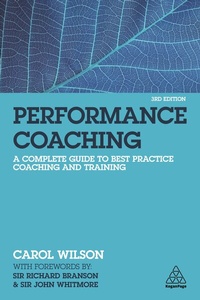
Performance Coaching
A Complete Guide to Best Practice Coaching and Training
3rd Edition
Published on 3. October 2020
Book
Paperback/Softback
432 pages
978-1-78966-446-1 (ISBN)
Description
Performance Coaching
is a complete resource for improving organizational and employee performance through coaching. Full of tips, tools and checklists, it covers all the fundamental elements of the coaching process, from developing the skills needed to coach effectively, to coaching in leadership, manager-as-coach training, cross-cultural coaching and measuring return on investment. It explores the key techniques and models in the field to allow readers to identify which approach is most suited to specific situations. Featuring case studies from organizations including Virgin, IKEA, the NHS and England Rugby showing how effective coaching approaches have been applied in practice, this book is for coaches of all levels of experience, as well as HR managers and leaders looking to embed a coaching culture in their organizations.
This revised third edition of
Performance Coaching
has been updated to include the latest insights and developments and contains new chapters on creating a global coaching culture, the coaching-mentoring-managing continuum and how to lead a generative thinking meeting. New material also covers distance coach training, neuroscience in coaching, coaching the bully at work and coaching in education.
Reviews / Votes
"A fundamental read to give a connected view of coaching from a broad range of perspectives, which is particularly important and helpful when it comes to applying coaching in a way that adds value in a complex corporate context."More details
Language
English
Place of publication
London
United Kingdom
Target group
College/higher education
Professional and scholarly
Edition type
Revised edition
Product notice
Paperback (trade)
Dimensions
Height: 234 mm
Width: 156 mm
Thickness: 23 mm
Weight
652 gr
ISBN-13
978-1-78966-446-1 (9781789664461)
Schweitzer Classification
Other editions
Additional editions
E-Book
10/2020
3rd Edition
Kogan Page Ltd
€42.99
Available for download
Book
10/2020
3rd Edition
Kogan Page Ltd
€167.60
Shipment within 3-4 weeks
Previous edition
Book
01/2014
2nd Edition
Kogan Page Ltd
€57.13
Article exhausted; check for reprint
Person
Author
Carol Wilson is a Fellow of the Institute of Leadership and Management, the Association for Coaching, and the Professional Speaking Association. She is on the Global Advisory Panel at the Association for Coaching and a Trustee to the non-profit MOE Foundation, where she designs coaching programmes for underprivileged young people and the African Prisons Project.
A multicultural expert, Carol Wilson has designed coaching and leadership programmes all over the world for organisations including IKEA, Philip Morris, the BBC, Hilti and NCR. She has won and been nominated for several awards for coaching and writing. She is the author of Performance Coaching, A Complete Guide to Best Practice Coaching and Training featuring forewords by Sir John Whitmore and Sir Richard Branson; she has also contributed to 6 books and published over 50 articles.
Carol experienced the value of a coaching culture firsthand during a decade working at board level with Sir Richard Branson at Virgin. Later she held board-level positions with Island Records, Warner Brothers and Polygram. Since entering the coaching field in 2000 she has studied with thought leaders including Nancy Kline and Tim Gallwey, and collaborated with Sir John Whitmore David Grove.
She is a keynote speaker at conferences worldwide including The HR Summit Budapest, the Asian Emerging Leaders Summit Hong Kong, Guts for Change Mumbai, Catalyst Australia, HRD London, and the China Executive Coaching Conference Shanghai.
Content
- Section - ONE: The fundamentals of performance coaching;
-
- Chapter - 01: What is coaching?;
- Chapter - 02: The differences between coaching, therapy, counselling, mentoring and consultancy;
- Chapter - 03: The directive-non-directive continuum;
- Chapter - 04: Self-limiting beliefs;
- Chapter - 05: Coaching and neuroscience;
- Section - TWO: Creating a coaching culture in organizations;
-
- Chapter - 06: The meaning of a coaching culture;
- Chapter - 07: Ten steps to creating a coaching culture;
- Chapter - 08: Coaching in the workplace;
- Chapter - 09: Coach training in the workplace;
- Chapter - 10: Coaching in leadership;
- Chapter - 11: Cross-cultural coaching;
- Chapter - 12: Distance coach training;
- Chapter - 13: Coaching in schools;
- Chapter - 14: Coaching for Crisis at Christmas;
- Chapter - 15: Corporate social responsibility and shared value - bringing business and society back together;
- Chapter - 16: Bullying in the workplace;
- Chapter - 17: Resilience in leadership;
- Chapter - 18: Coaching supervision: a workplace perspective;
- Chapter - 19: ROI - Measuring the return on investment in coaching;
- Section - THREE: Skills for coaches and managers;
-
- Chapter - 20: Listening;
- Chapter - 21: Reflecting, summarizing and clarifying;
- Chapter - 22: Questioning;
- Chapter - 23: Permission protocol;
- Chapter - 24: The GROW coaching model;
- Chapter - 25: The EXACT model - a coaching approach to goal setting;
- Chapter - 26: Coaching feedback;
- Chapter - 27: The structure of coaching;
- Chapter - 28: Setting and reviewing actions;
- Section - FOUR: Tools of the trade - continuing professional development;
-
- Chapter - 29: David Grove's Clean Language;
- Chapter - 30: David Grove's Emergent Knowledge;
- Chapter - 31: Transpersonal coaching;
- Chapter - 32: An introduction to neuro-linguistic programming;
- Chapter - 33: Systemic Coaching;
- Chapter - 34: Transactional analysis and the OK Corral;
- Chapter - 35: 360-degree feedback;
- Chapter - 36: The Reuven Bar-On Emotional Quotient inventory (BarOn EQ-i);
- Chapter - 37: Thomas-Kilmann Conflict Mode Instrument;
- Chapter - 38: Marshall Rosenberg's 'Non-Violent Communication';
- Chapter - 39: Peer leadership
- Chapter - 40: Situational Leadership;
- Chapter - 41: Kouzes and Posner: The Leadership Challenge;
- Chapter - 42: Cultural Transformation Tools;
- Chapter - 43: The Inner Game;
- Chapter - 44: Nancy Kline's Thinking Environment;
- Chapter - 45: Appreciative Inquiry;
- Chapter - 46: Mindfulness;
- Chapter - 47: Elizabeth Kubler Ross's Change Curve six stage model;
- Chapter - 48: Bruce Tuckman's 'forming, storming, norming and performing' team development model;
- Chapter - 49: The Myers-Briggs Type Indicator (MBTI®);
- Chapter - 50: The Enneagram;
- Chapter - 51: Kolb's learning styles;
- Chapter - 52: DISC;
- Chapter - 53: Johari Window;
- Chapter - 54: More team role models