

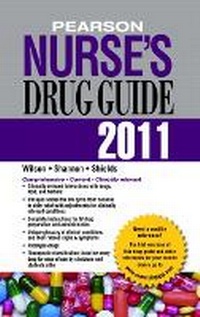
Pearson Nurse's Drug Guide 2011
Published on 12. October 2010
Book
Hardback
1792 pages
978-0-13-214926-6 (ISBN)
Description
With over 310 updates, the new 2011 edition of the PEARSON NURSE'S DRUG GUIDE providessafe, effective, current, and accurate drug information in a quickly accessible format. Comprehensive and complete, all drugs are listed alphabetically by generic names for quick referral, with an index that includes both generic and trade names. Included are important clinical information for hundreds of drugs including adverse reactions, interactions, and side effects. FInd out why this is the only drug guide nurses need:
ONLY handbook to identify prototype drugs!
Dosages for neonates, infants, adolescents, adults, and patients with obesity and renal or hepatic impairment
Clearly identified IV preparation and push, continuous, or intermittent administration information
ONLY drug guide to include a glossary of key signs and symptoms for which nurses should monitor during assessment for side effects, interactions, and impact on lab results.
The Pearson Nurse's Drug Guide 2011 also comes with an online companion version designed to assist nurses in providing drug information and nursing implications for patients in hospitals, clinics, and all community settings. The online version provides access to many more resources:
All monographs from the book, including prototypes and newly approved drugs
Printing capability for use in patient teaching or for quick reference
Calculators to help nurses do conversions or calculate dosages and IV drip rates
Audio pronunciation of prototype drug names
A link to download trial versions of this drug guide and other references for mobile devices
Access to drug updates, links to drug-related sites, drug-related tools
Medication administration techniques
Drug classifications
Principles of pharmacology
Common herbal remedies
List of look-alike, sound-alike drugs
ONLY handbook to identify prototype drugs!
Dosages for neonates, infants, adolescents, adults, and patients with obesity and renal or hepatic impairment
Clearly identified IV preparation and push, continuous, or intermittent administration information
ONLY drug guide to include a glossary of key signs and symptoms for which nurses should monitor during assessment for side effects, interactions, and impact on lab results.
The Pearson Nurse's Drug Guide 2011 also comes with an online companion version designed to assist nurses in providing drug information and nursing implications for patients in hospitals, clinics, and all community settings. The online version provides access to many more resources:
All monographs from the book, including prototypes and newly approved drugs
Printing capability for use in patient teaching or for quick reference
Calculators to help nurses do conversions or calculate dosages and IV drip rates
Audio pronunciation of prototype drug names
A link to download trial versions of this drug guide and other references for mobile devices
Access to drug updates, links to drug-related sites, drug-related tools
Medication administration techniques
Drug classifications
Principles of pharmacology
Common herbal remedies
List of look-alike, sound-alike drugs
More details
Language
English
Place of publication
United States
Publishing group
Pearson Education (US)
Target group
College/higher education
Dimensions
Height: 191 mm
Width: 117 mm
Weight
953 gr
ISBN-13
978-0-13-214926-6 (9780132149266)
Copyright in bibliographic data is held by Nielsen Book Services Limited or its licensors: all rights reserved.
Schweitzer Classification
Other editions
New editions
Billie A. Wilson | Margaret T. Shannon | Kelly Shields
Pearson Nurse's Drug Guide 2012
Book
07/2011
Pearson
€34.65
Article exhausted; check for reprint
Previous edition
Billie A. Wilson | Margaret T. Shannon | Kelly Shields
Pearson Nurse's Drug Guide 2010
Book
09/2009
Pearson
€30.94
Article exhausted; check for reprint
Persons
Billie Ann Wilson
is Professor Emerita in the School of Nursing at Loyola University in New Orleans, Louisiana. Prior to entering nursing, she taught natural and physical sciences at the secondary and collegiate levels. She holds a BS in Biology from Boston College, an MS in Biology from Purdue University, a BS in Nursing from Northwestern State University of Louisiana, an MSN from Louisiana State University Health Sciences Center, and a PhD in Curriculum and Instruction from the University of New Orleans.
Margaret T. Shannon is Professor Emeritus of Nursing at Our Lady of Holy Cross College, New Orleans, Louisiana. She holds a BS and an MS in Chemistry, both from Saint Louis University; an MA in Teaching Biology from Saint Mary's College, a BS in Nursing from Northwestern State University of Louisiana, an MSN from Louisiana State University Health Sciences Center, and a PhD in Curriculum and Instruction from the University of New Orleans. Prior to entering nursing, she taught physical science, natural science, and mathematics at the secondary and collegiate levels.
Kelly M. Shields is currently Associate Professor of Pharmacy Practice at Ohio Northern University's Raabe College of Pharmacy. She holds a Doctor of Pharmacy from Butler University and completed a fellowship in Natural Product Information and Research at University of Missouri-Kansas City. She has practiced pharmacy in retail, community, and academic settings and has worked as a freelance medical writer.
is Professor Emerita in the School of Nursing at Loyola University in New Orleans, Louisiana. Prior to entering nursing, she taught natural and physical sciences at the secondary and collegiate levels. She holds a BS in Biology from Boston College, an MS in Biology from Purdue University, a BS in Nursing from Northwestern State University of Louisiana, an MSN from Louisiana State University Health Sciences Center, and a PhD in Curriculum and Instruction from the University of New Orleans.
Margaret T. Shannon is Professor Emeritus of Nursing at Our Lady of Holy Cross College, New Orleans, Louisiana. She holds a BS and an MS in Chemistry, both from Saint Louis University; an MA in Teaching Biology from Saint Mary's College, a BS in Nursing from Northwestern State University of Louisiana, an MSN from Louisiana State University Health Sciences Center, and a PhD in Curriculum and Instruction from the University of New Orleans. Prior to entering nursing, she taught physical science, natural science, and mathematics at the secondary and collegiate levels.
Kelly M. Shields is currently Associate Professor of Pharmacy Practice at Ohio Northern University's Raabe College of Pharmacy. She holds a Doctor of Pharmacy from Butler University and completed a fellowship in Natural Product Information and Research at University of Missouri-Kansas City. She has practiced pharmacy in retail, community, and academic settings and has worked as a freelance medical writer.
Content
About the Authors
Editorial Review Panel
Preface
Classification Scheme and Prototype Drugs
Alphabetical Entries for Generic Drugs
Appendix A. Ocular Medications, Low Molecular Weight Heparins, Inhaled Corticosteroids, and Topical Corticosteroids
Appendix B. U.S. Schedules of Controlled Substances
Appendix C. FDA Pregnancy Categories
Appendix D. Oral Dosage Forms That Should Not Be Crushed
Appendix E. Prescription Combination Drugs
Appendix F. Glossary of Key Terms, Clinical Conditions, and Associated Signs and Symptoms
Appendix G. Abbreviations
Appendix H. Herbal and Dietary Supplement Table
Appendix I. Look-Alike, Sound-Alike Medications
Bibliography
Index
Editorial Review Panel
Preface
Classification Scheme and Prototype Drugs
Alphabetical Entries for Generic Drugs
Appendix A. Ocular Medications, Low Molecular Weight Heparins, Inhaled Corticosteroids, and Topical Corticosteroids
Appendix B. U.S. Schedules of Controlled Substances
Appendix C. FDA Pregnancy Categories
Appendix D. Oral Dosage Forms That Should Not Be Crushed
Appendix E. Prescription Combination Drugs
Appendix F. Glossary of Key Terms, Clinical Conditions, and Associated Signs and Symptoms
Appendix G. Abbreviations
Appendix H. Herbal and Dietary Supplement Table
Appendix I. Look-Alike, Sound-Alike Medications
Bibliography
Index