

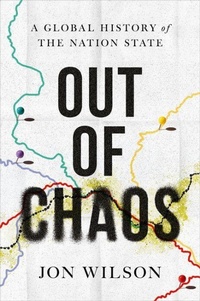
Out of Chaos
A Global History of the Nation State
Will be published approx. on 27. August 2026
Book
Hardback
432 pages
978-0-19-285867-2 (ISBN)
Description
Our present-day world of nation states was born by accident. Nation-states haven't been ever present; nor were they the inevitable outcome of nationalism. Instead, from Indonesia to Iran to the United Kingdom-all new nation states in the late 1940s-they emerged out of the chaos which followed World War II.
The nation state, we are told, was created in the West hundreds of years ago. It grew, so the story goes, from the steady development of national identities and as a triumphant product of Western political order and progress. Such oft-told stories are wrong. They are based on a fundamental misunderstanding of nations and nationalism, and the way in which the world we live in is organized today. In fact, our present global political order, with the nation state as its fundamental unit, is only as old as the postwar world: it emerged everywhere in the world at the same time, as the unplanned response to a moment of global crisis.
Before the 1940s the world was organized into empires or federations. Few thought nations could be the basis of political order. Acclaimed historian Jon Wilson shows how the crises which followed the end of World War II up-ended common-sense ideas about how the world should be organized. In a truly global story with as much to say about what happened in Montevideo, Yogyakarta, New Delhi, and Jerusalem as New York or London, Out of Chaos shows how political leaders debating the postwar order ended up with an unexpected compromise: the partition of the people, territory, and economies of the world into nation states. It traces a truly global tale; of how ideas from Latin America were picked up in Indonesia; or of how Indian military officials shaped the fate of central Africa.
Out of Chaos shows how the nation state emerged as the only form of organization political leaders from different ideological positions, from every continent, could agree on to manage the fractured, impoverished post-war world. This was not a political order created by any one power or ideology; there was never, for example, a US-led world order. The nation state was agreed by capitalist and communist states alike. The postwar world was multipolar from the start.
From the middle of the twentieth century to now, nation states have been sustained by peoples' affection for the communities they live in. But the chaotic process of their emergence, with limited agreement about ideas, means other ideas about how to organize the world survive. Out of Chaos radically reframes how we think about the history of the twentieth century, showing that the conflicts of the present day are rooted in the process by which nation-states emerged from the postwar crisis.
The nation state, we are told, was created in the West hundreds of years ago. It grew, so the story goes, from the steady development of national identities and as a triumphant product of Western political order and progress. Such oft-told stories are wrong. They are based on a fundamental misunderstanding of nations and nationalism, and the way in which the world we live in is organized today. In fact, our present global political order, with the nation state as its fundamental unit, is only as old as the postwar world: it emerged everywhere in the world at the same time, as the unplanned response to a moment of global crisis.
Before the 1940s the world was organized into empires or federations. Few thought nations could be the basis of political order. Acclaimed historian Jon Wilson shows how the crises which followed the end of World War II up-ended common-sense ideas about how the world should be organized. In a truly global story with as much to say about what happened in Montevideo, Yogyakarta, New Delhi, and Jerusalem as New York or London, Out of Chaos shows how political leaders debating the postwar order ended up with an unexpected compromise: the partition of the people, territory, and economies of the world into nation states. It traces a truly global tale; of how ideas from Latin America were picked up in Indonesia; or of how Indian military officials shaped the fate of central Africa.
Out of Chaos shows how the nation state emerged as the only form of organization political leaders from different ideological positions, from every continent, could agree on to manage the fractured, impoverished post-war world. This was not a political order created by any one power or ideology; there was never, for example, a US-led world order. The nation state was agreed by capitalist and communist states alike. The postwar world was multipolar from the start.
From the middle of the twentieth century to now, nation states have been sustained by peoples' affection for the communities they live in. But the chaotic process of their emergence, with limited agreement about ideas, means other ideas about how to organize the world survive. Out of Chaos radically reframes how we think about the history of the twentieth century, showing that the conflicts of the present day are rooted in the process by which nation-states emerged from the postwar crisis.
Reviews / Votes
Wilson's magisterial study of the nation-state explores the central contradiction of its history: how did the recent, unpredictable, and even accidental emergence of this state result in its seeming permanence in our imaginations as much as reality? A crucial intervention. * Faisal Devji, Beit Professor of Global and Imperial History, University of Oxford * This is a brilliant, very necessary rethinking of global history not as globalisation but as a global condition in which nation states became the key global actors. This startlingly original book not only forces us to rethink when the nation-state became the global norm but also shows the profound economic, political and social significance of this new form in the years after 1945, not least how it changed in the 1970s and beyond. A must read for all historians of the twentieth century. * David Edgerton, author of The Rise and Fall of the British Nation * Out of Chaos is a sparkling political history of the nation state as a political form. With lightly carried erudition, Wilson shows how the nation state emerged through the political contingencies of twentieth century politics. Full of telling historical vignettes, Out of Chaos tells the story of a monumental irony: no one planned for the triumph of the nation state form, yet practically every society got it. * Pratap Bhanu Mehta, author of The Burden of Democracy * A provocative and innovative book that draws on a very broad range of cases from around the world. Out of Chaos provides many fresh insights by re-telling a well-known narrative from an unfamiliar perspective, and it is filled to the brim with fascinating characters and their stories. * Eric Storm, author of Nationalism: A World History * A magnificent history of how concepts of territory, political power, and national identity were molded into nation-states. Necessary reading for all those who wants to understand how the modern world came into being. * O. A. Westad, author of The Coming Storm: Power, Conflict, and Warnings from History *More details
Language
English
Place of publication
Oxford
United Kingdom
Dimensions
Height: 234 mm
Width: 156 mm
ISBN-13
978-0-19-285867-2 (9780192858672)
Copyright in bibliographic data and cover images is held by Nielsen Book Services Limited or by the publishers or by their respective licensors: all rights reserved.
Schweitzer Classification
Person
Jon Wilson is a historian of South Asia and the world beyond, who is currently Tan Kah Kee Professor and Dean of the College of Humanities, Arts and Social Sciences at Nanyang Technological University, Singapore. He completed degrees in history and anthropology from the University of Oxford and the New School for Social Research, then taught at King's College London for twenty-five years. He is author of two books on the history of South Asia, The Domination of Strangers and India Conquered. His research connects the history of political thought and practice on a trans-national scale, and is informed by his engagement with the world of institutions, in politics and university administration.
Content
0: A Catastrophic History of the Nation State 1: Circumnavigators 2: Leon Duguit Travels the World 3: Thomas Lamont and his Allies 4: The Great Emergency 5: Civil Wars and United Nations 6: Unlimited Crisis 7: The Soviet Invention of Greece 8: The End of Imperial Sovereignty 9: Partitioning the World 10: Universality 11: The End of Decolonization 12: The Great Homecoming 13: Economies that Differ 14: Nationalization of Economics 15: Muigwithania in Gary 16: The Return of the King Epilogue