

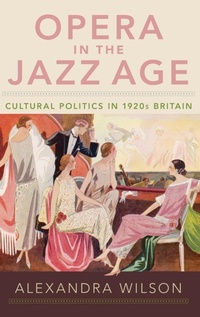
Opera in the Jazz Age
Cultural Politics in 1920s Britain
Published on 21. February 2019
Book
Hardback
256 pages
978-0-19-091266-6 (ISBN)
Description
Jazz, the Charleston, nightclubs, cocktails, cinema, and musical theatre: 1920s British nightlife was vibrant and exhilarating. But where did opera fit into this fashionable new entertainment world? Opera in the Jazz Age: Cultural Politics in 1920s Britain explores the interaction between opera and popular culture at a key historical moment when there was a growing imperative to categorize art forms as "highbrow," "middlebrow," or "lowbrow." Literary studies of the so-called "battle of the brows" have been numerous, but this is the first book to consider the place of opera in interwar debates about high and low culture. This study by Alexandra Wilson argues that opera was extremely difficult to pigeonhole: although some contemporary commentators believed it to be too highbrow, others thought it not highbrow enough.
Opera in the Jazz Age paints a lively and engaging picture of 1920s operatic culture, and introduces a charismatic cast of early twentieth-century critics, conductors, and celebrity singers. Opera was performed during this period to socially mixed audiences in a variety of spaces beyond the conventional opera house: music halls, cinemas, cafes and schools. Performance and production standards were not always high - often quite the reverse - but opera-going was evidently great fun. Office boys whistled operatic tunes they had heard on the gramophone and there was a genuine sense that opera was for everyone. In this provocative and timely study, Wilson considers how the opera debate of the 1920s continues to shape the ways in which we discuss the art form, and draws connections between the battle of the brows and present-day discussions about elitism. The book makes a major contribution to our understanding of the cultural politics of twentieth-century Britain and is essential reading for anybody interested in the history of opera, the battle of the brows, or simply the perennially fascinating decade that was the 1920s.
Opera in the Jazz Age paints a lively and engaging picture of 1920s operatic culture, and introduces a charismatic cast of early twentieth-century critics, conductors, and celebrity singers. Opera was performed during this period to socially mixed audiences in a variety of spaces beyond the conventional opera house: music halls, cinemas, cafes and schools. Performance and production standards were not always high - often quite the reverse - but opera-going was evidently great fun. Office boys whistled operatic tunes they had heard on the gramophone and there was a genuine sense that opera was for everyone. In this provocative and timely study, Wilson considers how the opera debate of the 1920s continues to shape the ways in which we discuss the art form, and draws connections between the battle of the brows and present-day discussions about elitism. The book makes a major contribution to our understanding of the cultural politics of twentieth-century Britain and is essential reading for anybody interested in the history of opera, the battle of the brows, or simply the perennially fascinating decade that was the 1920s.
Reviews / Votes
This is an interesting book on a topic that has received little scholarly attention. * W.E. Grim, CHOICE * Scrupulously researched and forcefully argued. * BBC Music Magazine * Through extensive primary-source analysis, Wilson captures an historical moment in which opera maintained social mobility and mass-culture appeal. [...] Not only does [the book] call into question longstanding presumptions about the intersections of opera, class, and politics, but it also points to methods for defining a heretofore littlestudied middlebrow culture. Thus, by demonstrating opera's pervious "resistance to reductive labeling", Wilson begins to reveal the cracks in social hierarchies long papered over by faulty cultural assumptions. * Journal of Musicological Research * A richly textured account * Cambridge Opera Journal * What a book. This is a glorious work of scholarship that's one of the most readable and intelligent scholarly monographs I've encountered. Seriously impressive. * Nathan Waddell, Senior Lecturer, University of Birmingham * Wilson is one of those rare musicologists capable of seeing opera in its widest historical context... Impressively researched and highly entertaining. * Opera * Wilson is interested in how opera, seen as a "foreign" art form, fit into the British cultural scene in the 1920s. She is particularly interested in where opera fit into the ongoing discussions of "highbrow," "middlebrow," and "lowbrow" art and efforts to combat charges of elitism... For Wilson, opera in the decade was interesting precisely because it could not be pinned down in this system of cultural categorization. * John M. Clum, New York Journal of Books * Alexandra Wilson's interest in the British operatic scene during the jazz age is longstanding, and, in this book, she imparts her wealth of knowledge in a lively and readable manner. She reveals that opera in the 1920s was the subject of fierce controversy-too highbrow for some, and not highbrow enough for others. Diving into impassioned, often rancorous, debates about opera, Wilson argues that much of the vexation was generation by peculiarly British notions of nationality and social class. It is essential reading for anyone who remains under the impression that this decade was an operatic wilderness in the UK. * Derek B. Scott, Professor of Critical Musicology, University of Leeds *More details
Language
English
Place of publication
New York
United States
Illustrations
8 illus.
Dimensions
Height: 240 mm
Width: 161 mm
Thickness: 18 mm
Weight
549 gr
ISBN-13
978-0-19-091266-6 (9780190912666)
Copyright in bibliographic data and cover images is held by Nielsen Book Services Limited or by the publishers or by their respective licensors: all rights reserved.
Schweitzer Classification
Other editions
Additional editions
E-Book
12/2018
1st Edition
OUP eBook
€18.99
Available for download
E-Book
12/2018
1st Edition
OUP eBook
€18.99
Available for download
Person
Alexandra Wilson is a musicologist and cultural historian, with research interests focusing primarily upon opera and operatic culture from the nineteenth century to the present. She is Professor of Music at Oxford Brookes University (UK), where she also co-directs the OBERTO opera research unit. Her first monograph The Puccini Problem: Opera, Nationalism, and Modernity (Cambridge University Press) was awarded the American Musicological Society's Lewis Lockwood Award for a work of outstanding musical scholarship. Alexandra has a high profile as a public musicologist: she has presented numerous broadcasts for BBC Radio 3 and has written programme essays and given talks for the UK's leading opera companies.
Content
Introduction
Chapter 1: Contexts
Chapter 2: Audiences
Chapter 3: Brows
Chapter 4: Boundaries
Chapter 5: Repertories
Chapter 6: Stars
Chapter 7: Identities
Epilogue
Bibliography
Chapter 1: Contexts
Chapter 2: Audiences
Chapter 3: Brows
Chapter 4: Boundaries
Chapter 5: Repertories
Chapter 6: Stars
Chapter 7: Identities
Epilogue
Bibliography