

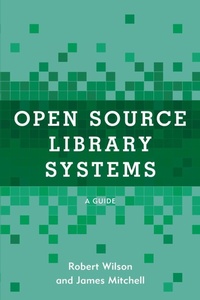
Open Source Library Systems
A Guide
Published on 11. September 2021
Book
Paperback/Softback
174 pages
978-1-5381-4139-7 (ISBN)
Description
Open source software and applications are all around us, and it's no different in today's libraries. Knowing about the open source alternative to integrated library system and being able to make accurate comparisons can save a library tens to hundreds of thousands of dollars a year while more closely matching the library's functional needs.
The fact is that the foundational software in place in nearly every industry is being built with open source components. Where software applications are still proprietary or closed, those systems are themselves often built upon open source applications like open source web services, database management systems, programming languages, and operating systems. It's the same story in the library world. Library software providers offering the latest and greatest software solution for many thousands of dollars a year are building these solutions with open source software. However, full-fledged open source applications built with the same underlying technologies are available to libraries at no cost for the software itself. Each of these applications have their own unique and interesting history and communities supporting them.
For the reader unfamiliar with open source software or apprehensive about using these applications in their library, this guide:
introduces the history of open source;demonstrate the global upward trend of adopting open source technologies in general and within libraries in particular;debunk various myths about implementing and using open source technologies;discusses several different types of library information systems including:Integrated Library Systems Institutional RepositoriesDigital Asset Management Systems Online Public Access CatalogsResource SharingElectronic Resource Managementand lastly, shares real world experiences in getting started with open source solutions, including discussing what systems and services are available and best practices for implementation and use.
The fact is that the foundational software in place in nearly every industry is being built with open source components. Where software applications are still proprietary or closed, those systems are themselves often built upon open source applications like open source web services, database management systems, programming languages, and operating systems. It's the same story in the library world. Library software providers offering the latest and greatest software solution for many thousands of dollars a year are building these solutions with open source software. However, full-fledged open source applications built with the same underlying technologies are available to libraries at no cost for the software itself. Each of these applications have their own unique and interesting history and communities supporting them.
For the reader unfamiliar with open source software or apprehensive about using these applications in their library, this guide:
introduces the history of open source;demonstrate the global upward trend of adopting open source technologies in general and within libraries in particular;debunk various myths about implementing and using open source technologies;discusses several different types of library information systems including:Integrated Library Systems Institutional RepositoriesDigital Asset Management Systems Online Public Access CatalogsResource SharingElectronic Resource Managementand lastly, shares real world experiences in getting started with open source solutions, including discussing what systems and services are available and best practices for implementation and use.
Reviews / Votes
The bulk of the book details the history, technical aspects, licensing issues, and major service providers of open source digital repositories, discovery layers, resource sharing platforms, and electronic-resource-management software. Specific examples of library organizational experiences with different systems provide practical insider information... This book is an even-handed overview of past and current open source library management systems, backed up by extensive references. They caution about implementing and supporting such software, but also note trends that make open source solutions less risky nowadays. The technical aspects of this book are not for the faint-hearted, but librarians will be better informed about this important management decision as a result of reading it. * Booklist * Wilson and Mitchell provide the most comprehensive survey of open source (OS) library systems to date.... The clear strength of this work is its detailed analysis of the various OS platforms. Because it weighs the strengths and weaknesses of major OS offerings, the volume will prove valuable for libraries considering a move to an OS system or tool. It offers practical deployment considerations and nuanced historical contexts for each platform discussed. Recommended. Graduate students and professionals. * Choice Reviews * Wilson and Mitchell provide big picture thinking about open source as well as practical, hands-on options libraries have when navigating the world of choices available now. As the traditional software markets shrink and the OSS flourish, every library thinking about their next generation of tools will want to read this. -- Tricia Racke Bengel, Ingram Library Services, sales & services manager Open Source Library Systems: A Guide should be required reading for anyone considering an ILS, Digital Repository, Discovery, Resource Sharing, or E-Resource Management system change. -- Rob Ross, executive director of NC LIVE A wonderfully inclusive, accessible, and forward-looking introduction to the universe of open source library systems. Writing for experts and general library science practitioners alike, Wilson and Mitchell elegantly demystify open source and demonstrate its vital importance to the future of libraries. -- Michael Rodriguez, collections strategist, University of Connecticut Library For libraries looking to replace existing technology or looking for new solutions, whether for ILS, digital repositories, discovery, ERM, etc., this is the essential guide. Authors Mitchell and Wilson provide a comprehensive review of the concepts, history, current state, and future directions of open source software (OSS) in libraries along with useful advice for software evaluation. Among these I note, 'An individual or organization must evaluate the ecosystem around an application,' which we have found to be of upmost importance. A better one-stop guide cannot be imagined! -- Walter Stine, executive director, Fenway Library Organization At a time when libraries struggle with spending more money on technology to manage resources instead of the resources themselves, this book is a welcome guide. The dual burden of annual price increases for resources and the need for expensive technical solutions to integrate and manage them is unsustainable. If library open source solutions weren't on your radar before, this book is a must. Open Source Library Systems is an excellent resource to either read through for a well-organized and comprehensive understanding of the topic or as a reference for information by library function. -- Janetta Waterhouse, MLIS, PMP, director of technical services and library systems, University at AlbanyMore details
Series
Language
English
Place of publication
United States
Publishing group
Bloomsbury Publishing Plc
Target group
Professional and scholarly
Illustrations
7 tables; 8 textboxes
Dimensions
Height: 229 mm
Width: 152 mm
Thickness: 10 mm
Weight
262 gr
ISBN-13
978-1-5381-4139-7 (9781538141397)
Copyright in bibliographic data and cover images is held by Nielsen Book Services Limited or by the publishers or by their respective licensors: all rights reserved.
Schweitzer Classification
Other editions
Additional editions
E-Book
09/2021
1st Edition
Rowman & Littlefield Publishers
€30.49
Available for download
E-Book
09/2021
1st Edition
Bloomsbury eBooks US
€30.49
Available for download
Persons
Robert Wilson is systems librarian and assistant professor at Middle Tennessee State University's Walker Library. He has worked with library systems since 2011 in school, public, and academic libraries as well as the vendor side as an analyst and implementation manager. He has an MS in information systems from Middle Tennessee State University and an MSLIS from Drexel University. He's implemented dozens of open and closed source library systems at the libraries he's worked with and as a support analyst and later as an implementation manager worked with hundreds of libraries in implementation and integration of dozens of types of library software and applications.
James Mitchell is systems librarian at the University of North Alabama's Collier Library, where he additionally serves as manager of Collier Experimental Learning Lab (CELL), Collier Library's makerspace. Since 2012, James has been responsible for implementing technology solutions within archives and libraries in both public and academic libraries. He holds an MLIS from the University of Alabama.
James Mitchell is systems librarian at the University of North Alabama's Collier Library, where he additionally serves as manager of Collier Experimental Learning Lab (CELL), Collier Library's makerspace. Since 2012, James has been responsible for implementing technology solutions within archives and libraries in both public and academic libraries. He holds an MLIS from the University of Alabama.
Content
Preface
Acknowledgments
1: Open Source Software: A Reorientation
2: OSS in Libraries
3: Open Source and the ILS
4: Open Source and Digital Repositories
5: Open Source Discovery
6: Open Source Resource Sharing
7: Open Source Electronic Resource Management
8: Additional Open Source Systems
9: Libraries, Open Source Software, and the Future
Appendix A: Notes on Library System Implementations
Appendix B: ILS Selection & Migration Example
Acknowledgments
1: Open Source Software: A Reorientation
2: OSS in Libraries
3: Open Source and the ILS
4: Open Source and Digital Repositories
5: Open Source Discovery
6: Open Source Resource Sharing
7: Open Source Electronic Resource Management
8: Additional Open Source Systems
9: Libraries, Open Source Software, and the Future
Appendix A: Notes on Library System Implementations
Appendix B: ILS Selection & Migration Example